The city does not wait for permission. Across the global South – and increasingly within the cracks of the formal North – communities have long constructed spaces that architects once dismissed as disorder. Today, those same spaces are being reconsidered with genuine intellectual curiosity. Informal growth, it turns out, constitutes a coherent, if uncodified, design language: one shaped by necessity, negotiation, and time rather than by the drawing board. The profession has spent decades trying to solve informality – it might finally be ready to learn from it.
The Grammar of the Unplanned
Formal architecture operates on a logic of anticipation – spaces imagined in full before a single brick is laid. Informal urbanism inverts this entirely. As Professor Kim Dovey of the Melbourne School of Design has observed, in the most informal of settlements, the architecture arrives first; the street network becomes an emergent phenomenon of whatever spaces remain after buildings have been produced (Dovey, 2023). This inversion is not a failure of planning. It is a different grammar – a design language written in real time, responding to social pressures, available materials, and the irreducible agency of its inhabitants.
What makes this design language particularly arresting is its capacity for layering. In contrast to the fixed aesthetic of institutional modernism, informal structures accumulate meaning incrementally. A concrete-block extension here, a corrugated-iron awning there – each addition is simultaneously pragmatic and expressive, a legible record of a family’s economic trajectory and social aspirations. Far from being chaotic, these accretions follow an internal logic that Dovey argues is as structured as any codified vernacular (Dovey, 2023). Architecture, in this reading, is not an object but a process.
Designed to Be Unfinished
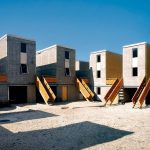
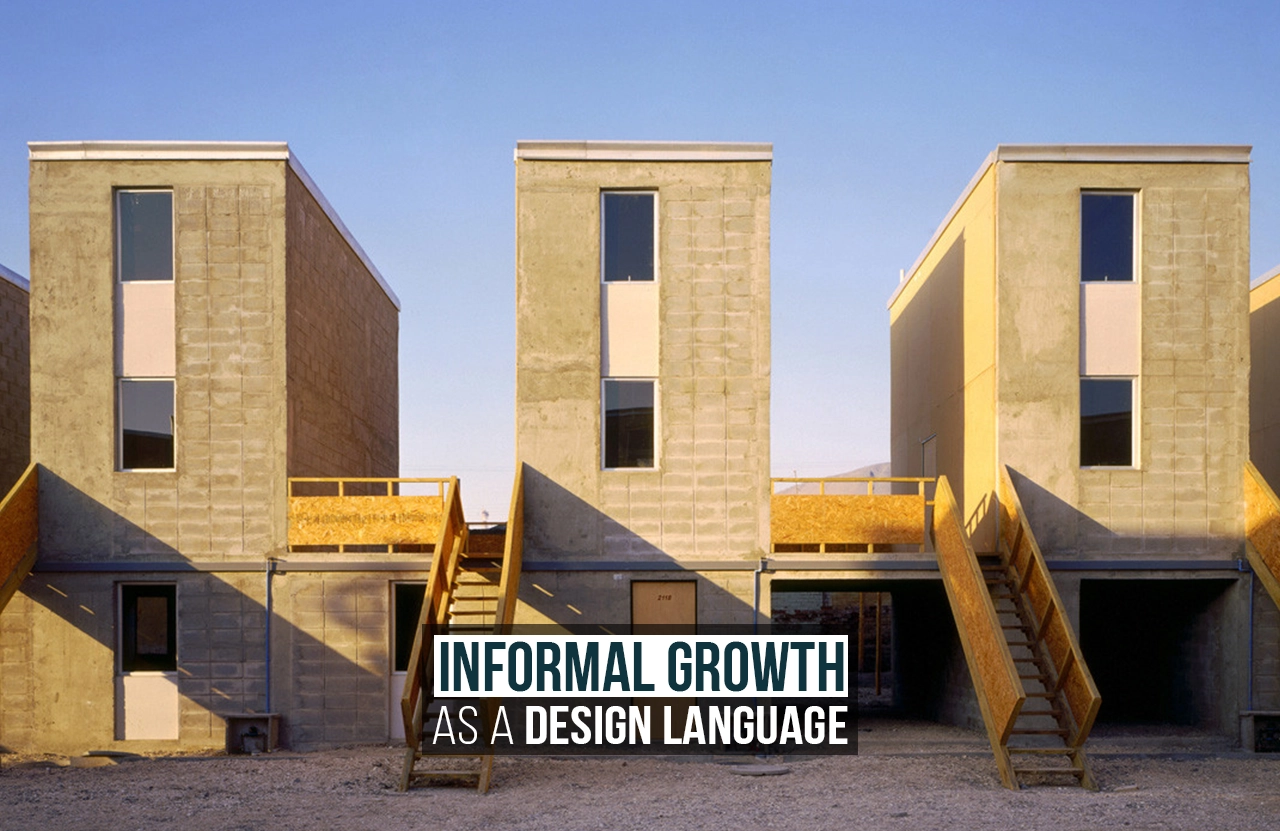
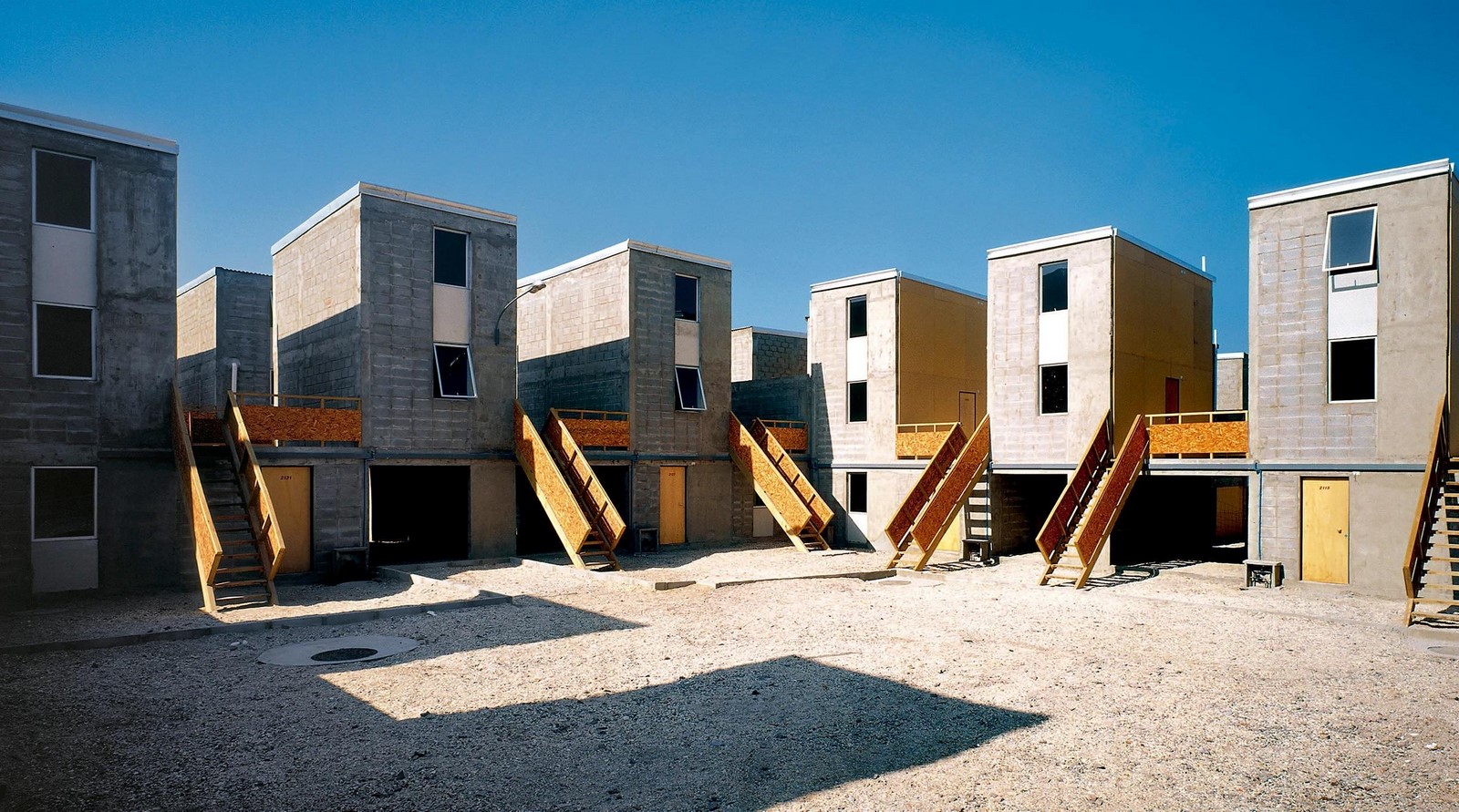
Alejandro Aravena’s Quinta Monroy, completed in Iquique in 2004, is perhaps the most cited attempt to formalise the design language of informal growth. Elemental’s “half a good house” strategy delivered 93 units at a cost of $7,500 per family; each unit was designed to be precisely half complete. The firm built the difficult half – foundation, structure, bathroom, kitchen – and left the other half as a deliberate void, structurally primed for occupant extension. Within a year of completion, property values had tripled (Urban Land Institute, 2016). The additions residents made were architecturally coherent: they did not undo the original design language – they extended it.
Quinta Monroy doesn’t romanticize informality – it frames it as a method. The design language here is one of productive incompleteness: an architecture that openly acknowledges what it cannot yet provide and invites co-authorship as a structural principle rather than a concession. The criticism is equally important: as units filled in, variation in material quality and construction skill produced uneven outcomes. The design language of informal growth, when grafted onto a formal subsidy framework, no doubt carries risks of fragmentation.
Verticality Without Instruction
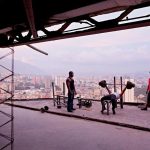
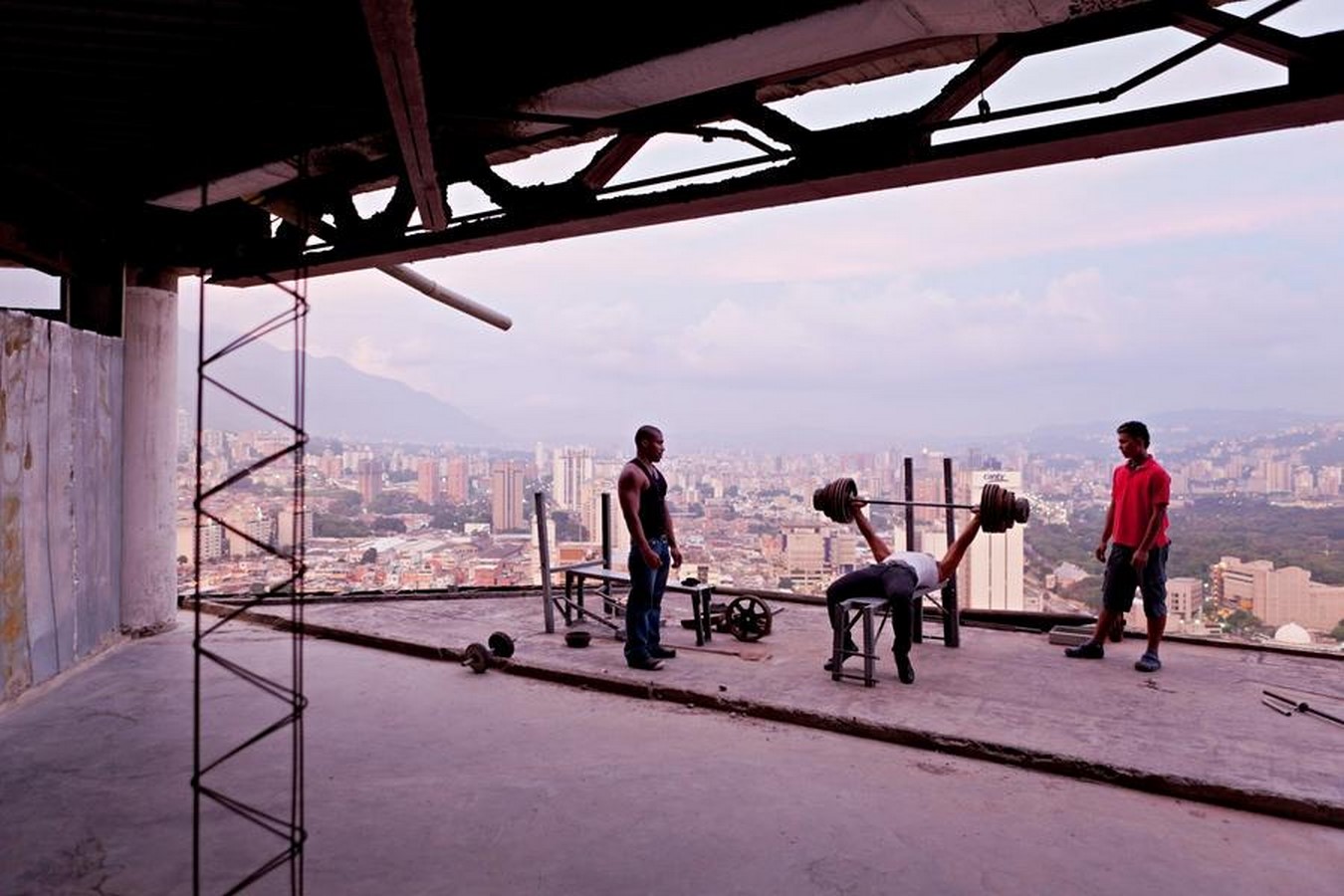
Few case studies are as polarizing – or as revealing – as Torre David in Caracas. Designed by Enrique Gómez as a 45-storey corporate tower, the structure was abandoned in 1994 following the death of its developer and the collapse of the Venezuelan economy (Divisare, 2013). Over 750 families colonised the skeletal frame, transforming it into a vertical neighbourhood complete with informal commerce, motorbike taxis operating between floors, and domestic spaces defined by salvaged partitions. Urban-Think Tank’s documentation of the tower won the Golden Lion at the 2012 Venice Architecture Biennale, arguing that Torre David represented not Venezuelan dysfunction but a globally legible design language of informal/formal hybridity (Urban-Think Tank, 2013).
Torre David‘s informal occupants produced a remarkably complex spatial organisation without a masterplan, without a lead architect, and in direct defiance of building codes. Communal spaces emerged through consensus; domestic thresholds were negotiated rather than designed. Critics who dismissed the occupation as a “vertical slum” missed precisely this point: the inhabitants were practising a sophisticated design language whose vocabulary included structural opportunism, programmatic flexibility, and collective memory. That this produced social solidarity rather than anomie is, perhaps, architecture’s most significant lesson from the global South.
When Formal Architecture Listens
Half a century before incremental housing entered mainstream discourse, Lima was already the stage for one of the most ambitious experiments in codifying the design language of informal growth. PREVI – the Proyecto Experimental de Vivienda – was announced in 1966 by President Fernando Belaúnde and co-financed by the United Nations Development Programme (Krishnamoorthy, 2019). British architect Peter Land headed a competition inviting 26 international architects, including Aldo van Eyck, James Stirling, and Charles Correa, to design low-rise, high-density housing units explicitly designed to grow (Architectural Papers, 2012). Every unit had to accommodate a growing-house concept with an integral courtyard.
What distinguishes PREVI is the plurality of design languages it invited to engage with informality’s logic. Van Eyck’s contribution operated on the principle that pre-designed environments should amplify rather than counteract the growth already inherent in informal occupation (Krishnamoorthy, 2019). Forty years on, residents had radically transformed almost every unit – not randomly, but in ways that maintained the project’s original spatial DNA: the plaza-passage system and pedestrian spine persisted intact. PREVI demonstrated that a design language of informal growth isn’t antithetical to professional authorship – it demands a different kind of authorship entirely: one that designs for transformation rather than against it.
The Unfinished City
The deeper provocation of informal growth as a design language is what it implies about authorship. When a family in Iquique extends their Quinta Monroy unit – adding a bedroom using materials from the local market rather than the architect’s palette – who authored the resulting building? The question has direct implications for how the profession values process versus product, and for whether architecture’s social contract extends to the majority of the world’s urban population or only to those who can commission it. The design language of informal growth is, at its core, a language of distributed authorship: a city written by its inhabitants in real time, revision by revision, room by room.
Evidence from contexts as diverse as the Ger districts of Ulaanbaatar – where over 60 per cent of the population inhabit a legal but un-serviced informal fabric derived from the nomadic ger dwelling – and the favela of Rio de Janeiro confirms that informal growth is not a temporary condition awaiting formalisation (Urban Resilience Research, 2020). It is, for vast populations, the permanent condition of urban life. The profession’s most pressing task may not be to replace this language but to learn it – and, in learning it, to become genuinely useful to the cities that are actually being built.
And what is even more important. A genuine engagement with the design language of informal growth would require not the aestheticization of poverty – the architectural tourism that sometimes passes for research – but a fundamental recalibration of what architectural authorship means. It would mean designing systems rather than objects, scaffolds rather than shells, rules rather than forms. Alfredo Brillembourg of Urban-Think Tank has argued precisely this: that the “urban toolbox” appropriate to the contemporary city must include instructions to “make networks, go vertical, grow local, and capture unused spaces” (Brillembourg, 2016). This is a pragmatic programme – and it speaks a design language that the majority of the world already understands.
References:
- Architectural Papers (2012) ‘Issue 9 – PREVI Revisited: A Contemporary Approach to the Proyecto Experimental de Vivienda in Lima.’ Available at: https://www.architecturalpapers.ch/indexe39c.html?ID=91
- Brillembourg, A. (2016) ‘Informal Is the New Normal.’ Urban-Think Tank lecture. Available at: https://www.youtube.com/watch?v=RIMRaqemuuY
- Divisare (2013) ‘Urban Think Tank, Iwan Baan – Torre David / Gran Horizonte.’ Available at: https://divisare.com/projects/209495
- Dovey, K. (2023) ‘Informal Settlements and Emergent Urbanism.’ Lecture, Melbourne School of Design. Available at: https://www.youtube.com/watch?v=HdfCUjGF4Yk
- Goethert, R. (2014) ‘Incremental Housing.’ MIT Lecture. Available at: https://www.youtube.com/watch?v=DuQrOLxUfTI
- Krishnamoorthy, H. (2019) ‘PREVI – Radical Modernism and Urban Experiments.’ Available at: https://harishkrishnamoorthy.com/PREVI
- Urban Land Institute (2016) ‘Power in Half Measures: Pritzker Prize Winner Alejandro Aravena.’ Available at: https://urbanland.uli.org/planning-design/power-half-measures-pritzker-prize-chiles-alejandro-aravena
- Urban Resilience Research (2020) ‘Incremental Urbanism: Resilient Urban Strategies for the Ger Districts, Ulaanbaatar.’ Available at: https://www.urbanresilienceresearch.net/2020/12/incremental-urbanism
- Urban-Think Tank (2013) ‘Torre David: Informal Vertical Communities.’ ArchDaily. Available at: https://www.archdaily.com/325204