Dearest Fellow Rulers,
If you know this author, you know it is time to grab your cup of your ‘fav’ beverage and go on an adventure with him. Today, we explore sound in architecture and various beautiful architectural concepts using an Africanfuturistic approach. Why? Because we are designing for the man, his spirit, and his environment within the sound world. Africanfuturism is exploring traditional wisdom to create futuristic technologies to build the futuristic present—a present built by us, for us. However, we will also draw parallels from other architecture to establish principles and wisdom properly. In any context, the best way to design is to design to your rotation (Prof Aradeon, interview with the Africanfuturist Collective, 2024). Let us begin.

Re-defining Sound in Architecture
One must note that a space communicates through our five senses: sound, taste, smell, sight, and touch. These senses are interwoven and must be catered for to create a space that feels like a second skin (Arc. Bofu, interview with the Africanfuturist Collective, 2024). Sound is a wave stimulus that frames the spatial experience through auditory pathways. It gives weight to the visual representation of that space. So, designing for sound is not supposed to be an add-on or a special consideration for specific spaces.
In spaces, the ability of the architectural elements to use speed, timbre, pitch, intensity, rhythm, pause, and repetition to enhance the sound produced within a period is crucial. It is a significant contributing factor that can make or break that space. For architecture, sound or frequencies enhance productivity in various human interactions. For example, calming, relaxing sounds in a study space can calm the nervous system and foster clarity, whereas loud, chaotic frequencies can trigger stress responses (Kang & Schulte-Fortkamp, 2016). This brings us to the most important factor in re-defining sound in architecture—The Man.

The Impact on The Man’s Health & Well-being
Apart from this piece, you will come across various others that will give you principles and strategies to produce an acoustically sound space. You will see the importance of the materials used and the principles of sound, such as reflection and deflection. However, you need to know that the most central aspect to sound in architecture is the man, the end user. Here, the man represents the users of that space.
In African architecture, we see the intentional use of acoustic design principles to ensure sound privacy in private spaces and sound enhancement in communal entertainment spaces. Local materials such as clay and wood possess acoustic properties. Courtyards and passages help propagate sound waves. Trees and vegetation are used as buffer zones. When these principles are implemented, they will foster the man’s health and well-being.
Scientific studies have shown that poor acoustics can lead to stress, chaos, anxiety, and even cardiovascular problems (WHO, 2018). This also shapes culture, for example, triggering violent behaviour in public settings like Lagos traffic. However, in user-centric design, acoustic spaces improve mental health, enhance recovery, and foster a sense of calm. Nature-centric hospitals and wellness resorts use these principles to craft spaces that boost patients’ recoveries. By designing spaces using biophilic principles, they create quiet zones, zen gardens, and meditation rooms, and the effect boosts the user’s overall wellness.
Now let us explore these concepts: acoustics, echo chambers, urban noise, and quiet zones.

Acoustics
Acoustics is the scientific study of how sound behaves in space. It affects speech clarity, musical richness, emotional responses, and health outcomes (Long, 2014). Acoustics are vital to architecture as it is needed to enhance speech comprehension, spiritual resonance, and general well-being. In sound-demanding spaces, it is necessary to ensure pitch perfection, intelligibility, and the best musical sound. So, no matter the space, poor acoustics will, of course, contribute to spatial inefficiency.
In traditional architecture, acoustics were vital because they designed spaces to foster spiritual harmony.
- In India, Vastu Shastra emphasised acoustic harmony. Temples like the Brihadeeswarar Temple used granite to reflect sound during chants.
- In Japan, Zen architecture emphasised silence and subtle natural sound—tatami mats and paper screens helped mute noise while letting soft natural sounds resonate.
- In the Yoruba Empire, Yoruba compounds had large courtyards surrounded by thick walls that allowed controlled sound reverberation.
- In Egypt, studies on the King’s Chamber in the Great Pyramid suggest deliberate acoustic tuning (~121 Hz), possibly for ritual use (Joseph & Ruggles, 2007).
Echo Chambers
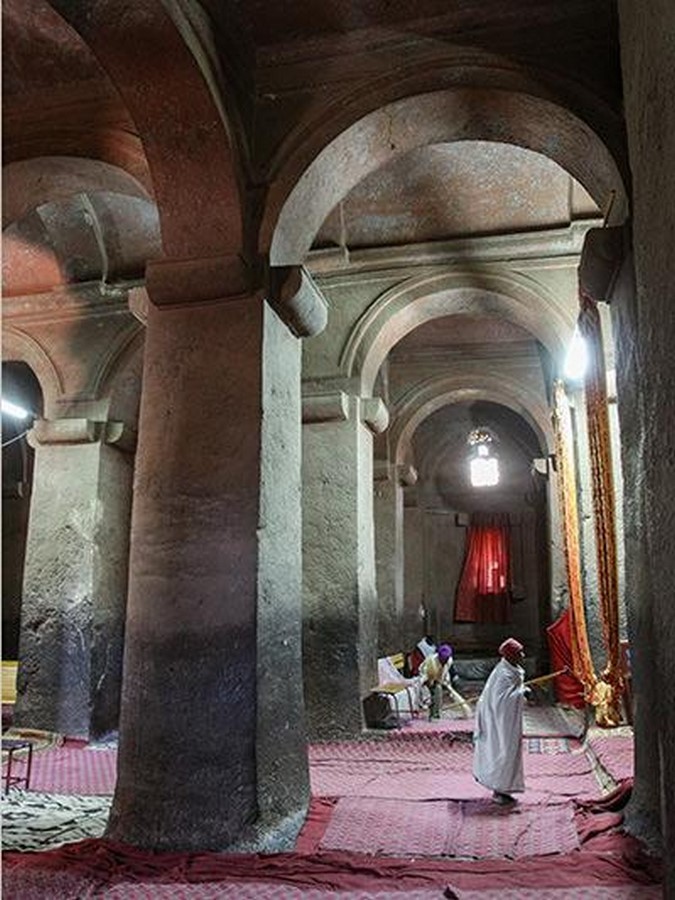
Echo chambers are architectural spaces where sound reflects repeatedly off surfaces, creating prolonged reverberation. The principle originated from studying spatial acoustics in sacred spaces, observed in medieval cathedrals, pre-colonial African temples, and sacred architecture. Some examples include the rock-hewn churches of Lalibela in Ethiopia and the hypostyle halls of ancient Egyptian temples, where such effects were intentionally designed (Zhao, 2020; Alemayehu & Kumar, 2023).
In traditional African and Asian architecture, designers achieved these effects using bare stone materials, curved or domed ceilings, and spatial symmetry. In traditional architecture across Africa and Asia, Architects used this effect to intentionally create reflections for sound amplification in performance spaces or sound vibrations in sound domes used for sound healing practices. To create this effect, they would use bare hard surfaces, hollow or curved forms, and highly acoustic reflective materials. (Annamalai & Dwarakanath, 2017; Lee & Sakuma, 2021). In these contexts, sound was not only functional—it was spiritual.
Modern architects replicate this principle using simulation tools and materials like angled panels, diffusers, and acoustic foam to eliminate or emphasise echoes. Even in unintended cases—like the Whispering Gallery in New York’s Grand Central Terminal or the Hamilton Mausoleum in Scotland—acoustic anomalies have become architectural attractions due to their impressive echo effects (Ardila-Mantilla et al., 2020).
Through an Africanfuturist lens, the concept of echo chambers can be intentionally reinterpreted to craft spaces for healing, meditation, and spiritual alignment. By combining natural materials like earth, timber, and bamboo with digital acoustic mapping software, designers can shape modular sanctuaries or wellness pods that use sound as medicine and memory, reconnecting the user to cultural rhythms and resonant identities.

Urban Noise
Urban noise is a byproduct of modernity—traffic, industry, and overcrowding. It affects sleep, cognition, and cardiovascular health (Basner et al., 2014).
- Traditional African cities—like Ile-Ife, Kano, or Kumasi—were zoned to reduce sound. Markets were separated from residential areas, and vegetation was used as buffers.
- In modern cities like Lagos, unregulated planning leads to constant 85+ dB noise levels (Oyedepo, 2012).
Asian architecture approached this through layered spatial buffers, such as internal courtyards in Indian havelis or garden walls in Japanese machiya.
An Africanfuturistic strategy would combine local acoustic materials (e.g., rammed earth, woven grass, bark textures) with urban planning models that apply digital sound-mapping tools to create “sonic zoning”—quiet belts, tree-buffered boulevards, and heritage-inspired urban cores. These zones could use cultural typologies like public cultural spaces or courtyard markets as nodes for acoustic modulation while maintaining a symbolic connection to the local context.

Quiet Zones
Quiet zones are intentionally designed for mental clarity, rest, and spiritual grounding. They must have low reverberation, soft textures, and natural sensory cues (water, plants, filtered light).
- In African tradition, sacred spaces like the inner courtyards of Hausa homes or Burkina Faso’s Dagara compounds served this function.
- Sankore Madrasah in Timbuktu had silent study zones crafted with mud walls and groves.
- In Japanese gardens and Indian ashrams, silence is a designed experience.
Modern equivalents: yoga rooms, therapy spaces, and quiet pavilions. An Africanfuturistic interpretation would build on this by designing acoustic sanctuaries into urban cores using modular domes, sound-absorbing sculptures, and vibrational wood panelling sourced from African timbers. Structures like these could be coded with cultural patterns (Nsibidi, Adinkra) that reflect not just form but acoustic purpose—spaces where sound is filtered, not suppressed.

So, from our journey thus far, you can see that sound is not a peripheral architectural concern; it is central to how we feel, heal, and interact in built spaces. No matter the typology, it should be a significant architectural consideration in designing spaces. Not only do cinemas and theatres need good acoustics—our homes do too.
In traditional African architecture, acoustics were treated as technical and symbolic, woven into everyday life’s sacred, social, and practical rhythm. Modern urban design in Africa has often neglected this, leading to the erosion of sound-conscious spatial planning.
Through Africanfuturism, we are called to reimagine sound not as noise to be eliminated but as a narrative to be designed. Combining traditional wisdom (natural materials, sonic zoning, and oral culture) with emerging technologies (acoustic simulation, bio-sensing surfaces, AI zoning), we can craft acoustic landscapes that reconnect us to our heritage while meeting modern needs.
In doing so, sound becomes heard and honoured—a design element that tunes the space, the spirit, and the society.
I hope I have not bored you, but provoked you to think and act.
Till next time,
Cheers!
References:
- Alemayehu, D., & Kumar, A. (2023). Acoustic heritage of Ethiopian rock-hewn churches: A spatial analysis of sonic culture. Journal of Architectural Acoustics, 12(1), 45–61. https://doi.org/10.1016/j.archacous.2023.04.005
- Annamalai, S., & Dwarakanath, K. (2017). Soundscapes of Indian temples: A study of acoustic responses in sacred spaces. International Journal of Architecture and Planning, 9(2), 23–35.
- Ardila-Mantilla, C., Prass, A., & Sandberg, A. (2020). Unexpected acoustic phenomena in heritage spaces: Case studies from Hamilton Mausoleum and Grand Central Terminal. Building Acoustics, 27(4), 315–328. https://doi.org/10.1177/1351010X20941027
- Africanfuturist Collective. (2024). Africanfuturism in Architecture and Its Impact on the Africans’ Health and Wellness [Unpublished undergraduate dissertation]. Covenant University.
- Basner, M., Babisch, W., Davis, A., Brink, M., Clark, C., Janssen, S., & Stansfeld, S. (2014). Auditory and non-auditory effects of noise on health. The Lancet, 383(9925), 1325–1332. https://doi.org/10.1016/S0140-6736(13)61613-X
- Joseph, R., & Ruggles, C. (2007). Ancient Architectural Acoustics and Psychoacoustics in the King’s Chamber of the Great Pyramid. In Time and Mind, 3(2), 145–160.
- Kang, J., & Schulte-Fortkamp, B. (2016). Soundscape and the Built Environment. CRC Press.
- Lee, J., & Sakuma, T. (2021). The role of acoustics in traditional Japanese architecture: A case study of Zen temples. Applied Acoustics, 177, 107931. https://doi.org/10.1016/j.apacoust.2021.107931
- Long, M. (2014). Architectural Acoustics. Academic Press.
- Oyedepo, S. O. (2012). Noise pollution in Nigeria: A review. Research Journal in Engineering and Applied Sciences, 2(4), 371–375.
- Ulrich, R. S., Zimring, C., Zhu, X., DuBose, J., Seo, H. B., Choi, Y. S., … & Joseph, A. (2008). A review of the research literature on evidence-based healthcare design. HERD: Health Environments Research & Design Journal, 1(3), 61–125.
- Zhao, F. (2020). Ritual acoustics and cultural symbolism in ancient architectural design. Journal of Sound and Space, 14(3), 89–102. https://doi.org/10.1007/s42489-020-00073-8