The origin of Nikolaos Gyzis’s art is the culture and folklore of Tinos, the island where he was born in 1842. Gyzis studied at the School of Fine Arts of Athens, where he would train under Nikiphoros Lytras who was part of the Royal Academy of Fine Arts in Munich, where Gyzis would later study and teach, Gyzis spent most of his life far away from his roots, yet he will carry the essence of his artistic pursuits up until he died in 1901. In Munich, the Greek artist was influenced by the Romanticism movement and learned the technique of realism. He would incorporate these into his devotion to national Greek history and folklore, which would turn him into one of the most recognized figures of the Munich School as well as one of the most influential artists in the formation of the Greek-artistic identity.
Transitioning between movements
Nikolaos Gyzis’s work focused on emotion and individual experiences that were popularised by the Romantic movement in Europe. The Greek artist also applied the notion of precise forms and the depiction of varied textures and materials which he incorporated from the realism movement. In his latest work the use of symbolism can be appreciated, as he developed a growing attraction to spiritual depictions, he aimed to break the surface of realistic representation and dive into the spiritual. Throughout his entire life, he devoted his work to depicting Greek glory and struggles, with the intention of evoking patriotism and spirituality.

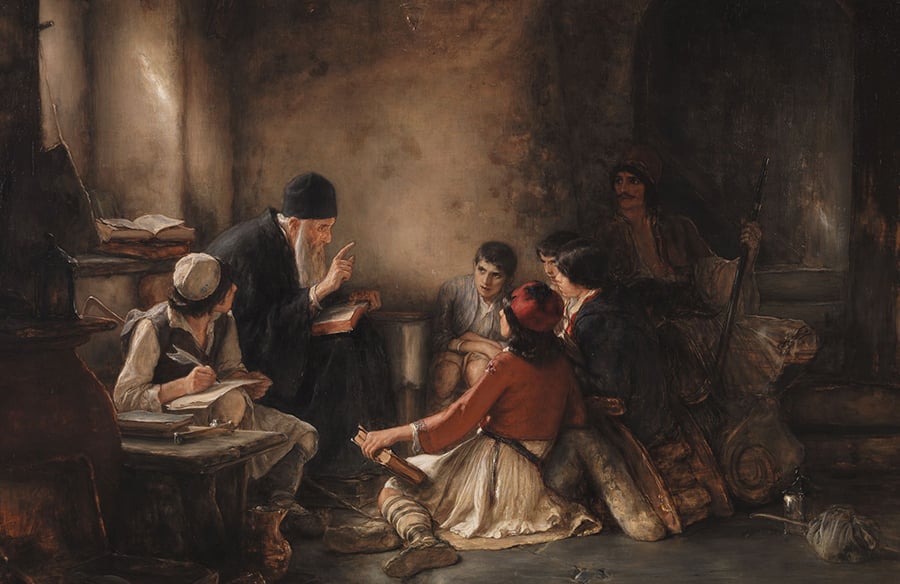
In his work ‘The Secret School’ Gyzis depicts a scene where children learned the Greek language and religion clandestinely during the Ottoman occupation. It is a representation of Greek resilience against an invasion of their culture. The scene tries to portray the underground nature of the circumstances, it is an act of rebellion. Nikolaos Gyzs understood the value of memory and education for the preservation of history and identity. In the piece the monk is the teacher that educates the younger generations, demonstrating that the Greek painter’s appreciation of religion was present before it became the main subject of his drawings.

Another notable piece is ‘The Destruction of Psara’. During the Greek War of Independence, the island of Psara was destroyed in 1824, it was left in ruins and the population was massacred. This incident is remembered as an example of Greek heroism and martyrdom. The population of Psara faced incredible odds during the war and bravely resisted until their demise. Nikolaos Gyzis intended to showcase the citizens of Psara as true national heroes, the defiance that they showed during the war was only possible because of patriotism, the painter hoped to evoke Greek pride through his work, to illustrate to the Greek population the value of national identity especially in times of peril.

Later in his life, Nikolaos Gyzis’s art became existential, as he shifted towards symbolism, spirituality, and faith. In his piece ‘Triumph of Religion’, he showcases the victory of faith against materialism. In the centre, there is a figure representing religion which dominates over the obscure and dark elements of the material world. As Gyzis grew older his perspective on death changed, it turned into an opportunity for transformation and ascendance, in his work he used light as an element of spiritual illumination, and death became a means of transcending the mundane towards enlightenment.
Greek identity
The work he did during the last period of his career contrasts the rest of his projects, he was used to depicting mundane scenes, as he was interested in the rural and familiar essence of Greek life. Nikolaos Gyzis’s understanding of the human condition and in particular Greek identity, his ability to depict everyday life interactions, and his unique style formed by the combination of romanticism and realism were the cause of his success. The composition and emotional drama of the artwork had a romantic nature as well as a curated and detailed formation typical of realistic depictions. These conditions transferred into the portraits of his various subjects, as in them the merging of detailed representation with emotional substance can be recognized.
What made Nikolaos Gyzs stand out in art history is that he was open to the influence of international movements, and applied them to his appreciation of his national culture. Gyzis merged the academic styles of 18th-century Europe and connected them to his interest in national identity and tradition. This made him a central figure in the cultural heritage of Greece and is the reason why today his paintings are exhibited in the National Gallery of Athens. His patriotism and talent redefined Greek art and continued to inspire artists to appreciate tradition and folklore. His techniques were admirable, but it was his passion and desire to evoke emotions that differentiated his work. Nikolaos Gyzs’s art is a reflection of a glorified and deprived Greek nation, this representation of Greece demanded to be acknowledged so the memory could live on and build national identity.