A Universal Humanist and Multifaceted Artist :
Rabindranath Tagore, a name synonymous with art, poetry, music, cultural renaissance, and social reforms, left an indelible mark on the global landscape of creativity and intellectual thought. Born in 1861 in colonial India, Tagore’s work transgressed through geographic and cultural barriers, and captivity during British rule, leaving a lasting impact on both Eastern and Western thought. As a poet, novelist, composer, painter, and philosopher, he pioneered a new vision of humanity grounded in universal humanism and the interconnectedness of all people. His body of work reflected a deep understanding of human emotions, spirituality, freedom, liberation, and nature, offering an alternative perspective to the rigid societal norms and colonial dominance.
Celebrated globally for his profound contributions, he became the first non-European to win the Nobel Prize in Literature in 1913, placing Indian Literature and Art on the global stage. His philosophy, the seamless blend of local tradition and modern sensibility in his creations, and his quest for freedom – both personal and national – resonate with artists, intellectuals, and activists to this day.
Seeds of Genius: The Early Life of Rabindranath Tagore:
Born in the vibrant city of Calcutta and into a highly cultured and affluent family, which had been at the forefront of Bengal’s intellectual and cultural awakening. His Father, Debendranath Tagore, was a philosopher and a leading figure in the Brahmo Samaj, a religious and social reformist movement in 19th-century Bengal that sought to modernise Hinduism and emphasised reason, monotheism, and the rejection of idolatry. The influence of his father and Brahmo Samaj played a significant role in shaping Tagore’s early beliefs, as he was raised in an environment that fostered spiritual inquiry, social reform, and intellectual freedom.
The Tagore household at Jorasanko, where he spent his childhood, was a crucible of cultural and artistic activity; surrounded by intellectuals, poets, musicians, and thinkers, young Rabindranath was exposed to a rich tapestry of ideas and a nourishing environment from an early age. Western-educated Family members brought to the home liberal ideas complementing the introduction to classical Indian literature, music, and philosophy. This unique blend of Indian tradition and Western modernity profoundly offered him a unique and multifaceted upbringing, influencing Tagore’s worldview, and setting him on a lifelong mission to synthesise the best of both worlds.
The Catalyst: Kickstarting his Journey:
During his time in England, he was deeply influenced by Western Literature, particularly the works of Shakespeare, John Keats, and Percy Bysshe Shelley. This exposure to European art, music, and philosophy added a new dimension to his intellectual development, but despite this, he remained deeply attached to his Indian roots. This also bestowed a tinge of duality to his work as he sought to bridge Eastern and Western thought through his writings, music, and art.
His Homecoming from England marked a turning point in his intellectual and creative life. Steeped in both Indian and Western traditions, Tagore was uniquely positioned to reflect on the complexities of colonial rule and the cultural tensions between tradition and modernity. He rejected narrow definitions of nationalism and cultural identity, advocating instead for a humanism that transcended geographical, and religious boundaries. These experiences, and influences coupled with his time in England, laid the foundation for his vast body of work, which went on to impact not only Indian society but across the globe.
The Journey: Exploring the Literary Mastery
Tagore’s career was an extraordinary journey that spanned multiple disciplines, including poetry, music, painting, drama, and education. His overarching philosophy can be summarised in Vishwa Manav (Universal Being) a concept that called for the spiritual and cultural unity of all people, transcending the confines of nationality, race, and religion. His belief in the interconnectedness of all human beings is evident in his artistic works, which are often laced with the themes of love, nature, and humanity’s inherent spiritual bond.
Literary Genius: Poetry and Prose:
Tagore is best known for his poetry, which captures the essence of Indian mysticism, nature, and the inner turmoil of the human spirit. His collection Gitanjali, for which he won the Nobel Prize in Literature in 1913, is a profound meditation on the sacred, the divine, and the mundane. His poetry speaks to the universal human longing for connection with the divine. His lyrical and evocative verses express a cosmic harmony, where human experiences are inextricably linked to the natural world and the larger mysteries of existence.

In his novels like Gora and Ghare Baire (The Home and the World), Tagore tackled social, political, and philosophical issues, offering reflections on India’s colonial context and the clash between tradition and modernity. His narratives are more than just stories; they are philosophical explorations of identity, nationalism, and the individual’s role in society. Gora is a profound commentary on the complexity of religious and national identity, while Ghare Baire dissects the tension between nationalism and personal freedom, making it a relevant reflection on the nationalist movements of the time. These novels underscored his belief in universal humanism, advocating for a society built on mutual respect and understanding rather than rigid dogma.
The heartbeat of his soul: Music
Music was another medium to project Tagore’s philosophy and creativity. Throughout his journey, he composed more than 2230 songs, collectively known as Rabindra Sangeet. These songs remain an integral part of Bengali culture and are known for their depth of emotion and philosophical insight. His music reflects his belief in the spiritual dimension of life, as well as the beauty of human emotions such as love, sorrow, joy, and devotion.
His compositions are preliminarily rooted in traditional Indian ragas, along with an infusion of sensibilities of Western music. This fusion of the East and West in his musical compositions also illustrates his universal humanism value; marrying different cultural traditions into a harmonious whole.
One of his compositions unites the whole nation in one note, one tune, filling every heart with valour, gratefulness, devotion, joy, a hint of sorrow, respect, pride, and national integration. Jana Gana Mana; the Indian National anthem and Amar Shonar Bangla; the national anthem of Bangladesh are testaments to the immense cultural influence of his music, which continues to inspire and unite people across generations. According to Tagore, Music is a medium of transcending limitations of language, allowing people to connect on a deeper, more spiritual level. Through his music, Tagore sought to express the inexpressible- to give voice to the deepest stirrings of the human soul.
From Verse to Visuals:
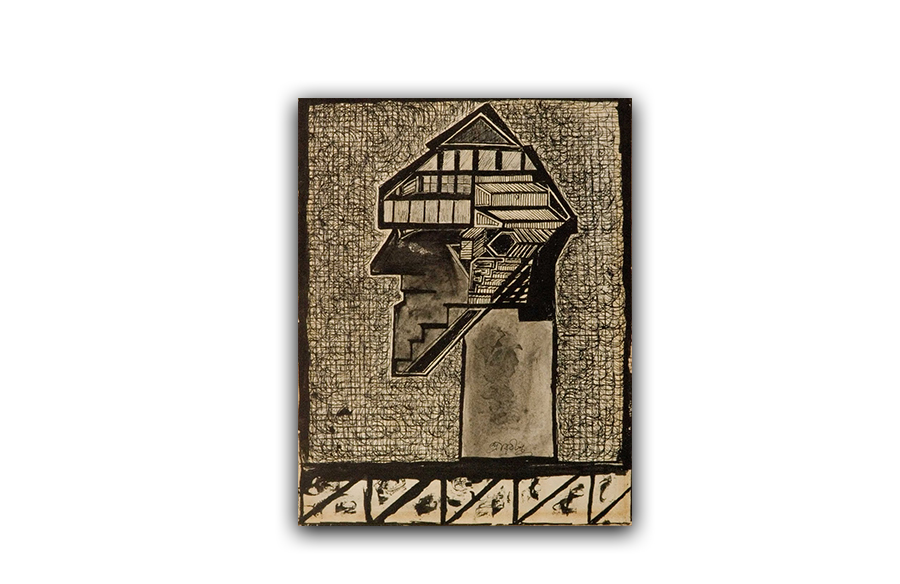
Tagore’s foray into visual arts came relatively late in his life, yet it marked an entirely new dimension of his creative output. He began painting in his sixties, and like his other artistic pursuits, his approach to painting was unconventional. He developed a distinctive style that fused abstract elements with figurative forms and his works often had an ethereal, dreamlike essence and bold, expressive, and confident lines and unusual colours conveying the emotional depth.
His visual art echoes the freedom and spontaneity that characterised his poetry and music. His painting style broke free from the traditional confines of Indian traditional art, showing a kind of fluidity and experimental spirit that mirrored his philosophies.
The art emerges from the canvas very organically and naturally, imbued with a sense of mystery and vitality; suggesting a deep engagement with the inner workings of the human psyche. This visual language was another way in which Tagore explores the themes of his poetry- the duality of life, the tension between light and dark, and the search for meaning in an often chaotic world.


The Theatrical choreography:
Tagore was a key contributor to the world of drama and dance. His plays are rich in symbolic meaning, often revolving around spiritual, philosophical, and social issues. Chitrangada, The King of the Dark Chamber, and Red Oleanders were not only deeply poetic but also philosophically complex. The plays typically went beyond entertainment achieving the dimension of allegory and realism which is poetic and spiritual.
He believed that Dance is the power of the body to express emotions and spiritual truths. His dance dramas, like Chitrangada and Shyama, combined music, poetry, and dance in a seamless fusion of art forms, embodying his vision of a holistic, interconnected approach to creativity. These works remain important cultural and artistic contributions that reflect his ability to innovate and create across multiple mediums.


Immortal Influence: Enduring Impact on Art and Thought:
A Global Legacy:
Tagore’s influence on art and culture is not restricted to the borders of India. His works were translated into multiple languages, earning him a place in the global literary canon. His philosophy of universalism, humanism, and cultural exchange resonated with intellectuals, artists, and political figures.
Tagore’s vision for education is pivotal in changing the learning landscape for everyone. In 1921, Visva-Bharati University in Shantiniketan was established, a place where students and teachers from around the world could come together to foster cultural exchange and holistic learning. His educational philosophy was centred around the idea of learning in harmony with nature, encouraging creativity, critical thinking, and the pursuit of knowledge without the constraints of a formal curriculum. This institution remains a beacon of his idea, attracting students and scholars from all over the world.
Posthumous Recognition:
Tagore’s recognition kept on growing exponentially, as his influence extended to modernist poets, writers, and thinkers around the world inspiring a new generation. His paintings, which were relatively under appreciated during his lifetime, became famous. Today, his artworks are exhibited in major galleries worldwide. His writings, prose, poetry, music, and songs became symbols of India’s cultural revival during its struggle for independence. His vision for a free, unified, and culturally rich India influenced other leaders, contributing to the formation of modern Indian thought.
The Power of Expression: Bridging Art and Social Justice.
Rabindranath Tagore’s journey was one of profound artistic innovation and unyielding social activism. His vast body of work- poetry, music, painting, drama, and essays- embodied his belief that art was not just for aesthetic pleasure, but also a powerful tool for personal and societal transformation. Beyond his artistic accomplishments, Tagore was a social reformer who advocated for freedom- personal, cultural, and national. He advocated education as a means to empower individuals and encourage creativity and critical thinking. His commitment to humanism led him to speak out against social injustices, including the caste system, gender inequality, and the colonial oppression of India.
He believed in awakening people’s inner consciousness, encouraging them to challenge oppressive norms, inspiring them to strive for a just and equitable society, and empowering them. Tagore’s legacy is that visionary who believed that art could elevate the human spirit and foster a world where empathy, compassion, and understanding transcend all divisions, rifts, and conflicts.
Citations:
- Wikimedia Foundation. (2024, October 22). Rabindranath Tagore. Wikipedia. https://en.wikipedia.org/wiki/Rabindranath_Tagore
- YouTube. Rabindranath Tagore: The Greatest Renaissance Genius of the 20th Century. YouTube. https://www.youtube.com/watch?v=cIk63bCn1kk
- The nobel prize in literature 1913. NobelPrize.org. (n.d.). https://www.nobelprize.org/prizes/literature/1913/tagore/biographical/
- Goodreads. (n.d.). Rabindranath Tagore (author of Gitanjali). Goodreads. https://www.goodreads.com/author/show/36913.Rabindranath_Tagore
- YouTube. Rabindranath Tagore: The citizen of his country and the universe. YouTube. https://www.youtube.com/watch?v=3EIbvpqoYc0
- Wikimedia Foundation. (2024a, October 8). Shantiniketan. Wikipedia. https://en.wikipedia.org/wiki/Shantiniketan
- VisvaBharati – Santiniketan. Santiniketan. (n.d.). https://www.visvabharati.ac.in/Santiniketan.html