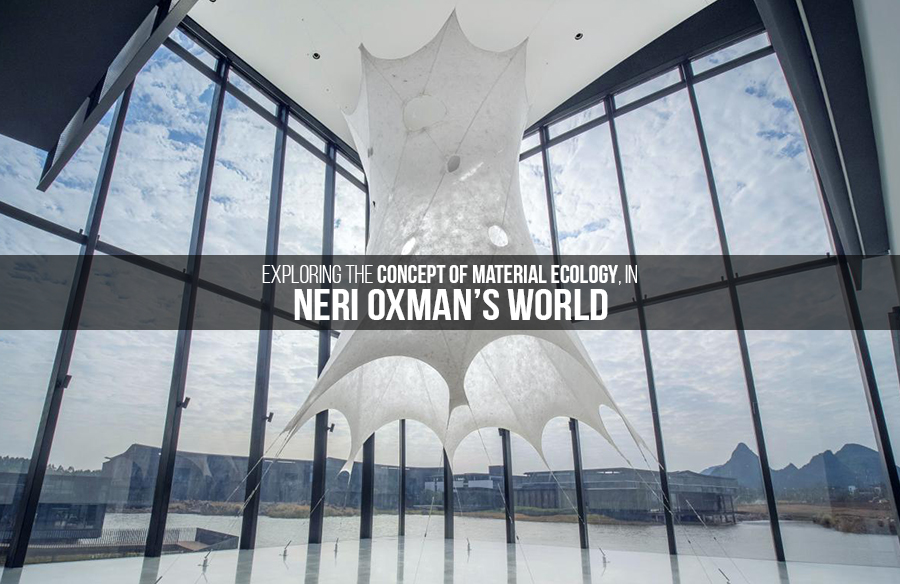
Let us begin exploring with an interesting question – What if the structures of the future were grown rather than being constructed? Is it possible for architecture to develop to resemble the intricacy of living things? Imagine buildings that are in tune with nature rather than in opposition to it—buildings that can breathe, adapt, and even regenerate. This is Neri Oxman’s revolutionary perspective; her ground-breaking work in Material Ecology has completely remade the field of architecture.

Neri Oxman presents a future in which structures serve as living systems, developing from renewable materials and collaborating symbiotically with their surroundings through the integration of art, science, and nature. Her avant-garde approach challenges us to rethink how we create and build our environments, paving the way for a day when architecture is as alive as the ecosystems it coexists with.

The following article explores the innovative contributions of Neri Oxman and how bio-architecture might change our cities and our way of life. Oxman is not only an architect but also an innovator who is guiding humanity toward a more sustainable future with her groundbreaking work with natural materials and her futuristic designs.
Could Buildings Soon Be Grown Without Being Built?
Neri Oxman proposes a building that similarly develops from nature to how a tree grows from a seed. Her research on Material Ecology investigates the possibility of implementing biological materials that self-assemble, adjust to their surroundings, and even have the capacity to cure themselves in buildings, in order to design structures as living beings. Oxman’s bio-architectural works have the power to rebuild our cities, much like a forest recovered from a fire.
Neri Oxman established the phrase “material ecology,” which blends cutting-edge manufacturing techniques with the biological principles of growth. Her art is inspired by the natural building processes of the world, where waste is almost non-existent and each structure has a certain use. Within the realm of bio-architecture, the artificial and natural coexist harmoniously.

Take note of her Silk Pavilion project, in which Oxman worked with silkworms to use their innate ability to weave a building. The ultimate product was not only constructed; it was grown through a design process that emulated the tactics of nature. Such avant-garde building techniques herald a new age in architecture—one that honours and accommodates the requirements of the ecosystem.
“Nature doesn’t design with human tools, and yet, it achieves efficiency and beauty that far surpasses anything we can create,” as Neri Oxman famously stated.
Her idea creates a world of opportunities that go against conventional techniques of building and designing.
Material Ecology: Employing Living Systems for Construction
The way that Neri Oxman views materiality is a fundamental aspect of her vision. Concrete, steel, and glass are examples of synthetic, non-renewable materials that have been extensively used in traditional design and have a negative environmental impact. By posing a thought-provoking query, Neri Oxman is rewriting history: What if our structures were composed of living materials?

Her work in Material Ecology is centred around the use of sustainable materials derived from biological sources that are integrated into broader ecological systems. For instance, Oxman has experimented with mycelium, a fungus that grows quickly and can be utilised to build biodegradable, lightweight buildings. Neri Oxman imagines a day when architecture would be infused with biological materials, allowing buildings to self-repair, expand, and eventually decompose—returning nutrients to the soil instead of leaving a wasted legacy.
During an MIT speech, Oxman succinctly outlined her idea: “Neri Oxman sees an architect as a curator of nature’s processes, not as a creator.” This change in perspective makes architecture a cooperative endeavour between people and the natural world. Structures can respond, adapt, and completely integrate into the biosphere.
Living Facades: ‘Breath-taking’ Architecture
Envision exploring a city where structures are living things that respond to environmental changes, rather than merely being immobile monuments. This scenario is no longer a far-fetched dream because of Neri Oxman’s advancements in bio-architecture.
Her work with “living facades,” in which a building’s exterior is composed of organic materials that breathe, develop, and change colour in response to environmental conditions, is one of Oxman’s most notable achievements. These living facades are able to naturally regulate internal temperatures, absorb pollutants, and change carbon dioxide into oxygen by integrating biological systems into their architectural design.

An intriguing illustration of Oxman’s approach to creating with nature is the Agua Hoja project. She made a pavilion that reacts to temperature and humidity like a living thing by using water-based biopolymers. The main idea behind Neri Oxman’s bio-architecture is that living systems should be created rather than merely imitating natural phenomena.
“To create living architecture is to create a dynamic organism that coexists with its surroundings,” as Oxman puts it so eloquently.
In a world facing enormous climatic difficulties, her method may offer flexible, sustainable solutions that safeguard and enhance our environment.
The Future Prospects of Bio-Architecture: Moving Toward a Mutually Beneficial Alliance
As we look toward the future of architecture, Neri Oxman challenges us to imagine a built environment that is no longer in conflict with nature but fully integrated into its systems. The concept of buildings that grow, adapt, and respond to their environment is more than just a utopian vision—it is a tangible future, thanks to advancements in bio-architecture.
Through her pioneering work in Material Ecology, Oxman is laying the groundwork for a future where human structures no longer act as parasites to the Earth, but as symbiotic partners. The potential is vast: cities made of living organisms, buildings that contribute to the ecosystem, and a design philosophy that prioritises life over lifelessness.
In her own words, “Nature is the world’s greatest architect. It’s time we learn from its wisdom.” With Neri Oxman at the helm, the future of bio-architecture is not just a possibility—it is an inevitability.

With her groundbreaking concept of Material Ecology, Neri Oxman is paving the road for the imminent ecological renaissance in the field of building. Her creations show how biology, technology, and design can all be combined to potentially completely change how we interact with our surroundings.
Oxman is demonstrating that humans may coexist peacefully with nature rather than in conflict with it by bringing architecture to life. Her method gives hope for a more sustainable and connected future as the globe deals with escalating environmental issues.
Future architects will be influenced by Neri Oxman and will not only create buildings but also manage ecosystems to ensure that human ingenuity coexists with the natural world.
Citations & Credits:
- Books
Oxman, N. (2020). Material Ecology: Designing for the Future. Cambridge: MIT Press.
- Articles
Print Journals:
- Barnett, M. (2021). Biological Integration in Architecture. Journal of Eco-Architecture, Volume 14 (1), pp. 22-39.
Journal Articles Accessed on a Website:
- Benjamin, D. (2019). Material Ecology and the Future of Bio-Architecture. Volume 6 (3), pp. 15-29. Available at: www.materialecologyjournal.com/benjamin [Accessed: 15 September 2024].
- Online sources
- Oxman, N. (2023). Silk Pavilion and Bio-Architecture. Available at: www.nerioxman.com/silkpavilion [Accessed: 15 September 2024].
- GDS Architects. (2020). The Future of Living Facades. Available at: www.gdsarchitects.com/living-facades [Accessed: 15 September 2024].
- Images/visual mediums
Citations for Images
- Image 1: Unknown. (Year of production not specified). Natural Design. [JPEG image]. (Available at: https://betterworld.mit.edu/wp-content/uploads/2013/04/natural-design.jpg).
- Image 2: Ahlefeldt, F. (2023). Digestive House. [JPEG image]. (Available at: https://fritsahlefeldt.com/wp-content/uploads/2023/03/lb20230331-digestive-house-storylinegrid-frits-ahlefeldt.jpg?w=1200).
- Image 3: Unknown. (Year of production not specified). Integral Silk Pavilion II. [JPEG image]. (Available at: https://www.esquel.com/sites/default/files/20210104_Integral_Silk%20Pavillion%20II.jpg).
- Image 4: Unknown. (Year of production not specified). Hy-Fi. [JPEG image]. (Available at: https://cdn2.hubspot.net/hubfs/4043727/Imported_Blog_Media/hyfi_01-1.jpg).
- Image 5: Unknown. (2018). Aguahoja Pavilion. [JPEG image]. (Available at: https://v2-nerioxman.imgix.net/59383491-33f2-4efa-a243-45b351c39a25/aguahoja-2018-pavilion-horizontally-positioned-ocn-process-1.jpg?auto=compress%2Cformat&fit=min&fm=jpg&q=80&rect=0%2C91%2C4388%2C2742).
- Image 6: Gibson, A. G. (2023). Stable Diffusion XL. [WEBP image]. (Available at: https://andrewggibson.com/wp-content/uploads/2023/09/stable-diffusion-xl_clipdrop-cleanup-59-jpg.webp).