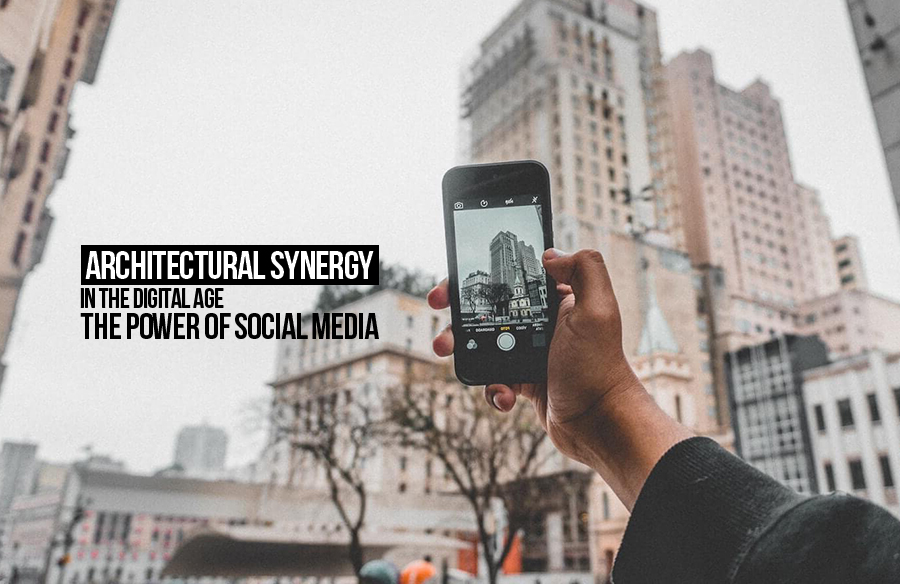
In today’s world, social media plays a crucial role in bringing together various elements of architecture. There are broadly two categories of people involved in the architectural realm: professionals and users. Social media serves as a vital platform for facilitating active participation and interaction between these two groups, enabling the exchange of information and experiences.
Through social media, information about different attributes of physical spaces, their experiences, and their significance can travel globally, eliciting reactions and feedback. This exposure helps achieve public recognition on a broader scale.

Transition Since Ages
Architecture has existed in various forms since the dawn of humanity, playing a crucial role in providing shelter. From caves to the diverse structures that now form part of India’s rich history and culture, architecture has always been significant.
In ancient times, living environments were documented through manuscripts and carvings, preserving their architectural significance for future generations. Additionally, information about these structures spread through word of mouth, as people shared their architectural experiences with others they encountered throughout their lives.
The dissemination of information has always been vital in the architectural industry. While the methods have evolved over time, the importance of spreading knowledge about architectural developments has only increased.

Need of Social Interaction
Why is it essential for information to travel? Architecture is a field focused on designing spaces by people and for people. Every major factor—whether spatial planning, human comfort, functionality, or aesthetics—is intended for the user group. Therefore, involving people in the process is of utmost importance. Social media plays a crucial role in providing a platform for discussions, opinions, trends, and feedback, ensuring public participation in the architectural process.
Post-project opinions are particularly important. They help determine what works and what doesn’t, guiding the direction for future projects.

Easy Communication
In addition to ensuring transparency and inclusivity, social media also facilitates effective communication within the field of architecture. This field is supported by various pillars, including students, teachers, professionals, universities, firms, vendors, stakeholders, publishers, and readers. These individuals collectively contribute to making architecture a well-understood and efficiently evolving industry.
Today, users and stakeholders play a crucial role in designing spaces. Why? Because users are the ones who will utilize the space, experience it, and be most affected by its spatial planning and ambiance. Social media plays a vital role in this process by storing experiences and information, helping millions of people and saving a lot of effort and energy in finding simple solutions through experimentation.

Sharing ideas and information with everyone leads to effective and impactful decisions, resulting in productive outcomes. The exchange of ideas and sharing of tried-and-tested methodologies can be incredibly beneficial for someone working on the other side of the world.
Through social media, we can increase productivity by reducing the energy and effort spent on unproductive experiments, simply by learning from others..

Impact on the Industry
The impact of social media and the inclusivity of people in the design or planning process has both positive and negative aspects. On the positive side, the availability of information online exposes users to various possibilities, scenarios, and trends. It allows users to communicate their needs more clearly and facilitates easy exchange of information and discussions. Consequently, tasks can be completed with less effort. When less effort is required for simple tasks, the saved energy and time can be directed towards more creative endeavors and better decision-making in other areas, leading to improved spaces and more effective results.

Every coin has two sides, and the impact of social media on architecture is no exception. While social media can be a valuable asset, it can also lead to adverse situations. The abundance of information online can be overwhelming and may reduce the confidence of young firms entering the industry. The plethora of options and comparisons among projects with different contexts and features can lead to unnecessary discussions and explanations.
Today, with references available for nearly every requirement and option in demand, there is less emphasis on innovation and experimentation. This lack of creativity can be detrimental to the field. While healthy competition can generate new ideas, unhealthy competition can harm both human relationships and architectural principles.

Motives or Takeaways
Social media has been instrumental in transforming architecture worldwide. It serves as a valuable asset, aiding in architectural expansion and becoming a necessity in modern life. Social media has become an integral part of daily routines, whether for casual browsing or intensive research and job-related activities.
The ultimate motive is the optimal and appropriate use of social media aims to improve humanity and contribute to an infrastructurally rich future.

Making the best use of social media is within our control. It is our decision to foster connections, encourage productive interactions, and promote healthy competition, or to spread insecurity, confusion, unhealthy comparisons, and a lack of creativity and innovation. While there are always good and bad sides to everything, it is our responsibility—both as professionals and users—to use this valuable resource thoughtfully and considerately. We must ensure that social media does not hinder growth and creativity but instead spreads positivity, motivation, and healthy relationships.
As key players in the vibrant and dynamic world of architecture, which is shaped by and for the people, we have a responsibility to foster a healthy and progressive environment. We should leverage social media to promote wellness and stimulate growth across the industry.