

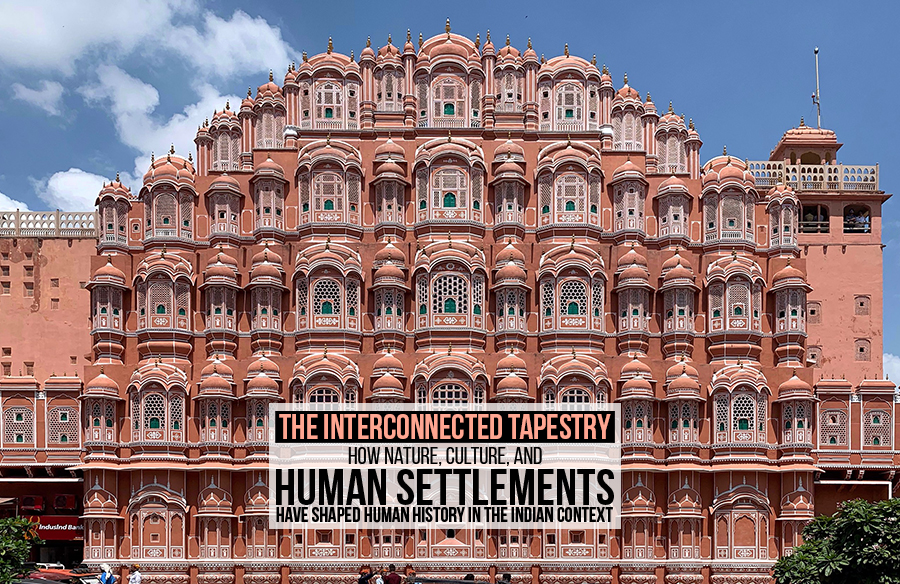
The Triad relationship between nature, culture and human settlements is a great point of study in understanding the growth and development of human societies. Its place in an Indian context has indelibly inscribed the destiny of civilization. Hence this text tries to have a look at all such complexities written across historical timelines, geographical spreads and contemporary studies. It seeks to provide an all-rounded view of how the natural landscapes have influenced the cultural practices and settlements in India, and how human activities have transformed landscapes over time.

Natural Resources and Ancient Indian Civilizations
Natural features played a great role in the shaping of ancient Indian civilizations. Water, for instance, arable land and other resources were the determining factors of whether the creation of early human settlements would succeed or fail.

- The Indus Valley Civilization: Because the Indus Valley was crossed by an extensive river system, the landscape was fertile, thus enabling agriculture to do very well—a fact that supported one of the most ancient urban cultures in the world. It was, in this light, that cities like Harappa and Mohenjo-Daro were successful because their sites provided the main settings along the Indus River, which was a perfect outlook for commerce and agriculture productivity. The most complex and elaborate urban planning and water management systems show that the Indus Valley Civilization set a relationship with the intensive employment of natural resources.
- The Ganges Plain: The Ganges River and the vast plain it flows through have very much been the crucible of Indian civilization. The ongoing alluvial soils enabled highly productive agricultural practices, which furthered the development of such influential ancient cities as Pataliputra and Varanasi. These urban centres became important nodes for cultural and political activity, testifying to the strong relationship that exists between local resource conditions and urban growth (Kulke & Rothermund, 2004).
Cultural Adaptations to the Environment
Yet, different cultures in India adapted to their environment, which thus influenced their agricultural practices, architectural styles, and also urban development.
- Agricultural Practices: The diversified climatic zones of India have diverse agricultural practices. Water scarcity in relatively arid zones, such as Rajasthan, called for labor investment in the development of traditional water harvesting systems like johads and baolis. In other more fertile zones, such as Bengal, the cultivation of rice, a water-intensive crop, coloured the primary occupation of the population, fostered by the high rainfall and large-scale river systems of the region.
Architectural Styles Indian architecture reflects adaptations to local climates and materials. Buildings in the hot and arid regions of Rajasthan keep their interiors cool, and courtyards and jharokhas provide shade and ventilation in them (Tillotson, 1987). On the contrary, to illustrate another case in point is that of the coastal area of Kerala, where houses have steeply pitched roofs and open verandas to cope with heavy monsoon rains and provide ventilation (Rao, 2004).

- Urban Planning: In India, environmental factors have always been a major consideration during urban planning. For example, Jaipur was planned with large streets and a grid pattern to promote air circulation and not let the city get hot in a hot semi-arid region. The same design was further incorporated with water bodies and green spaces for setting up a microclimate (Sachdev & Tillotson, 2002).
The Role of Trade and Migration
Trade routes and migration patterns have greatly eased cultural exchanges and the spread of settlements in India.
- The Silk Road and spice trade: The strategic location of India along the Silk Road and spice trade routes contributed to the development of a melting pot of cultures. The ports, like Calicut and Surat, were abuzz with intercultural influences because they were the points of trade interaction among three regions: Asia, the Middle East, and Europe. The kinds of intensifications finally led to the exchange of goods, ideas, and technologies to an extent that enriched Indian culture and consequently the growth of its urban centres.
- Migrations and Invasions: Ancient history also reveals the impact of migratory changes and invasions concerning Indian culture and settlements. In ancient times, the migration of Aryans impacted the social and cultural configuration through borrowed technological know-how and new cultural practices (Thapar, 2002). The entry of the Mughals brought their architecture, administrative techniques, and the Mughal culture, some of the prominent changes introduced in ancient history which left an impact, particularly in Indian society (Chandra, 1997).
Impact of Climate on Historical Events
It is thus known that climate changes have influenced important historical events and the growth and development of settlements in India.
- The Indus Valley Civilization’s Potential downfall: Climate change is one theory put out to explain the civilization’s potential downfall. It might have caused a shift in the monsoon pattern, which might have decreased rainfall and agricultural productivity and ultimately given rise to an excuse for people to leave metropolitan areas (Staubwasser & Weiss, 2006).
- The Little Ice Age: The Little Ice Age, a cooling phase that persisted from the 14th through the 19th centuries, affected Indian agriculture and numerous settlements within its territories. Cooler temperatures combined with unpredictable monsoons cut agricultural yields, leading to famines and bouts of social unrest across many parts of India (Grove, 2004).

Modern Cultural Explorations
In modern times, the investigation of culture in the aspect of nature and settlements is in constant development, based on present research and practices.
- Sustainable Water Management: Traditional water management practices in Rajasthan and the Western Ghats give a cue that there is a requirement to use techniques, which are aware of environmental or ecological changes. Revival and modernization would be an effective way of providing answers to the problems of water drought, which are very relevant for today’s world (Agarwal & Narain, 1997). Modern research stresses the ideal use of traditional knowledge with modern technology, making it a sustainable water management system (Kumar et al., 2019).
- Climate-Responsive Architecture: The architectural adjustments going on in different regions of India disclose the potential of climate-responsive academics. Borrowing conventional architectural characteristics that are embraced for improved aeration classically also leads to minimal use of energy, adding up to the general sustenance in urban planning—modern-day research concentrating on innovation within the application of vernacular architectural principles in contemporary constructions through sustainable designs.
- Cultural Heritage and Urban Development: Efforts should be guided by the historical importance of natural landscapes and cultural practices to ensure that India’s rich heritage continues into perpetuity. This involves the protection of heritage on the one hand and the adoption of traditional knowledge into modern development strategies. Currently, urban planning in the country is primarily centred on balancing heritage conservation with urban growth.
- Ecotourism and Community Involvement: Ecotourism operations and related activities are promoted in such a way as to foster natural and cultural heritage by the promotion of sustainable tourism practices. For example, in the Western Ghats and the Himalayas, the projects involve the local community in conservation intending to secure economic benefits while ensuring the conservation of biodiversity and continuity of cultural values (Das & Chatterjee, 2015).
The history of India has been strongly etched by the tapestry interwoven between nature, culture, and settlements. Since ancient times—through monuments on river banks, which are resonant, to infinitesimally modern cities, which are stricken by the dichotomy of ecology—the dynamic interaction among these elements has continued to play its roles in the shaping of human societies. These interactions help derive an understanding of good practices and ways to secure a culture-nature balance for sustainable development in the future.
References:
Agarwal, A., & Narain, S. (1997). Dying Wisdom: Rise, Fall, and Potential of India’s Traditional Water Harvesting Systems. Centre for Science and Environment.
Chandra, S. (1997). Medieval India: From Sultanat to the Mughals. Har-Anand Publications.
Das, M., & Chatterjee, B. (2015). Ecotourism: A panacea or a predicament.
Dutta, V. (2012) Land Use Dynamics and Peri-Urban Growth Characteristics: Reflections on Master Plan and Urban Suitability from a Sprawling North Indian City. Environment and Urbanization ASIA, 3(2), 277-301.
Grove, R. H. (2004). The Little Ice Age and Its Impact on India’s Environment and Economy. In H.F.P. Green & J.M. Grove. Ed. The Great El Niño of 1789–1793 and Its Global Consequences. University of Hawai’i Press.
Kenoyer, J. M. (1998). Ancient Cities of the Indus Valley Civilization. Oxford University Press.
Kulke, H., & Rothermund, D. (2004). A History of India. Routledge.
Kumar, R., Singh, R. D., & Sharma, K. D. (2005). Water resources of India. Current Science, 89(5), 794-811.
Ludden, D. (1999). An Agrarian History of South Asia. Cambridge University Press.
Meir, I. A., Garb, Y., Jiao, D., & Cicelsky, A. (2009). Post-occupancy evaluation: An inevitable step toward sustainability. Advances in Building Energy Research, 3(1), 189-219.
Mukherjee, R. (2006). The Rise and Fall of the East India Company: A Joint-Stock Company in the Imperialism of India. Monthly Review Press.
Possehl, G. L. (2002). The Indus Civilization: A Contemporary Perspective. AltaMira Press.
Rao, P. R. (2004). Kerala: Development Experience. ICFAI Books.
Sachdev, V., & Tillotson, G. (2002). Building Jaipur: The Making of an Indian City. Reaktion Books.
Staubwasser, M., & Weiss, H. (2006). Holocene Climate and Cultural Evolution in Late Prehistoric-Early Historic West Asia. Quaternary Research, 66(3), 372-387.
Thapar, R. (2002). Early India: From the Origins to AD 1300. University of California Press.
Tillotson, G. H. R. (1987). The Tradition of Indian Architecture: Contin.Introduction
Coscodan, E. (2014, October 31). 7 Scary Places To Visit While You Study Abroad. Pinterest. https://in.pinterest.com/pin/515099276108392595/
Cant, M. (2024, February 8). Ramkund. Pinterest. https://in.pinterest.com/pin/7388786882937744/
Gupta, A. (2023, August 8). Indian Culture: A Journey through Past & Origin of Indian Culture. https://cityfurnish.com/blog/a-brief-history-of-indian-culture
Lamouroux, J. P. (2022, September 21). Visit Jaipur. Pinterest. https://in.pinterest.com/pin/6966574416964227/







