History of Biophilia
Erich Fromm first used the term “biophilia” to poetically describe the “passionate love of life and all that is alive” (Fromm). A decade later in 1984, EO Wilson further evolved the word to represent human beings’ innate attraction to nature and the subconscious desire to emulate natural processes.

Incorporating this idea with the stage of all life – the built environment – biophilia has since become a driving force in the architectural world. Architects have

Elements of Biophilia
The architect must recognize where the architecture is placed to incorporate the appropriate biophilic approach. Elements of biophilia are physically visible representations of the natural world blended into architecture.
A common misconception of the practice is when an architect places singular trees or plants in or around a building and deems a building biophilic. True biophilia is when nature is seamlessly integrated into architecture.
There currently is a strong divide between city and nature. Therefore, to integrate the two, an architect must either bring the building to the landscape or the landscape to the building. In doing so, one can establish an overall setting or habitat amidst the architecture.

Fay Jones brings architecture to the forest in his Thorncrown Chapel. Steel bracing sets a foundational border between perceived exterior and interior, while there is no true enclosure. The forest canopy acts as the enclosure, protecting the occupant. The metal’s colour seems to disappear into the background while the yellow and blue accents create a visual landscape.
The chapel does not overtake the forest, nor does the forest overshadow the chapel. Together they create a harmonious integration of architecture into the built environment.

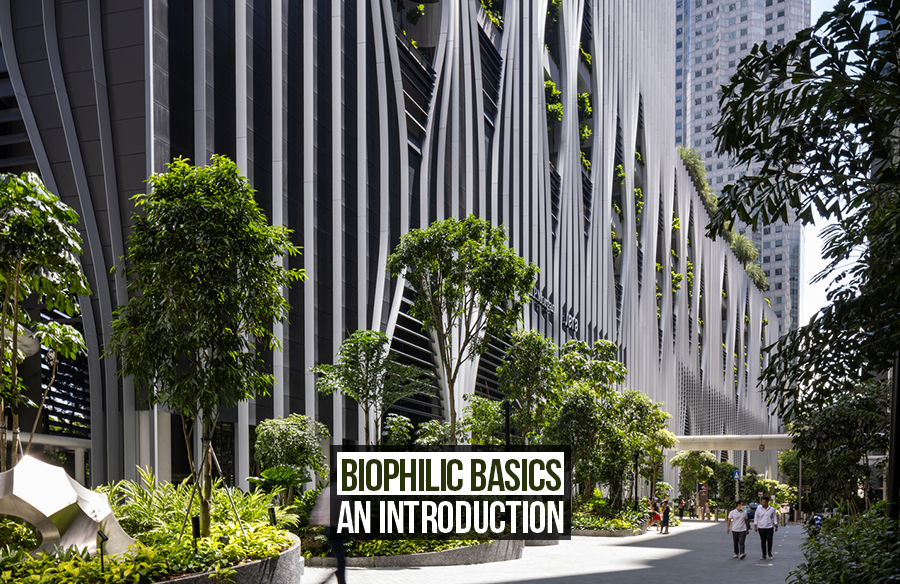
Comparatively, Capita Springs in Singapore reintegrated nature back into the concrete jungle of the city. With wavering breaks in the facade, points of vegetation peak through as if the plants are originating from the interior of the building. In the middle of the building, multiple floors have been overtaken by natural elements to create a multi-layered park in the sky.

Patterns of Biophilia
While elements of biophilia are tangible representations of nature in architecture, patterns of biophilia can be used to mimic natural formations seen in the natural world, also known as biomimetics. These non-visual connections still hold the innate principles of nature.
Studies have shown that, despite not actually being a natural, living being, naturally seeming patterns can still be perceived in the same way by the brain. Even manufactured natural patterns can lower blood pressure and reduce stress hormones.
These forms bring a sense of content, interest and captivation. Human beings’ visual preference of biomimetic forms inspire the viewer by symbolising life.
The Manuel Gea Gonzalez Hospital tower in Mexico City is not only an example of sustainable practices, but biomimetics. The facade was created to transform air pollutants into harmless chemicals and reduce pollution in the city. To physically represent this, the form takes on a quasicrystal pattern that can be seen in constellations, atomic arrangements and crystallite formations. These forms satisfy the part of the brain searching for harmony and cohesion.

Processes of Biophilia
With elements and patterns of biophilia absorbing the visual sense, processes of biophilia are left to the other senses. The touch, taste, smell, and feel of a natural environment is drastically different than that of an artificially manufactured space.
Reiterating the idea that a biophilic space is not just a room with a plant, but rather an integrated habitat, one must recognize the invisible processes that occur in the landscape beyond the greenery. Most commonly understood and used is natural ventilation.
Natural ventilation is the movement of air through a space purely guided by air’s natural path, determined by wind and temperature. Stack ventilation allows rising hot air and falling cool air to circulate vertically, while cross ventilation allows wind to move horizontally through a space depending on wind patterns.
These atmospheric qualities are also commonly perceived in natural light. When there is more opportunity provided in a building for natural light to enter a space, occupants are considered happier, livelier and more present. This occurs because of light’s ability to affect a person’s circadian rhythm. Natural light exposure grounds the body back in alignment with the natural day’s cycle.

Frank Lloyd Wright once said, “I go to nature every day for inspiration in the day’s work. I follow in building the principles which nature has used in its domain.” Whether or not a building possesses visible or invisible elements, patterns and processes of biophilic design, integration of nature into the city is imperative in regrounding society.
Where human beings once aspired to overtake the landscape with creation and innovation, it is now time for the landscape to naturalise itself back into the built environment.
Citations:
Champion, V. (2021) Biophilic Design in the ancient world, Journal of Biophilic Design. Available at: https://journalofbiophilicdesign.com/podcast-journal-of-biophilic-design/biophilic-design-in-the-ancient-world (Accessed: 02 June 2024).
Eltringham, M. (2024) Biophilic design has a long history and an even bigger future, Workplace Insight. Available at: https://workplaceinsight.net/biophilic-design-has-a-long-history-and-an-even-bigger-future/ (Accessed: 02 June 2024).
Holland, O. (2022) ‘biophilic’ skyscraper bursting with 80,000 plants opens in Singapore, CNN. Available at: https://www.cnn.com/style/article/capitaspring-singapore-skyscraper-biophilic/index.html (Accessed: 02 June 2024).
Team, E. (2024) How biophilic design is making humans happier, TerraMai. Available at: https://www.terramai.com/blog/biophilic-design-making-humans-happier/ (Accessed: 02 June 2024).
Team, F. (2023) Architectural design trends 2024: Innovations in Sustainability, FORMAT. Available at: https://www.format.com/magazine/resources/architecture/architectural-design-trends-2024#h-biophilic-design (Accessed: 02 June 2024).
What is and is not biophilic design (2024) Metropolis. Available at: https://metropolismag.com/viewpoints/what-is-and-is-not-biophilic-design/ (Accessed: 02 June 2024).
14 patterns of biophilic design (2014b) Terrapin Home – Terrapin Bright Green. Available at: https://www.terrapinbrightgreen.com/reports/14-patterns/ (Accessed: 02 June 2024).