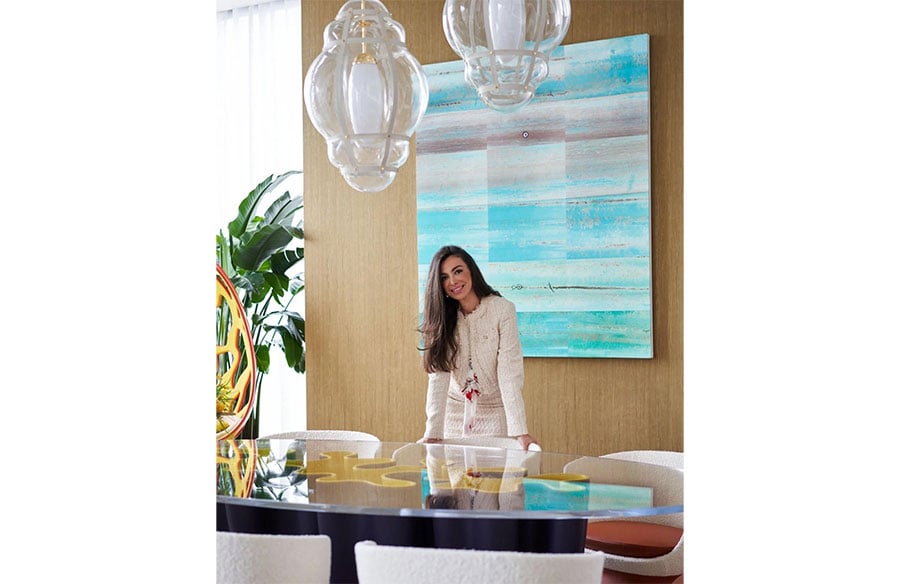
Rita Chraibi’s interiors bring together architectural composition, bespoke furniture and the decorative traditions of French art de vivre. Across residences in New York, Miami Beach and Greenwich, her work explores how these elements can form a coherent setting for domestic life.
The interiors convey the richness of the materials and furnishings. Assessing the practice also means considering the decisions behind them: how an interior responds to its building, how individual pieces relate to the wider composition, and how creative direction carries through to execution. These relationships offer a useful way to understand Chraibi’s work and what prospective clients can expect from her studio.
Background and Practice
Rita Chraibi is a French interior designer and the founder and creative director of International Designers. Established in 2013, the practice operates from Paris, New York, Greenwich and Miami.
Her education at the École Camondo in Paris provides a foundation for an approach attentive to volume, light, sequence and proportion. These concerns inform the arrangement of rooms as well as the selection of furniture and finishes, giving the interiors a spatial framework within which decorative decisions develop.
Creative direction across four studios
Chraibi personally directs the creative work of each commission. This continuity is central to the practice’s model, connecting its international presence with an individual design sensibility.
For prospective clients, the relevant consideration is how that involvement takes shape throughout a project, from the initial concept to the review of materials, furnishings and bespoke details.
The Method: Composing the Interior
Responding to the building
The practice’s approach begins with the existing architecture: its history, scale, light and spatial character. These conditions establish the basis for an artistic direction specific to each residence.
This relationship becomes particularly important in buildings with a strong architectural identity. An interior must accommodate the client’s preferences while responding to the proportions, views and circulation it inherits. Chraibi’s projects offer different settings in which to examine that balance.
Proportion, light and materials
Chraibi’s design vocabulary combines classical references with contemporary forms. Perspectives, volumes and material relationships establish the composition, while furniture, art and decorative elements give individual rooms their character.
French art de vivre provides a recurring reference. In this context, the term encompasses an attention to comfort, craftsmanship and the experience of inhabiting a room. Its value depends on how those priorities translate into practical decisions about scale, arrangement and use.
Maison Royale and bespoke design
Chraibi also founded Maison Royale, a Paris atelier producing bespoke furniture, joinery, architectural elements and decorative pieces with European artisans.
The atelier allows individual components to be developed in relation to a particular interior. A piece’s dimensions, finish and detailing can be considered alongside the room’s proportions and surrounding materials, extending the design process from the overall composition to the objects within it.
For clients, the significance lies in the relationship between design and fabrication: how an idea is translated into a finished piece, and how closely that piece serves its intended setting.
Selected Projects
Several commissions illustrate how the practice’s approach operates across different architectural contexts.
Residence 42, 111 West 57th Street, New York
Residence 42 at 111 West 57th Street, also known as Steinway Tower, is among Chraibi’s most widely publicised projects. Developed in collaboration with Louis Vuitton and covered by WWD, it brings the studio’s residential work into dialogue with the fashion house’s design vocabulary.
The commission offers a useful lens through which to consider the relationship between collectible furnishings and an interior’s overall composition. The question is how successfully distinctive pieces contribute to the room’s scale, circulation and atmosphere.
Monad Terrace, Miami Beach
At Monad Terrace, designed by Jean Nouvel, Chraibi worked within a building with an established architectural identity. Her couture-inspired interiors, featured in Harper’s Bazaar Arabia, introduce another set of references into that setting.
The project raises a different compositional challenge: how furnishings, textures and decorative details relate to the building’s architecture and coastal surroundings. It is through these relationships that the interior’s contribution can be assessed.
Recognition and Editorial Coverage
Chraibi’s work has received recognition through the A’ Design Award and design et al’s awards programmes, with honours reported in 2023 and 2024.
Her interiors have also appeared in publications including AD PRO, ELLE Decor, Forbes, WWD, Harper’s Bazaar, Robb Report, The Wall Street Journal and Mansion Global. This coverage reflects visibility across design, fashion, business and property media.
Awards and publication history provide context for the practice’s reputation. A fuller assessment comes from examining the projects themselves, including their spatial decisions, detailing and response to the brief.
Strengths and Considerations
Continuity of design
One of the practice’s defining strengths is the continuity of its creative direction. Chraibi’s involvement establishes a consistent point of reference for decisions about space, materials, furniture, art and bespoke elements.
The potential benefit is a coherent interior in which individual choices contribute to a shared concept. Achieving that coherence also depends on coordination with the wider project team and the quality of execution.
Integration of bespoke elements
Maison Royale gives the practice a means of developing pieces specifically for its commissions. This can be particularly valuable where standard dimensions or available finishes would compromise the intended composition.
The quality of bespoke work should nevertheless be assessed through completed examples, material samples and fabrication details. These reveal more about craftsmanship than the designation alone.
Design preferences and working relationships
Chraibi’s portfolio will appeal particularly to clients interested in expressive materials, crafted details and interiors informed by French decorative traditions.
As with any practice with a distinct creative direction, compatibility matters. Prospective clients should discuss how their preferences, existing possessions and everyday routines will inform the proposal, alongside the studio’s own references.
Scope and delivery
International Designers provides interior design, conceptual interior design and creative direction. Where a commission requires regulated professional services, these are undertaken by appropriately licensed local professionals.
Clients should establish how responsibilities are allocated across the project team, including technical documentation, approvals, procurement and site coordination. The extent of Chraibi’s involvement, the decision-making process and the delivery programme should also be agreed at the outset.
Questions to Ask Before Commissioning
Four questions can help prospective clients evaluate International Designers or a comparable practice:
- How will the principal designer be involved? Clarify who develops the concept, reviews key decisions and remains the main point of creative responsibility.
- How are bespoke pieces designed and produced? Ask about makers, materials, samples, lead times and approval procedures.
- How is responsibility shared across the project team? Establish who handles design, technical services, approvals, procurement and construction coordination.
- How does the design process unfold? Understand when decisions about layout, lighting, materials and furnishings are made, and how the client participates.
Commissioning the Studio
Rita Chraibi’s practice is distinguished by the relationship it establishes between architectural space, furnishings and bespoke production. Her portfolio presents a consistent interest in proportion, material richness and craftsmanship across a range of residential settings. For prospective clients, the strongest reason to consider the studio is the opportunity to develop an interior under sustained creative direction, with individual elements conceived as part of a larger composition.
International Designers works with private clients on residential projects internationally. Rita Chraibi leads conceptual interior design and creative direction, bringing together spatial composition, materials, furniture, art and bespoke design.
Private consultations may be requested through the studios in New York, Greenwich, Miami and Paris, or through intdesigners.com.
New York: +1 (646) 793 9492
Greenwich: +1 (475) 500 2530
Miami: +1 (786) 763 0100
Paris: +33 1 40 07 80 30
Professional services notice: International Designers provides interior design, conceptual interior design and creative direction services. Architectural, engineering, permitting, construction documentation, code compliance and other regulated professional services, where required, are provided by appropriately licensed local professionals within their respective professional scopes.