The roof of the Steve Jobs Theatre in California rests on nothing but glass. No columns hold it up. The roof is of carbon fibre, and keeping it light has allowed the glass walls to carry it.
That roof is the clearest picture of how composite materials are changing architectural design. A composite combines strong fibres, usually glass or carbon, with a resin that binds them. Because designers can choose where the fibres go, they can put strength where a building needs it and leave weight out everywhere else.
The result is lighter roofs, freer shapes and some buildings that could not be made any other way. Composites also have real limits, and those matter just as much.
1. What Is a Composite Material, in Plain Terms?
A composite material combines two or more materials so that together they perform better than either would alone. In architecture, the word usually means fibre-reinforced polymer (FRP). Thin fibres carry the load, and a resin holds them in place.
The idea is old. Builders have mixed straw into mud bricks for thousands of years so the bricks crack less. In a modern composite, the fibres do the straw’s job, and the resin works like glue.
Three fibre types turn up most often.
- Glass fibre reinforced polymer (GFRP): The most widely used and most affordable, common in cladding and moulded panels.
- Carbon fibre reinforced polymer (CFRP): Stiffer and stronger for its weight but more expensive, so it is saved for places where weight matters most.
- Aramid fibre. Best known as Kevlar, it is tough and resists impact, though it is less common in buildings.
2. Why Does Fibre Direction Matter to a Designer?
A composite is strongest in the direction its fibres run. That lets a designer decide where a structure is strong, instead of accepting the same strength everywhere.
Timber works the same way. A plank is hard to snap along the grain but splits easily across it, because wood is a natural composite of fibres, but in a softer material. Hence, engineers can set the angle of the fibres to suit the job.
| Fibre direction | What it resists | Think of |
| Along the length (0°) | Bending | A fishing rod flexing under a catch |
| Diagonal (±45°) | Twisting | Wringing out a towel |
| Wrapped around (90°) | Crushing or bursting | The hoops on a wooden barrel |
Many carbon fibre tubes are made by wrapping layers of resin-coated fibre around a steel rod, with each layer set at a chosen angle. Extra layers can go where a bracket will be fixed, and the tube can taper where it carries less load.
What this means for a building
When a canopy is fixed to a wall at one end only, its arm bends most near the wall and hardly at all at the tip. A composite arm can be thicker at the wall and slimmer towards the tip, using less material for the same job. The structure follows the forces, instead of a catalogue of standard steel sizes.
3. What Do Composites Make Possible in Real Buildings?
These projects show three different strengths.
Steve Jobs Theatre, California, USA (Foster + Partners)
- The idea. A round glass lobby with no columns.
- The composite. A CFRP roof made from 44 matching panels, lifted onto the glass in one piece.
- What it made possible. A roof more than 40 metres across, held up by the glass walls alone.
Elytra Filament Pavilion, V&A, London (University of Stuttgart)
- The idea. A garden canopy modelled on the hard wing cases of flying beetles.
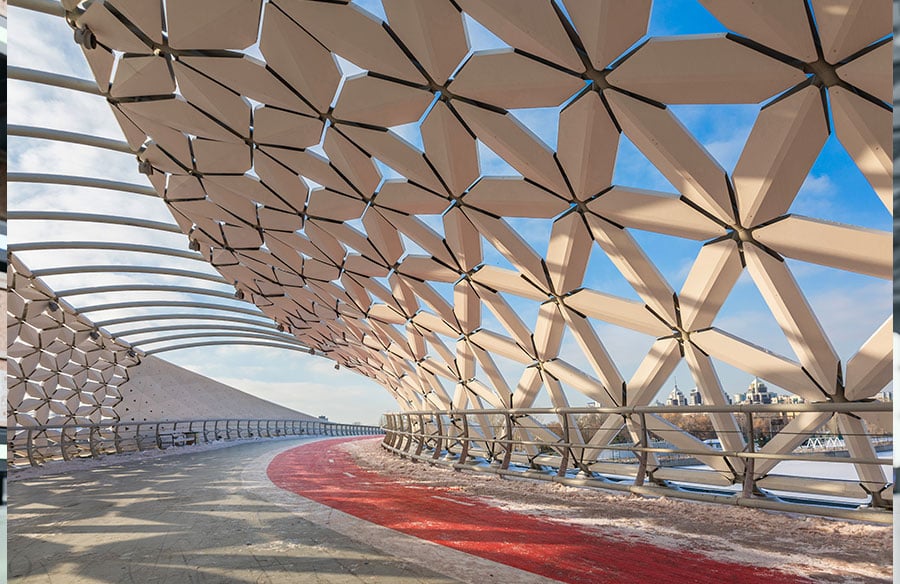
- The composite. Forty hexagonal cells, each wound by a robot from glass and carbon fibre threads. The glass formed a lattice, and the stiffer carbon was laid over it to carry the loads.
- What it made possible. A canopy covering about 200 square metres that weighed under 2.5 tonnes.
4. How Do Composites Change the Way Buildings Are Built?
Composite parts are usually made in a factory and arrive on site ready to fix.
- Lighter parts are easier to move and install: The Steve Jobs Theatre roof was assembled on site and craned onto its glass walls in a single lift.
- They do not rust: Composites suit wet and coastal settings, where steel needs regular protection.
- Moulds cost money, so repetition matters: Most composite parts are formed in a mould. A design that repeats one shape can reuse its mould, while unique shapes need a new one each time. The theatre roof used 44 matching panels. At SFMOMA, every panel had its own computer-cut foam mould.
5. Where Do Composites Fall Short?
Composites are not a straight swap for steel, concrete or timber. These limits most often stop or reshape a project.
- Fire. The resin in most composites is a plastic, and plastics burn. In England, Regulation 7(2) of the Building Regulations requires materials in the external walls of residential and certain other buildings with a storey 18 metres or more above ground to be non-combustible or of limited combustibility, classed A1 or A2-s1,d0. Most fibre-reinforced polymers cannot meet those classes. Even SFMOMA’s panels needed dedicated fire testing before they could be used above the fourth storey.
- Cost. Carbon fibre costs more than steel, and one-off moulds add to the bill.
- Connections. Drilling or bolting through fibres can weaken a part unless the fixings are planned from the start.
- Weathering and inspection. Sunlight can degrade some resins over time, and damage inside a part is not always visible from the surface.
A promising material is not the same as an approved building product. Fire testing and specialist advice belong at the start of a composite project.
6. Are Composites Sustainable, and What Comes Next?
Sometimes. It depends on the material, how long the part lasts and what happens to it afterwards.
In their favour, lighter structures need less support, and parts that do not rust can last a long time with little upkeep.
Against that, carbon fibre takes a lot of energy to produce, and most composites use thermoset resins. A thermoset sets permanently, like a boiled egg, so it cannot be melted down and reshaped. There is still no fully satisfactory way to recycle it, and much of it ends up landfilled, ground into filler or burned in cement kilns.
Three developments could change that.
- Recyclable resins that soften again when heated, so fibres can be recovered and reused.
- Plant fibres such as flax, tested as a lower-impact option for lighter-duty parts.
- Robots placing fibres. Stuttgart’s later BUGA Fibre Pavilion in Germany laid glass and carbon fibre only where needed. Its 23-metre structure is around five times lighter than a steel equivalent.
When Are Composites the Right Choice?
Composites make the most sense where shape, span, weight or corrosion is the hardest problem on a project. They are rarely the answer for a whole building.
Used well, they give architects another option alongside steel, concrete and timber, and a new question to ask early in a design. The future question is less “composite or steel?” and more “where should the fibres go?”