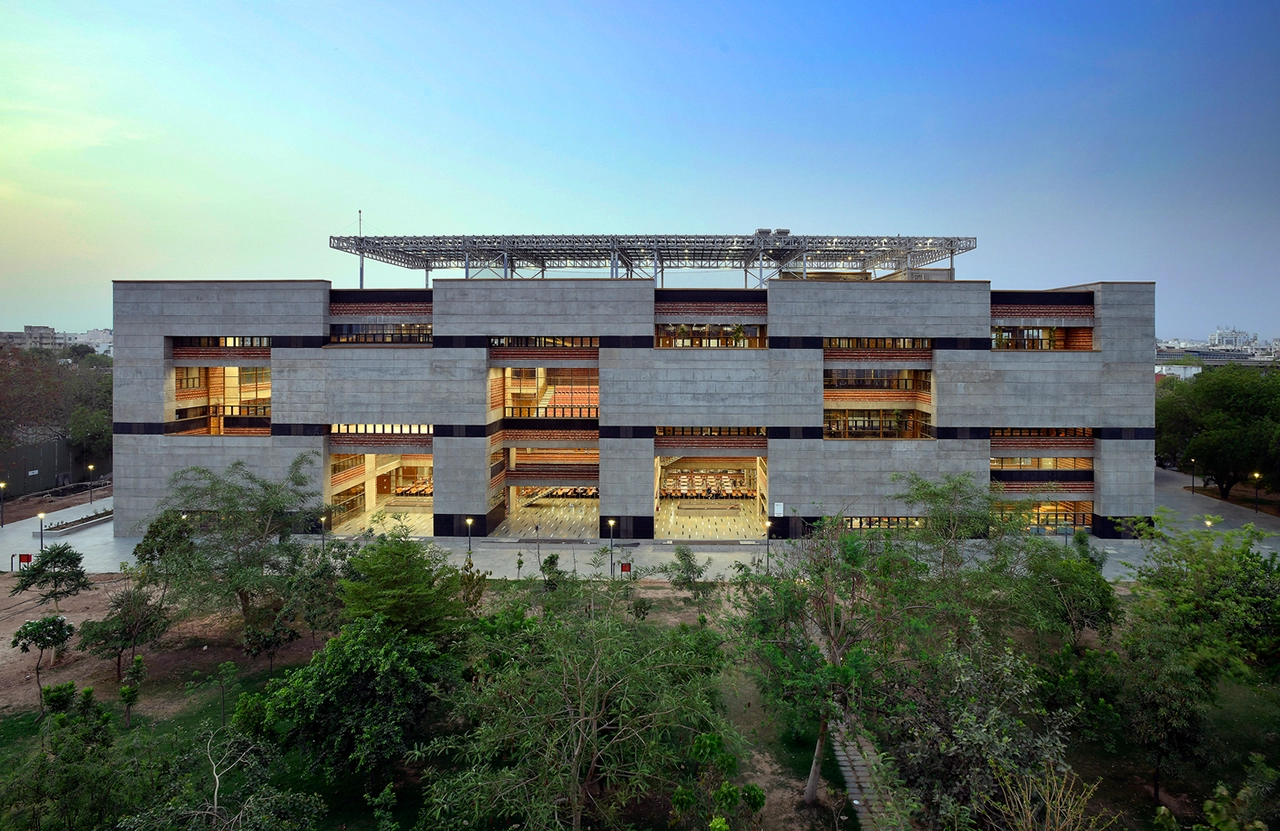
The Ahmedabad University is one of the finest examples of modern architecture in India, with a direct legacy from the modern masters, like Louis Kahn and Le Corbusier, who worked in close vicinity here. They passed down their teachings to prominent Indian architects like Anant Raje, B.V.Doshi, and Charles Correa, who reflected these ideals in their projects, which they executed in the city. The Ahmedabad University, which consists of various different campuses for different disciplines, was shaped and designed by various architectural firms across the country. The principal architects of these firms are either contemporaries or students of these prominent Indian architects, and hence thoroughly reflect the principles of modernism in their designs for the university. This article shall try to deeply discuss each campus from an architectural standpoint and decode the architect’s ideas and philosophy behind their designs.
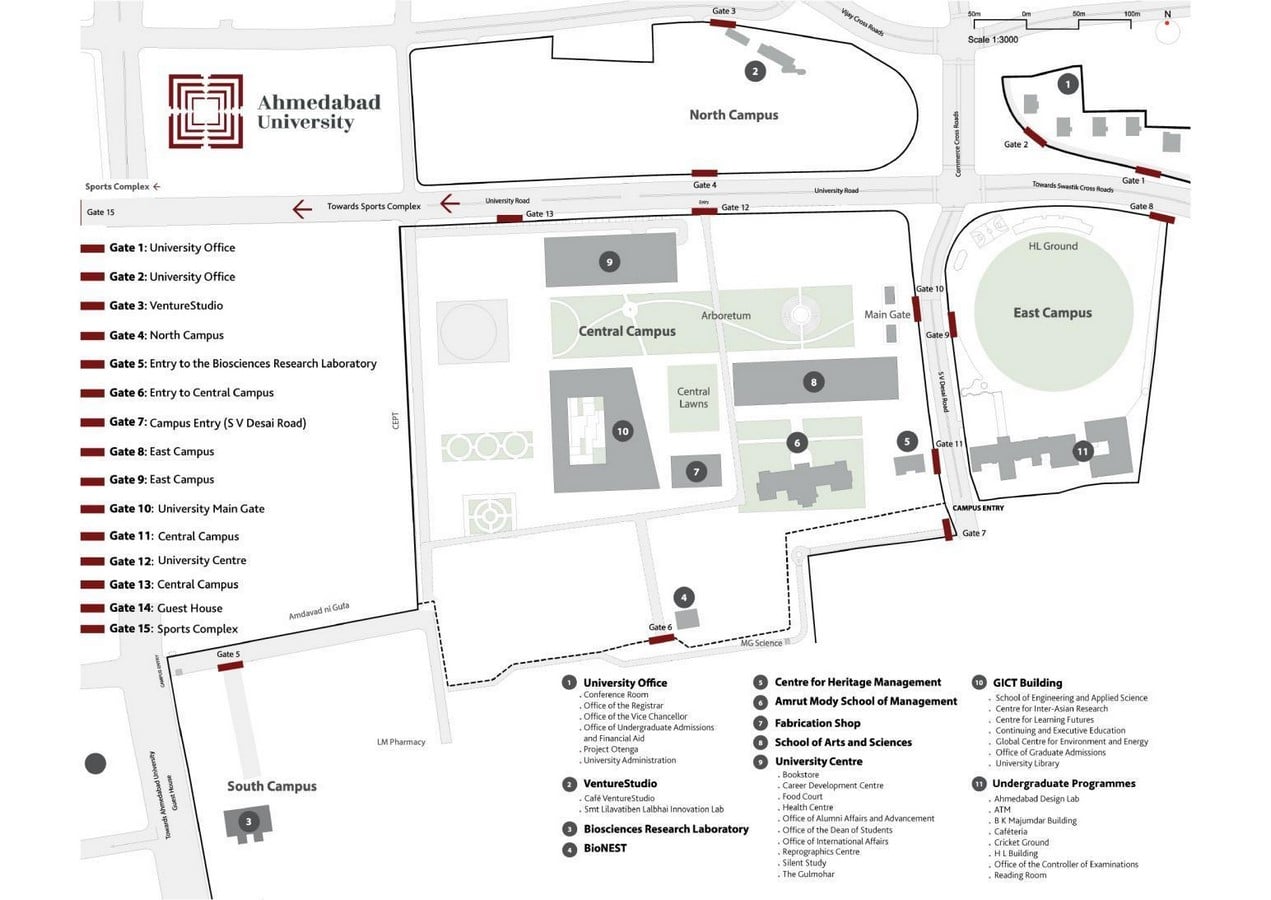
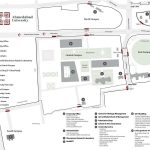
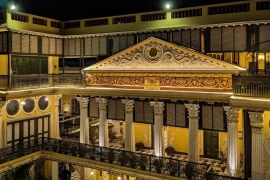
Let’s first understand the campuses present within the Ahmedabad University. Refer to the image with the campus map of the university. One would recognize 3 to 4 large buildings in the central campus. Firstly, we have the University Centre (UC), designed by architect Stephane Paumier of SPA Designs, based in New Delhi. Then, we have the School of Arts and Sciences (SAS), designed by architect Rahul Mehrotra, of RMA, based in Mumbai. Further, we have the Institute of Engineering and Technology (IET), designed by Vir.Mueller architects, based in New Delhi. This is also called the Global Centre for Environment and Energy (GICT). We also have the Amrut Mody School of Management (AMSOM), which was originally designed by Atmaram Gajjar in a truly Art Deco style but was later restored by architect Rahul Mehrotra. There are many more buildings present in this university, but these would be the ones in focus in this article.
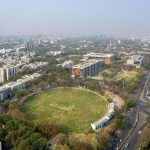
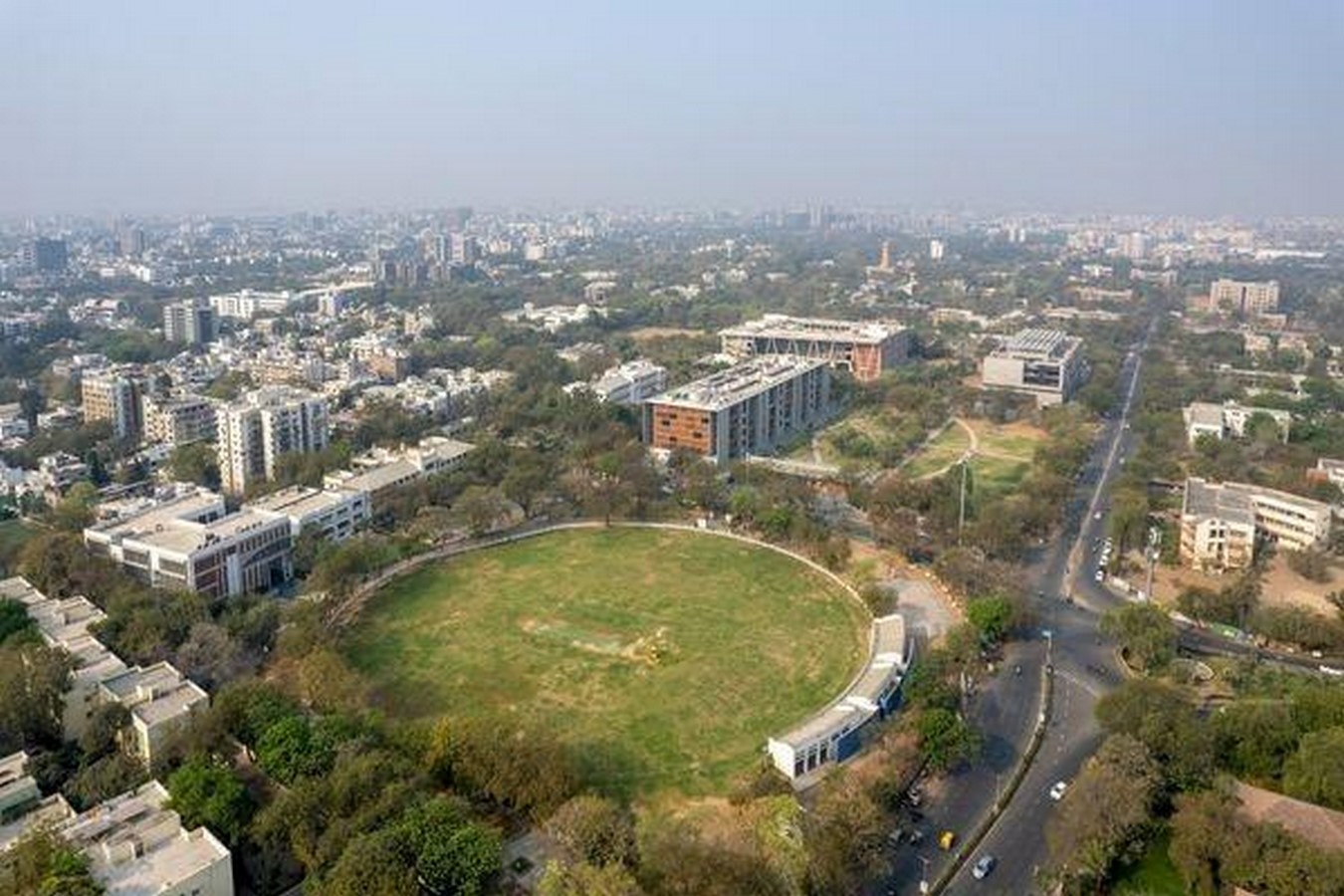
Together, these campuses are spread across a fairly tight piece of land, but this actually allows for the campuses to be in contact with each other, allowing the intermingling of students of various disciplines to meet, interact and collaborate. This, interdisciplinary interconnectedness, is what the Ahmedabad University and the clients behind it stood for, from the very beginning. And hence, credit must be given to those visionary leaders as well who thought of this over-arching philosophy, which was later followed in the designs of all campuses, individually as well.
The Ahmedabad University Centre (UC)
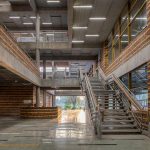
This structure is like the backbone of the student culture in the university. Very few universities have a special block dedicated to student activities and their personal development, apart from academics. Here, the block is especially designed as a student getaway, disconnected to some extent from their classrooms, where students can sit with themselves, or groups, or pursue extra-curricular activities, hold meetings and discussions and much more. It’s truly a student hub. It draws inspiration from the Galata Koprusu bridge in Istanbul, which features a string of restaurants and views of the Golden Horn; here, a ground-level ‘food street’ that mirrors the vibrant street food culture in Ahmedabad is created, which runs through the ground floor, opening out into the landscape regularly. The basements consist of parking facilities and also a sewage treatment plant which recycles grey water from the entire university, later supplying it for irrigation, in washrooms and in cooling towers.
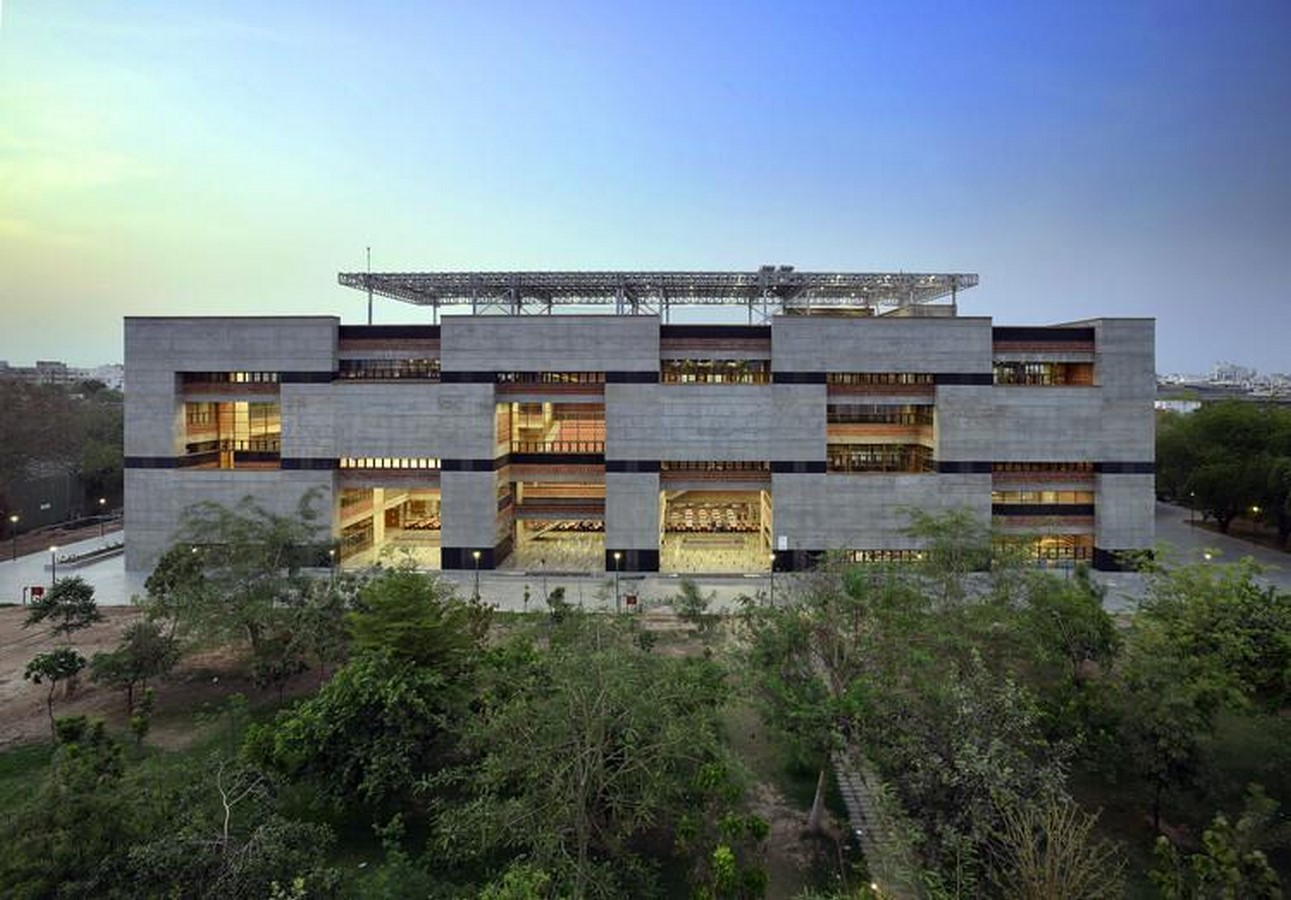
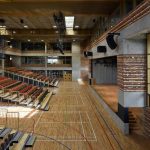
The first floor is an extension of the covered ‘street’ with multipurpose rooms and clubs/activity rooms, immediately accessible from the ground level. The large multipurpose hall on the second floor has a permanent stage for performance-oriented activities such as cinema, theatre, dance, conferences, and music. The seating comprises telescopic sliding bleachers that can be otherwise stacked vertically on the wall, so that the space opens up for various indoor sports like basketball, table-tennis, badminton etcetra. Even the verandahs opening into the landscape on the ground floor were imagined as small open air amphitheatres which could be used for impromptu performances or gatherings.
This flexible, multiple-use of spaces was promoted in design, allowing users to come up with their own interpretations of the spaces. This helps in developing a bond between the users and the architecture, since they start to view spaces as their own. This also promotes an informal behaviour, which is necessary to some extent in a student hub of this nature.
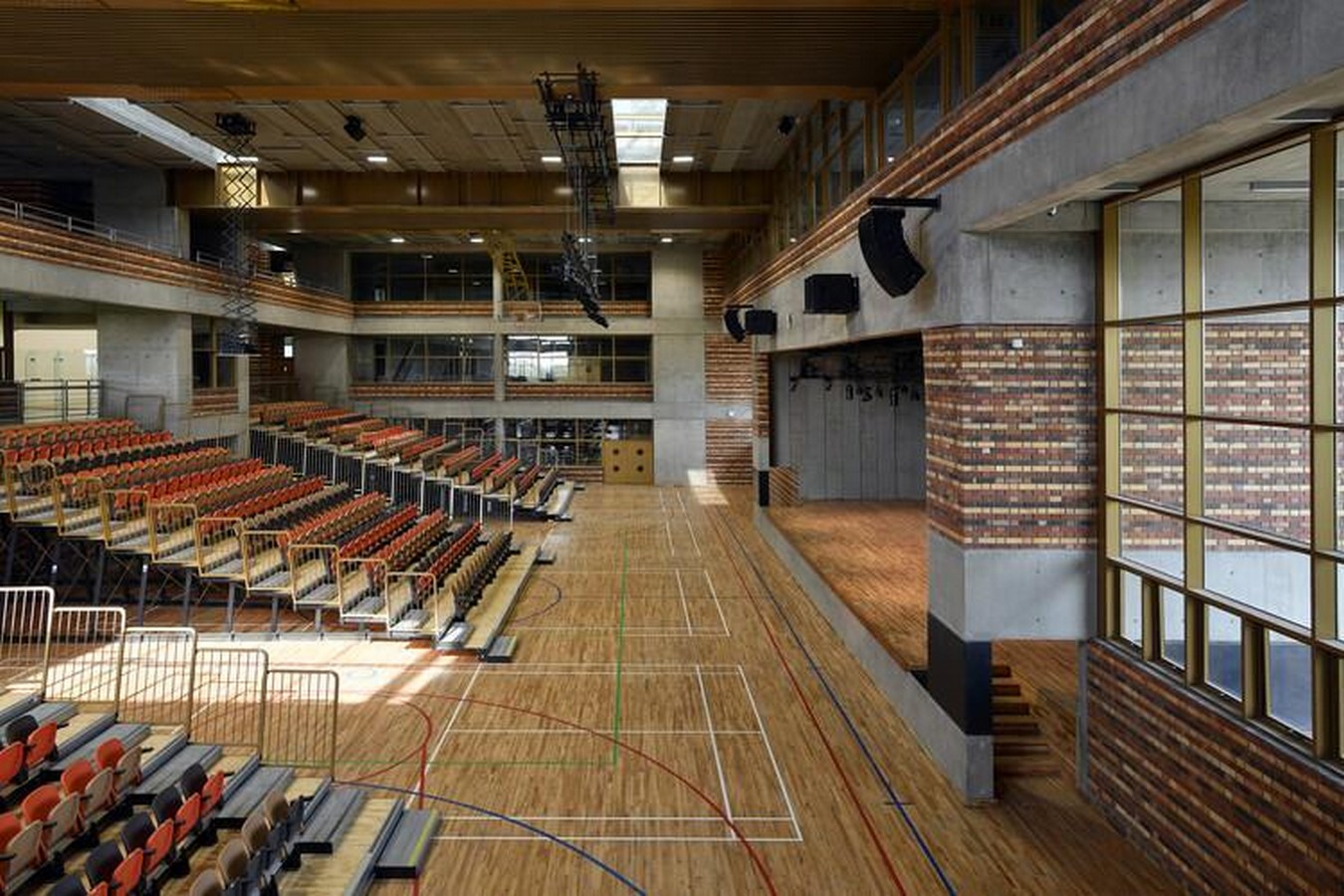
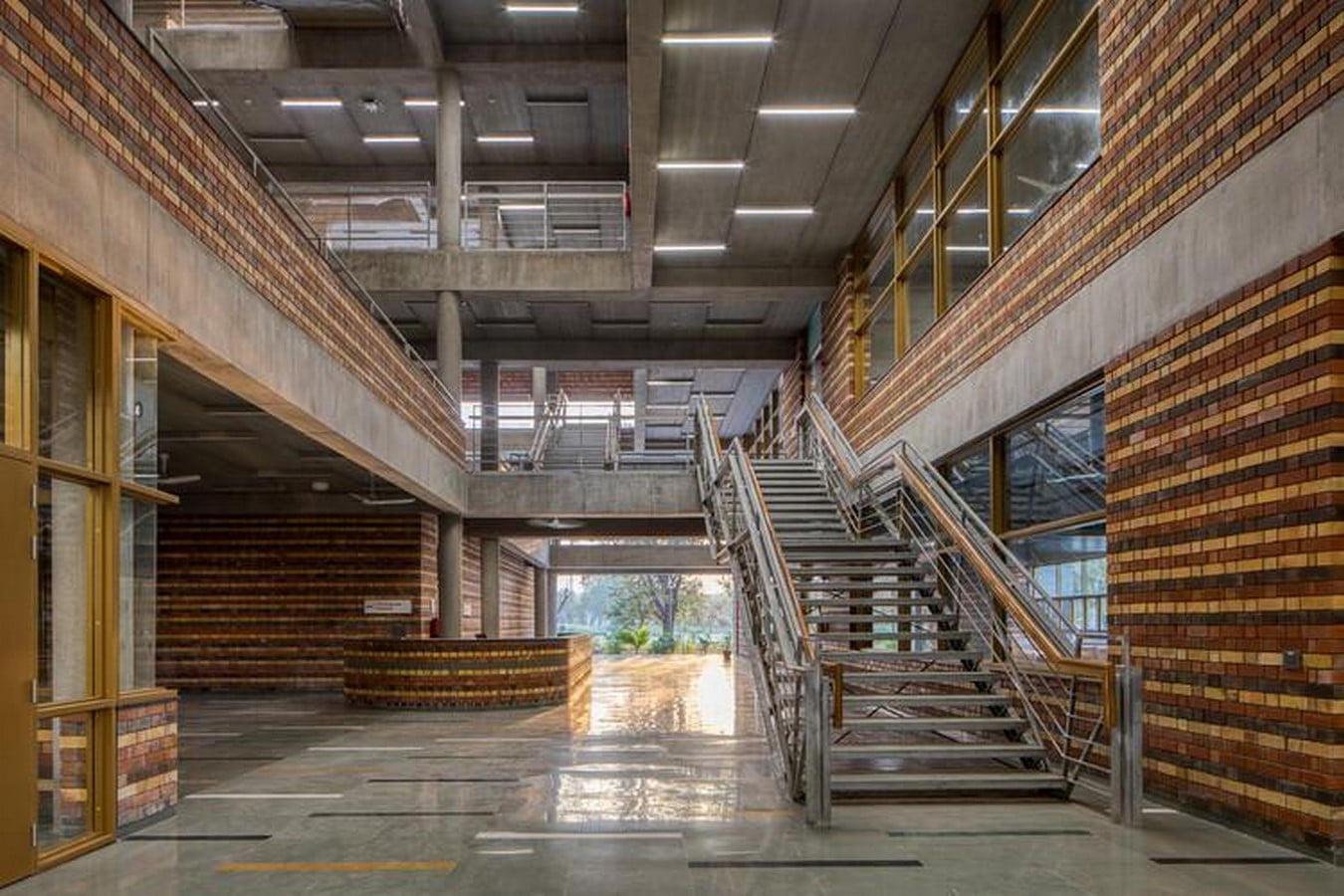
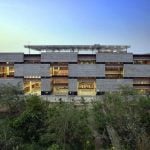
This building is also LEED Platinum certified in Energy Efficiency and sustainability. As mentioned earlier it is able to recycle and reuse its own water. Apart from this the solar panels above the rooftop futsal court also generate enough energy to power the university block through clean solar energy. The recessed openings due to the staggered arrangement of volumes in the built mass create and maintain a cool environment inside the building, inspite of the harsh summer temperatures in Ahmedabad. A lot of natural light is also filtered into the building through skylights illuminating within without heating the interiors much during day time. This reduces the need to use artificial lights and air-conditioning systems for such a large build mass, catering to so many users.
Further, an innovation worth mentioning is the use of precast hollow core slabs in the built mass. This is one of the first times that precast concrete construction technology has been used for a large-scale institutional building in Ahmedabad. This was done to reduce the steel needed as reinforcement within the structure. In these precasted slabs, only thin cables of diameter 12.7mm have been used, decreasing the steel usage by almost 20% as compared to a regular reinforced slab of this scale. Also this gave excellent exposed concrete finish which was left as it is in the final structure.
The School of Arts and Sciences (SAS)
Like the University Centre, the building of the School of Arts and Sciences also has a large rectangular footprint. But the architecture here focuses on freeing the ground as much as possible with organically shaped columns and seating platforms along this floor, smoothing the transition from outside to inside.
The flow of nature and natural elements also remains quite unbroken as one enters the building at the ground level. There is no hierarchical entrance or an order of circulation as the architects aimed to create a liberal space where the users could find their own paths through the institute, thus developing a greater connection of the users with the structure.
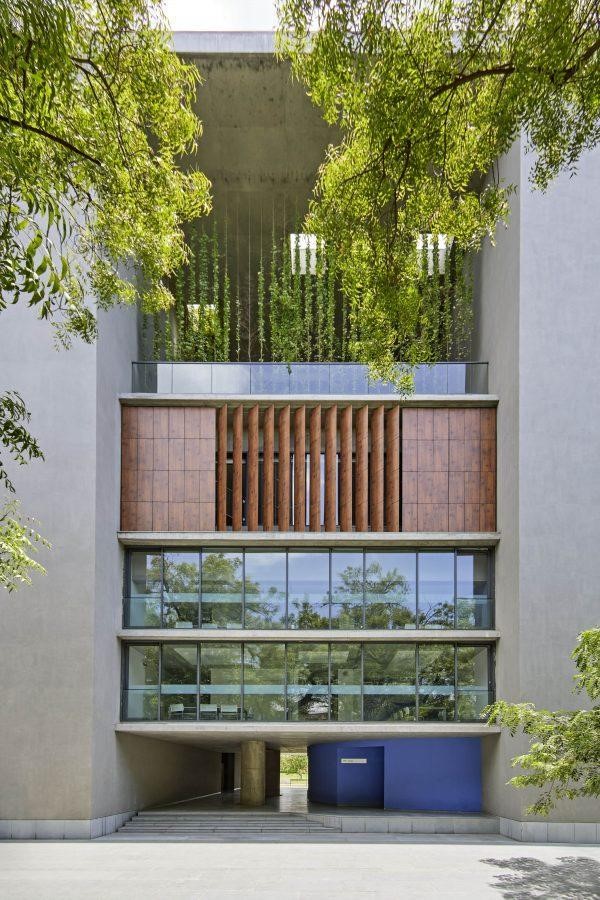
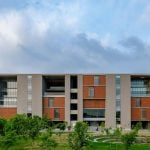
The logic behind the planning of the building programs has been kept very simple. All the services in the building have been stacked into vertical shafts occuring at regular intervals across the long horizontal axis of the building. These also become the load bearing structural units holding the large spans of concrete slabs between them efficiently. These services include, stairwells, lift shafts, service shafts for MEP and fire systems, washrooms and storerooms. This frees up the space on the rest of the floor area, wherein functions can be planned flexibly, without having to think much about the structural grid and hindrances caused due to services. The expression of these vertical service cores can also be seen on the facade of the building, while leaving the rest open for louvered openings and balconies as per the requirement of the spaces they serve.
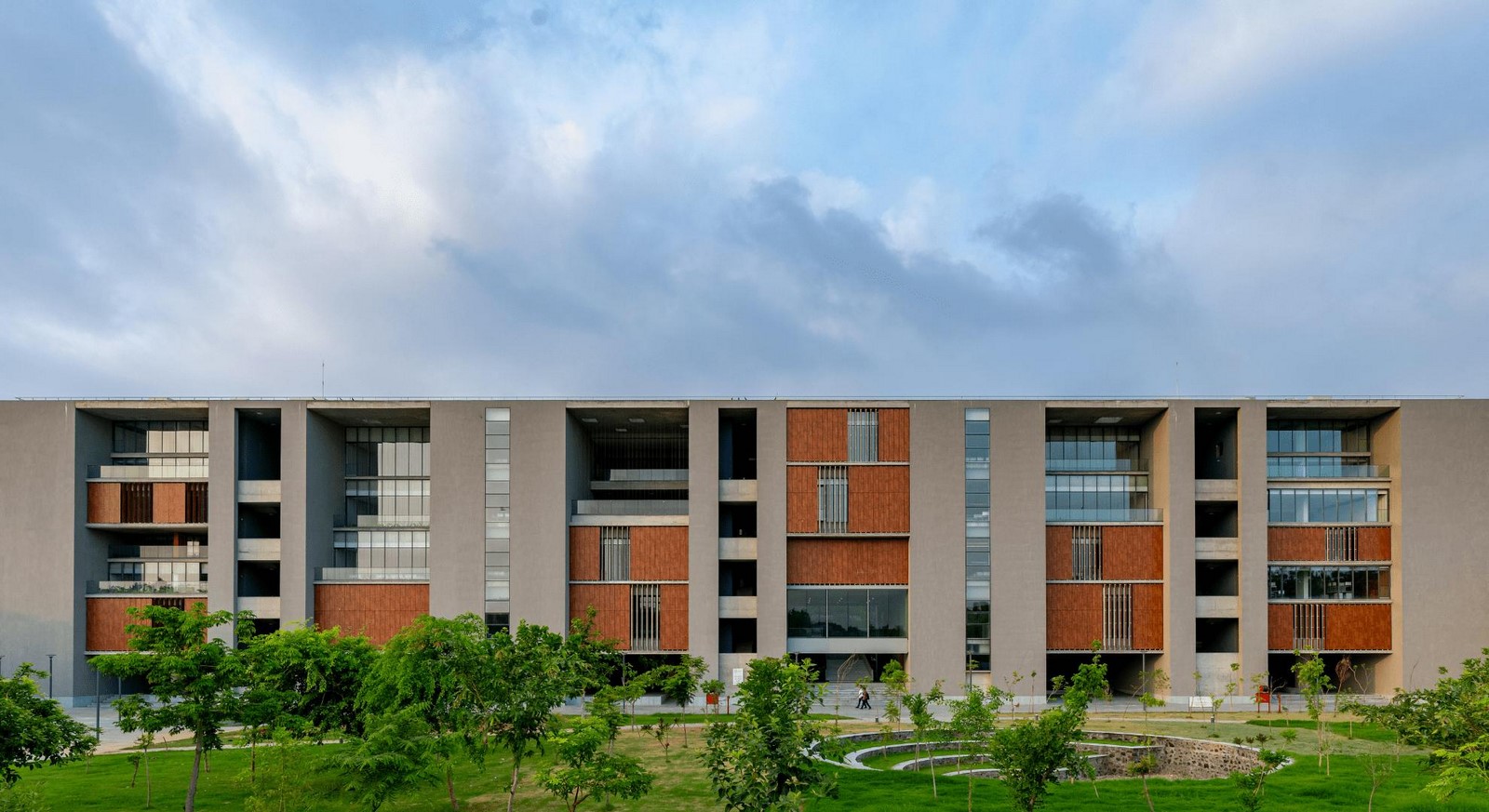
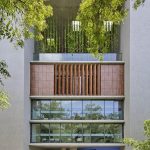
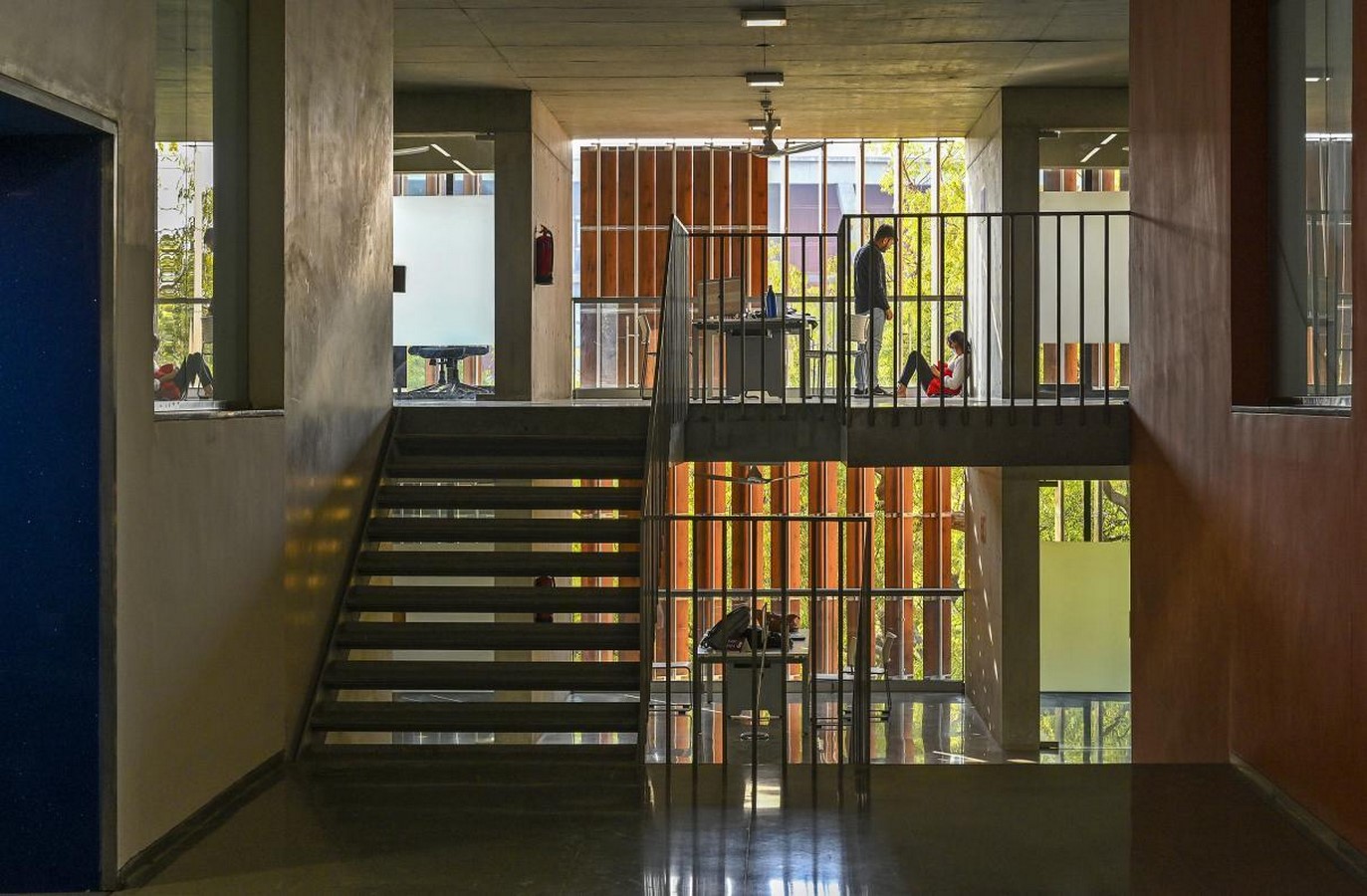
These operable louvred openings not only help in regulating the internal climate of the spaces but also provide a shifting quality of light throughout the day, while framing the greens outside. Some openings also have integrated planting areas, which allow vines to grow across the facade, utilising their evaporative cooling to maintain cool interiors. They also provide for a great contrast to the greys of the concrete and the browns of the wood, enhancing interest in the minimal facade. Another climate control measure used to good measure in this structure is the gradual recessing of the floor plates as one moves to the higher floors. The programmatic functions spread across the plan of these floors get less dense. This dedicates more space to the balconies with double heights, but this semi-open space provides a natural transition of temperatures between the cooler interiors and harsh outsides.
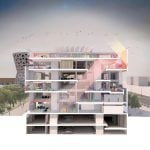
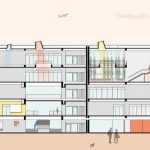
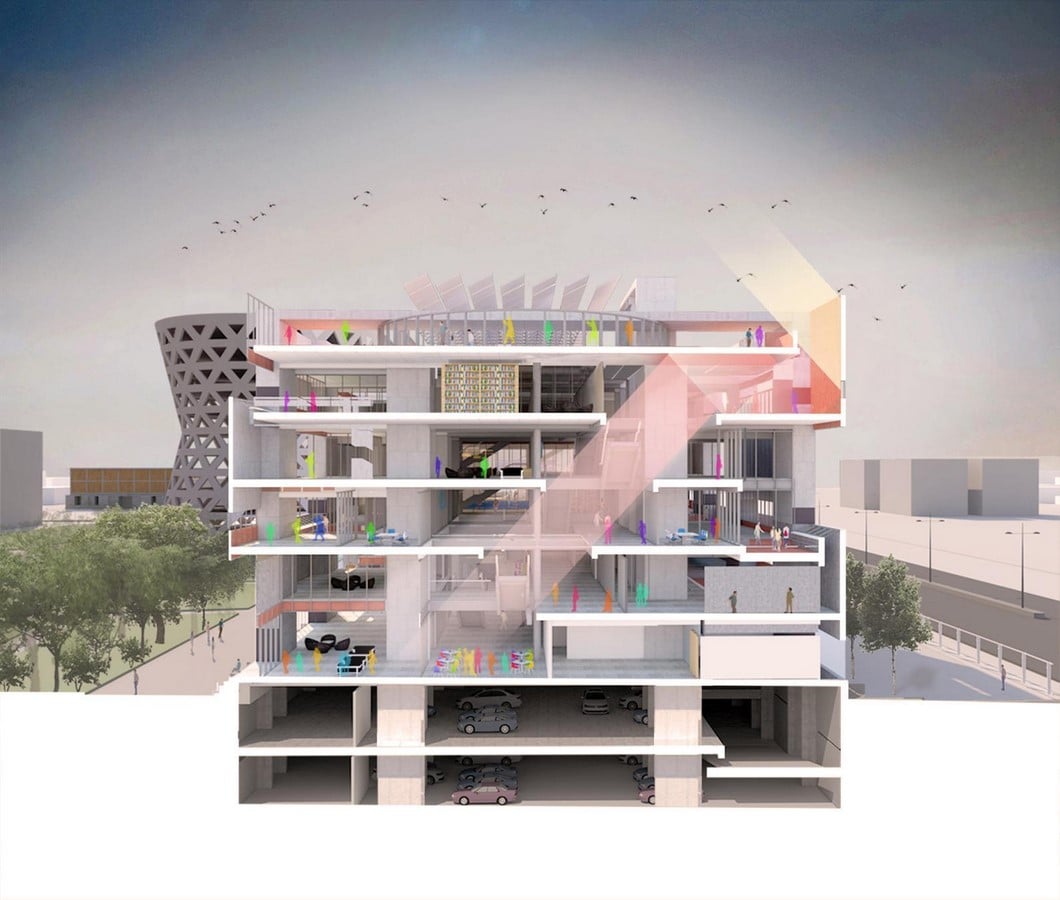
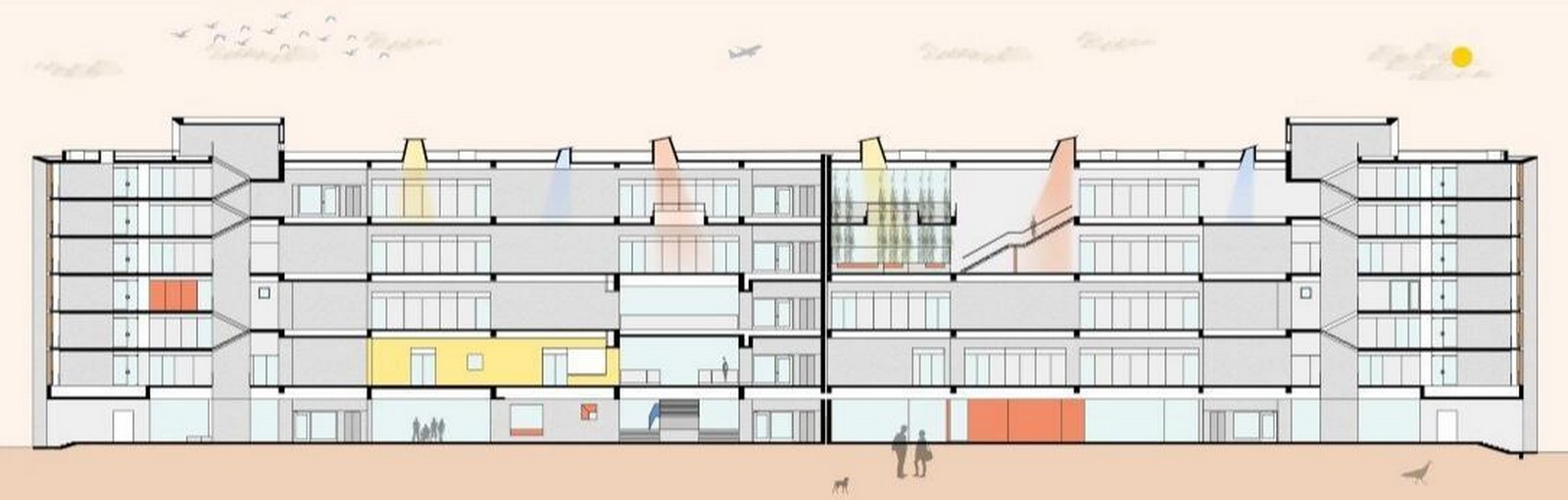
The sectional logic that stands out is how the central core areas have been used for classrooms and lecture halls requiring larger ceiling heights, while the ends, towards the east and west sides of the structure, have been utilised for faculty rooms and refreshment spaces for the users, which do not necessarily need larger ceiling heights. Hence, mezzanine levels have been created in these bays as seen in the section to efficiently use space. Also, there is a visual connection maintained between various levels across the institute, adding to the interconnected character.
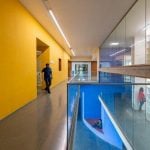
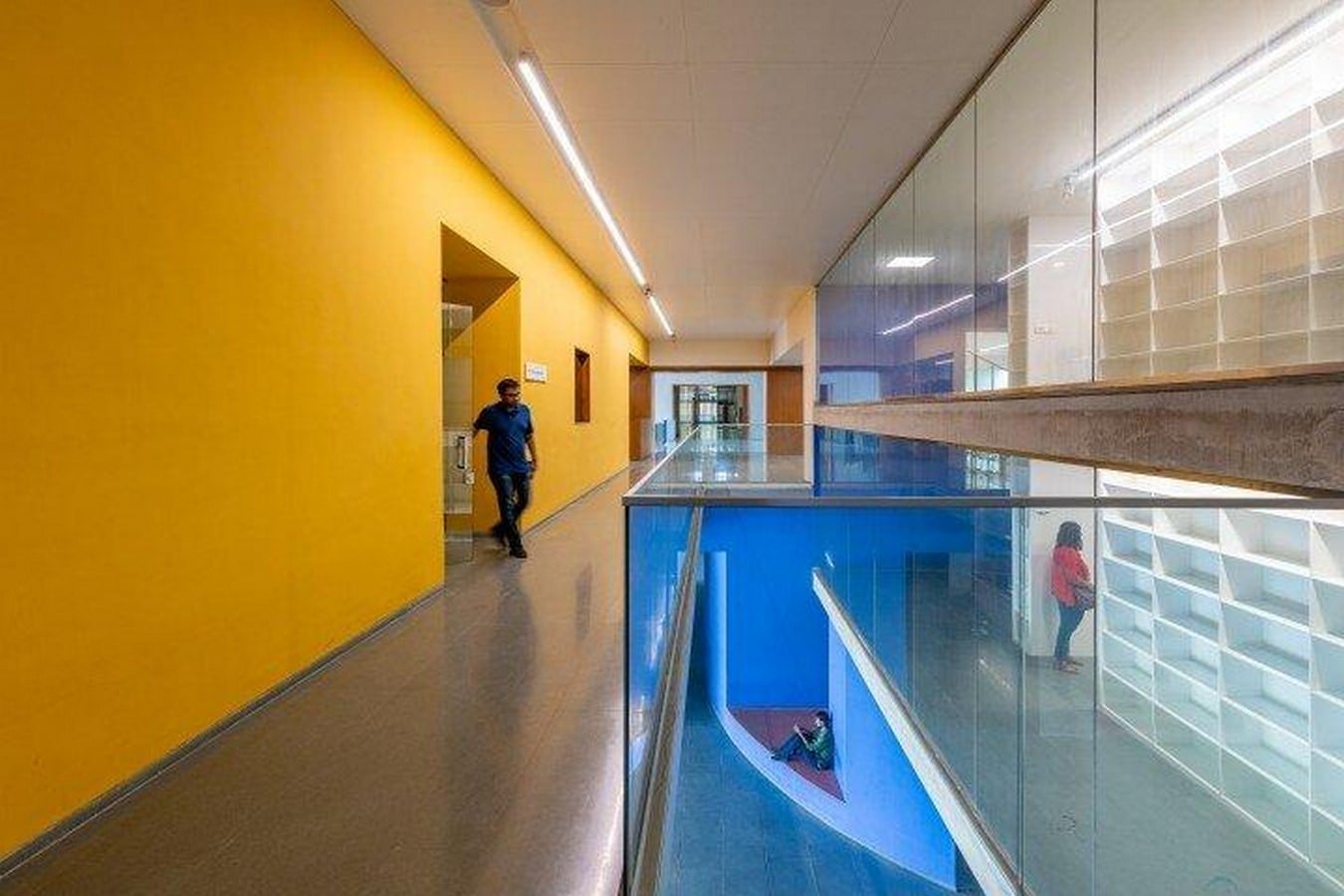
The combination of primary colours used for the interiors adds a playful nature to the space, suggesting and encouraging educational and democratic use. These have been executed very thematically, sometimes floor-wise, resulting in varying frames of colour and interest as one moves across the space. The colours have been used to highlight openings, skylights, certain walls framing views or important spaces. The use of the original greenish-grey Kota stones with red Kota stones in the flooring and plinths has also been done very intentionally. The red Kota stones symbolise gathering and seating spaces, acting as a cue to the public, while the greenish-grey stones have been used for all circulation spaces primarily. It gives us a strong insight into how colour plays a role in space-making and the curation of experiences.
The Institute of Engineering and Technology (IET/GICT)
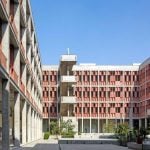
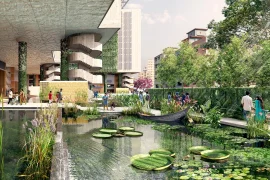
This institute, which is again almost a rectangle in plan, more like a quadrangle, is a great example of how educational architecture is not merely about accommodating the classrooms and the corridors, but rather about creating spaces which naturally foster learning and curiosity as an experience. It demonstrates how, by reinterpreting the courtyard typology and incorporating environmentally intelligent systems into the structure, the architecture can serve beyond just functional use.
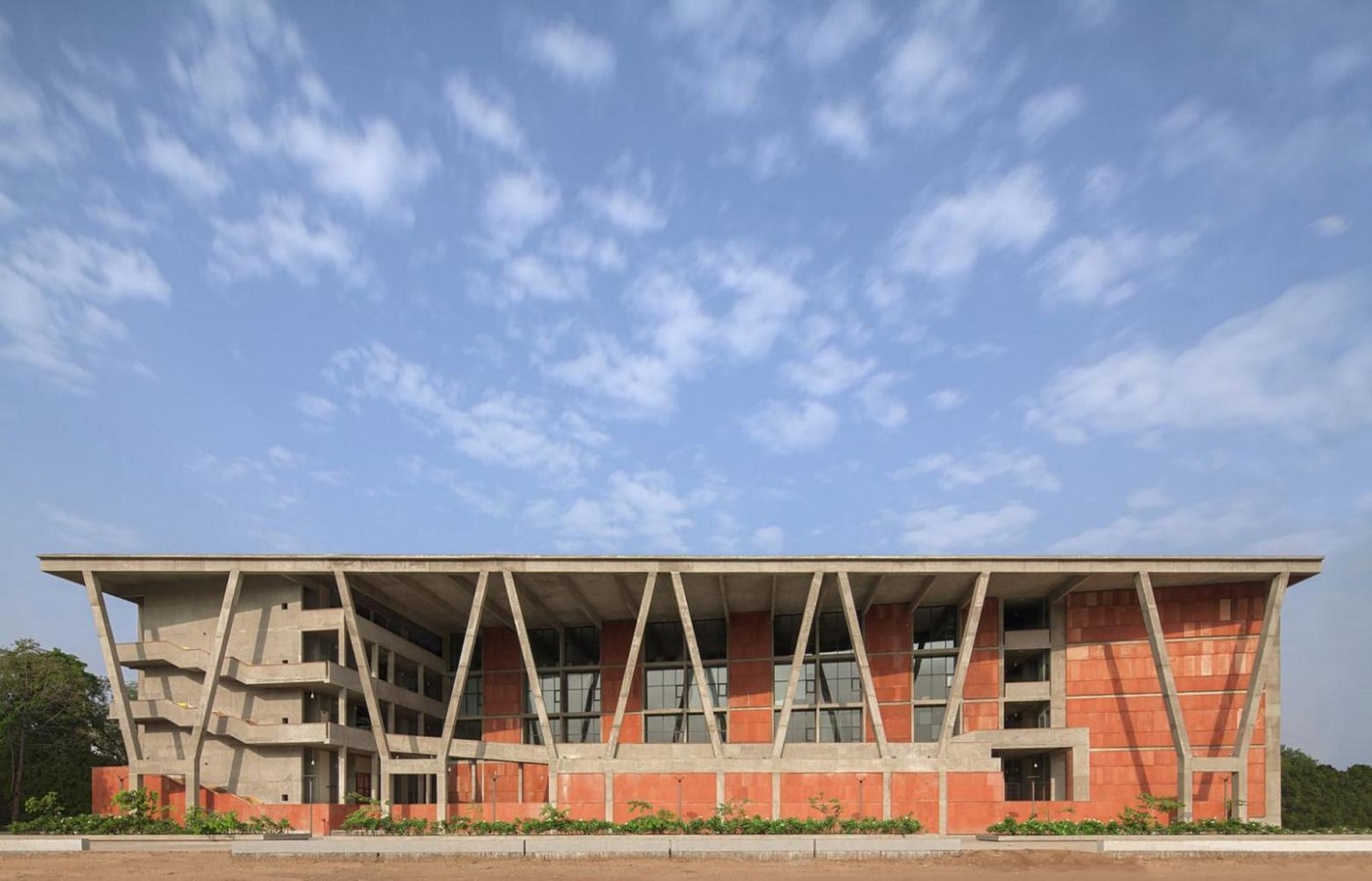
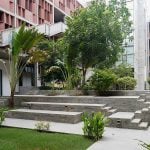
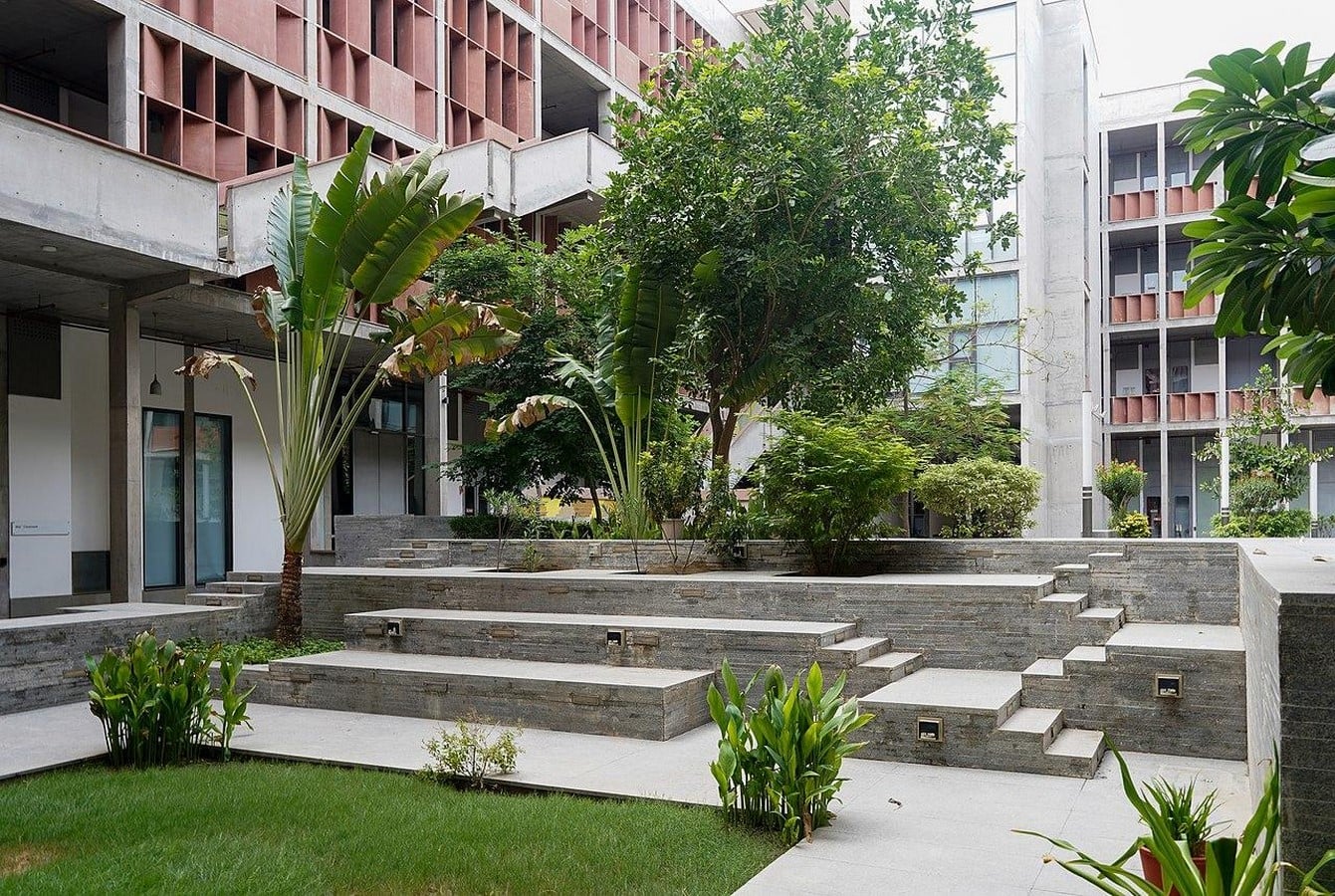
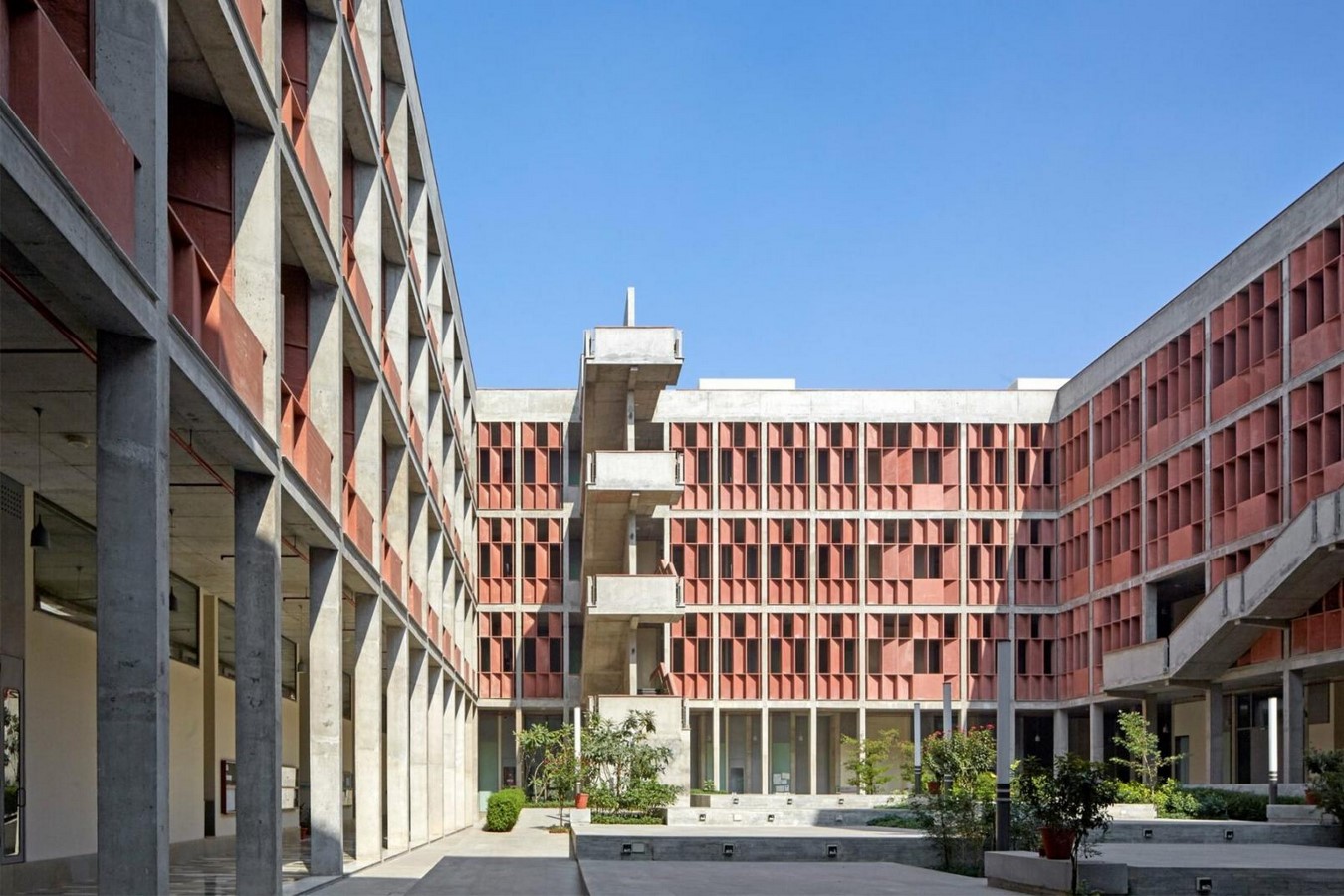
To explain the project, the built mass positions itself around a large central courtyard which is very carefully detailed and landscaped, with variations in levels, allowing for gatherings, seating and chance encounters. The surrounding corridors and galleries maintain a continuous visual connection to this central space, reinforcing a sense of collective belonging among students and faculty. As described by the architects, the building acts as a “cloister anchoring a community of scholars, many of whom are first-generation learners”.
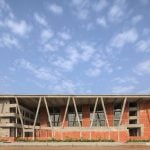
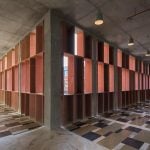
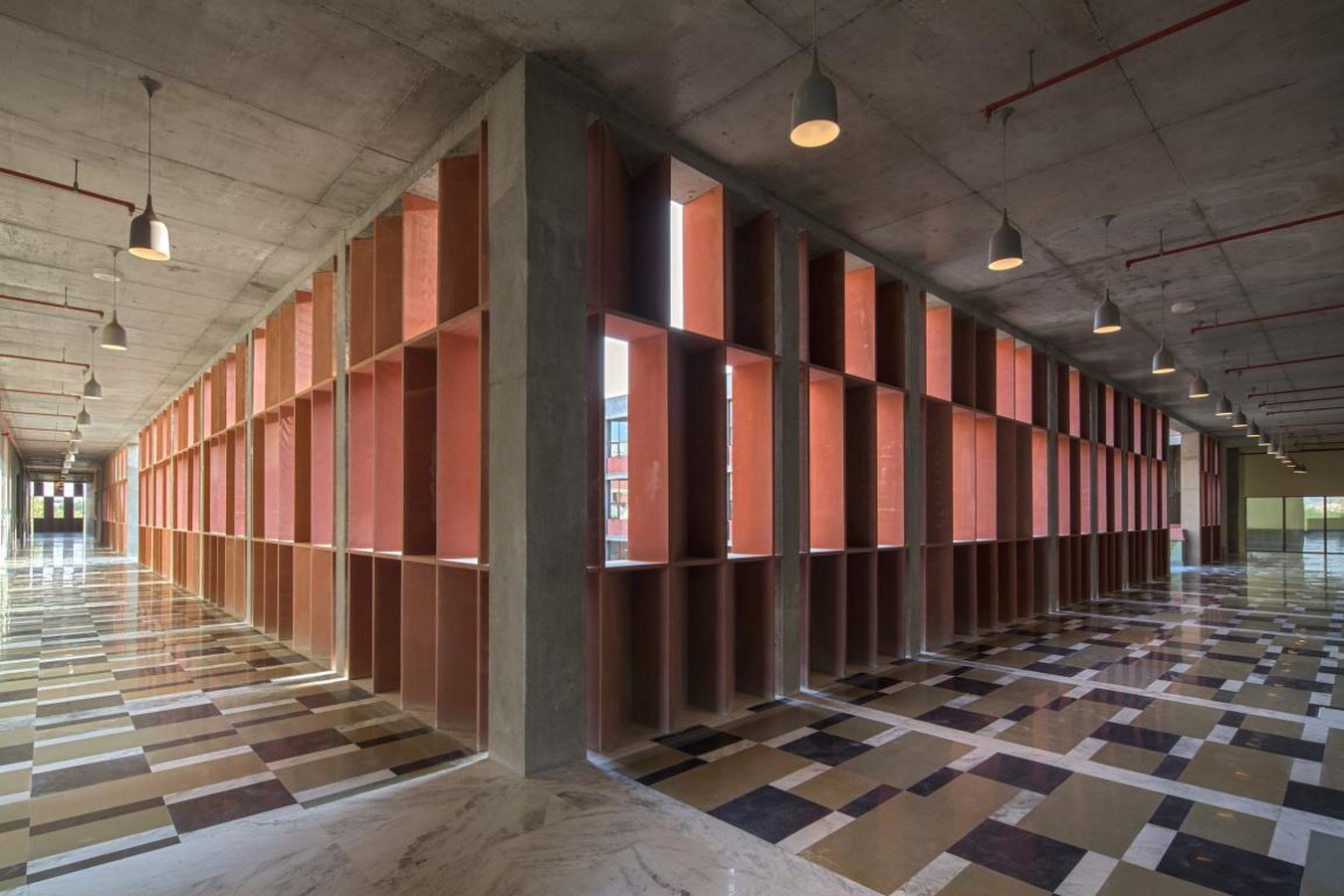
A standout feature of the architecture is the abundant usage of Red sandstone as a material with concrete. Not only does it visually create a harmonious blend, but climatically it has a lot of meaning behind its usage. The openings have been specially curated from this stone to resemble ‘jaalis’, creating a composition of big and small cut-outs at varying angles to the facade, casting shade on the surfaces and bringing in only diffused light. To maintain the abundance of natural light, these ‘jaalis’ are actually floor-to-ceiling height, maximising the number of openings as sources of light. This also provides a unique language to the institution, making the structure warm and inviting.
Another stand-out feature would be how the circulation spaces have been elevated to spatial experiences in motion. The staircases are made in such a way that they not only become sculptural pieces, but people traversing through them experience great views of the entire campus. This also increases social interconnectedness among the users through chance encounters. Even the corridors inside the built mass directly benefit from the sandstone screen ‘jaalis’ and add character and interest to circulation. On the ground floor, the circulation extends beyond the built form into a carefully crafted landscape strategy. The sunken garden of the central courtyard, also called the ‘kund’, is positioned as a thermal and social refuge. It creates a cooler microclimate within the campus. Additionally, the roof of the auditorium space is conceived as a usable terrace or “maidan”, further dissolving the distinction between built and unbuilt.
Thus, these elements transform everyday movement into a sequence of framed views, light conditions, and pauses. Benches along corridors encourage lingering, turning circulation spaces into informal learning or evolving zones rather than mere connectors. This supports our claim of how architecture can move beyond mere functional service.
Ahmedabad University, shaped by the vision of various architects and stakeholders, becomes a valuable case study for the upcoming generation of architects, looking for inspiration and ideas to tackle climate, context and build user-friendly spaces in innovative yet aesthetic ways. Although these structures have almost no common language amongst them, they are all built for the same end goal of user friendliness and interconnectedness . Also, they are all located in close vicinity to each other on a single plot of land, hence even their context and site conditions remain constant, but we get to see such varied responses to context, and one can’t say if one is right and one is wrong. One must understand that there are several possible iterations for a given program on a given site, all of which may be mostly suitable for the given conditions. But our job is to chase that ultimate iteration, according to ourselves, that would be perfectly appropriate, keeping everything in mind.
References:
- Ahmedabad Architects: Vir.Mueller architects, Archello. Available at: https://archello.com/project/ahmedabad-university (Accessed: 21March 2026).
- Dar, V.K. (2025). Ahmedabad University’s new Student Centre is designed to spur social interactions. [online] Architectural Digest India. Available at: https://www.architecturaldigest.in/story/ahmedabad-universitys-new-student-centre-is-designed-to-spur-social-interactions/ [Accessed 22 Mar. 2026].
- Anon, (2022). Art Deco on Ahmedabad University Campus. [online] Available at: https://ahduni.edu.in/stepwell/stepwell-newsletter/art-deco-on-ahmedabad-university-campus/ [Accessed 21 Mar. 2026].
- Ahmedabad University (2026) Global Centre for Environment and Energy. [Online] Available at: https://ahduni.edu.in (Accessed: 23 March 2026).
- Buildofy (2022). Architect Rahul Mehrotra designs this institute in Ahmedabad University (Home Tour). [online] YouTube. Available at: https://www.youtube.com/watch?v=t-eXMGpshlI [Accessed 21 March. 2026].