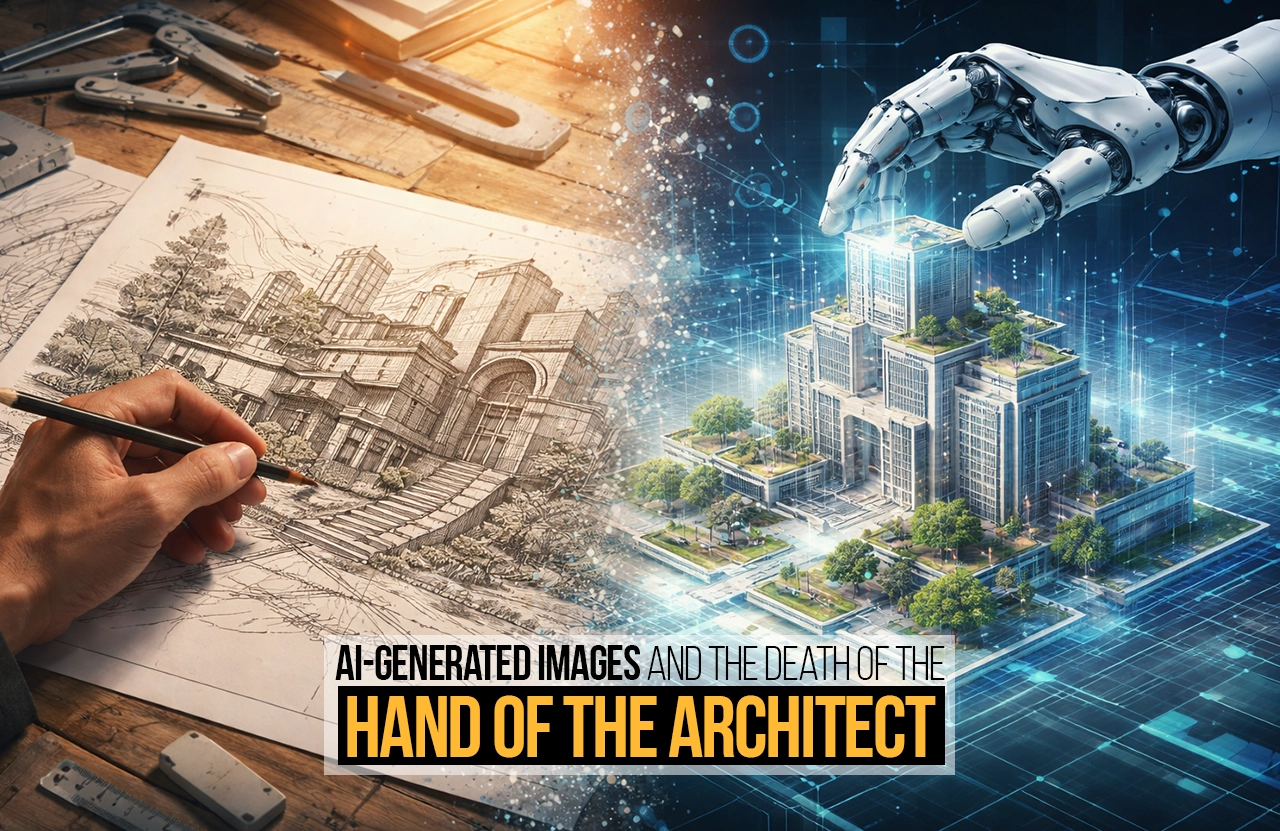
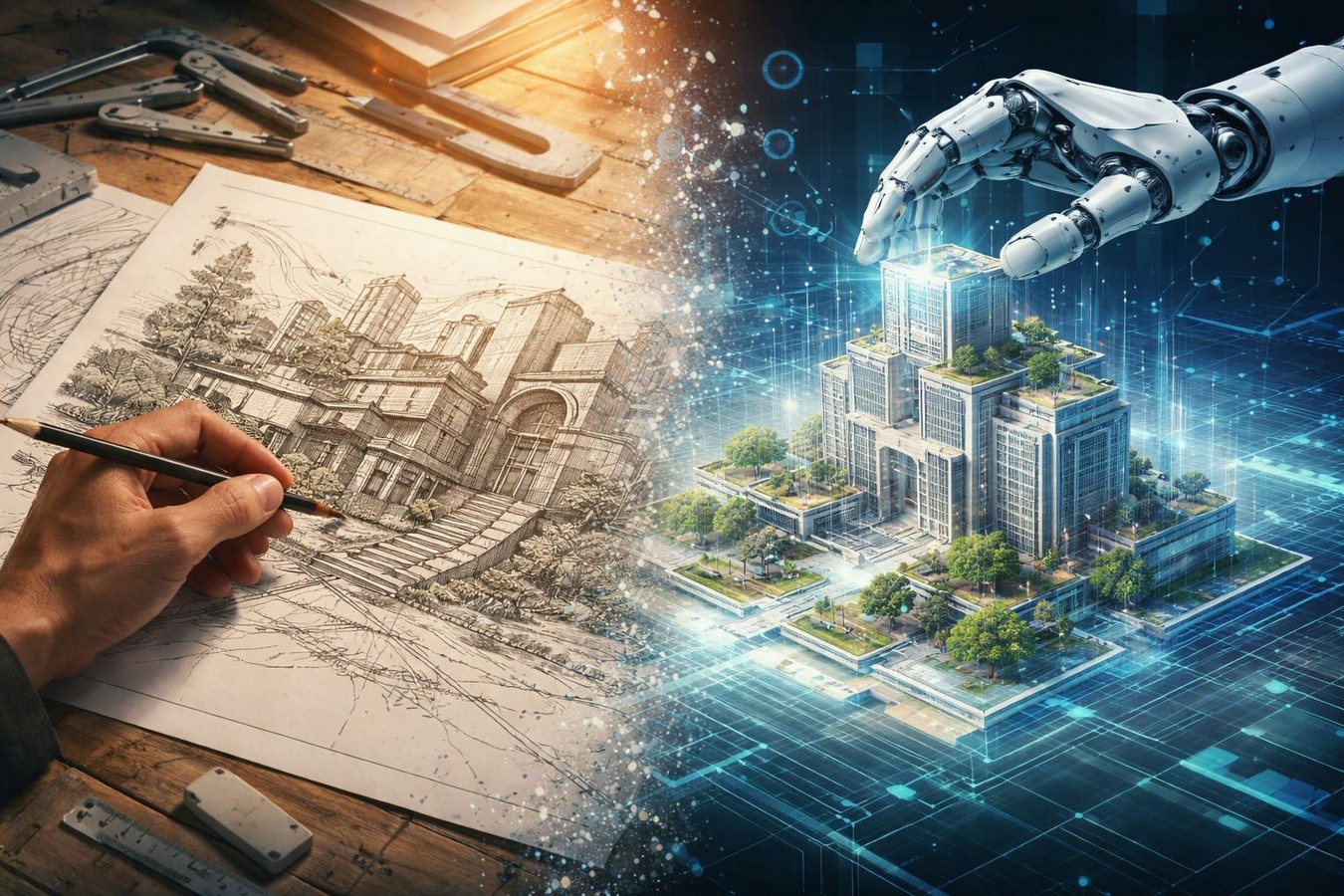
Something changed the moment AI-generated images stopped being a curiosity and became a deliverable. In studios around the world, architects initiate the first conceptual step – that vital, irreplaceable moment of spatial intuition – through a diffusion model and a text prompt. This influences procurement decisions, shapes client expectations, and increasingly forms the foundation on which buildings are designed, approved, and constructed. The question is not whether the architect’s hand is dying – it’s whether anyone in the profession has noticed it is already on life support.
What Guru Says
The debate surrounding AI in architecture remains divided and tense. At one extreme is Patrik Schumacher, principal of Zaha Hadid Architects, who has positioned himself as the most outspoken supporter of AI adoption in the profession. Schumacher argued that AI tools provide architects with a considerable boost in productivity and creativity. His studio has openly revealed the use of DALL-E 2 and Midjourney for early-stage ideation, with Schumacher claiming personal authorship over what AI produces on the basis that he validates, selects, and develops the output.
Others are less certain. Oliver Wainwright, architecture critic at The Guardian, has characterised AI image generation as superficial, pointing to its reliance on stylistic pattern-matching rather than spatial reasoning. The anxiety within schools of architecture runs deeper still: if the hand-drawn sketch was once the site where architectural ideas were formed – tested, failed, revised – what happens to that generative struggle when the image arrives fully formed and promptless? The professional community is not having a single conversation about AI. It is having several contradictory ones simultaneously.
What unites even the dissenting voices is a shared unease about speed. AI-generated images shorten the timeline between concept and presentation to the extent that the typical, doubt-filled process of design – the process through which good buildings traditionally arise – risks being completely skipped. Whether this compression is a form of liberation or catastrophe depends almost entirely on who bears the responsibility when the image hits the ground.
Yes,..
The case for AI is not trivial. Schumacher has described the use of AI text-to-image tools as enabling his team to evaluate a broader range of concepts during competition phases. Where a team might previously develop three or four conceptual directions in the available time, AI-assisted workflows can produce dozens, allowing choice from a more diverse pool. This is not a replacement – it is an enhancement. And if the selecting intelligence belongs to an experienced architect, the outcome can, in principle, be better – not worse – than the unaided process.
It is also argued that AI lowers the barrier to professional-quality visualisation, enabling smaller practices and emerging architects to produce presentation materials that were previously only accessible to well-funded studios. The London-based platform Gendo – which raised £1.1 million in pre-seed funding in 2024 and counts Zaha Hadid Architects, KPF, and David Chipperfield Architects among its early users – is specifically designed to generate images within an architect’s own model, preserving spatial accuracy while significantly reducing rendering times (The Architect’s Newspaper, 2024). For a sole practitioner competing against a hundred-person firm for a public commission, that is no trivial advantage.
..But No
Architecture is not a content industry. While a poorly crafted social media post only causes embarrassment, a poorly resolved structural concept can lead to collapse.
In structural engineering, researchers have documented scenarios where machine-learning systems correctly identified structural weaknesses but misjudged their severity, recommending superficial repairs for defects that later proved catastrophic (Frontiers in Built Environment, 2025). The question posed by this case is not hypothetical: should responsibility rest on the engineers who relied on the AI, the developers who created the flawed algorithm, or the organisation that deployed it without sufficient oversight? Under current professional frameworks, the answer is clear: the engineer. The algorithm has no licence. It cannot be struck off.
And that’s how it should work in architecture too. When AI-generated images establish a project’s spatial concept in competition, and that concept is approved by a client who has been shown nothing but those images, and a contractor is engaged based on a brief derived from that concept, the chain of accountability is being undermined at its source.

Why No AI Images Here?
That is not an accident.
The debate surrounding AI-generated images in architecture is almost entirely conducted through images. Studios share AI renders on social media. Critics respond with counter-renders. The argument about what AI-generated images do to architectural thinking is itself conducted in the register that AI-generated images have colonised.
The question of AI-generated images in architecture is not yet adequately formulated. The professional community does not know whether it is losing a tool, a habit, a competence, or something closer to its identity. And the hardest problems are not those that lack solutions, but those that lack adequate formulations.
References:
The Architect’s Newspaper (2024) ‘Meet Gendo, a New AI Platform for In-House Renderings’, The Architect’s Newspaper, 3 July. Available at: https://www.archpaper.com/2024/07/gendo-ai-platform-zaha-hadid-architects-david-chipperfield-architects-and-others-for-in-house-cgis/ (Accessed: March 2026).