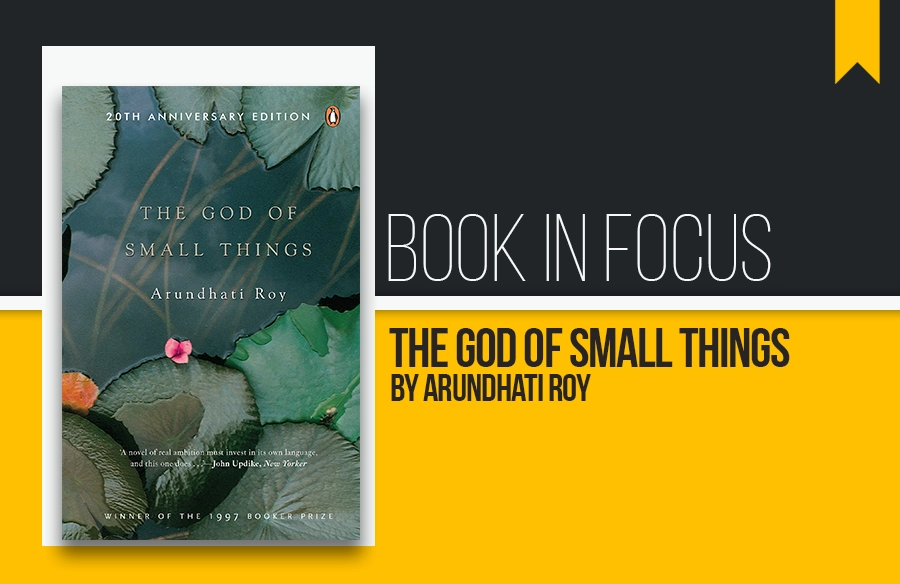
Published in 1997, The God of Small Things introduced the world to the distinctive literary voice of Arundhati Roy. The novel went on to win the prestigious Booker Prize, making Roy the first Indian woman to receive the honour. More than two decades later, the book remains widely read, studied, and debated.
Set against the humid, green stillness of Kerala, the novel moves through the fragile interiors of a family — their memories, their quiet wounds, and the invisible lines drawn by caste and society. It reflects on how structures larger than us shape even our most intimate relationships. Yet, what makes the book unforgettable is its attention to the “small things” — fleeting gestures, overheard words, moments that seem ordinary at first but slowly gather emotional weight.
Instead of depending on dramatic twists, Arundhati Roy builds her narrative like memory itself — layered, circular, and deeply felt. She asks the reader not to rush, but to pause, to sit with discomfort, to notice how human behaviour often speaks loudest in silence.
About the Author

Born in 1961 in Shillong and raised largely in Kerala, Arundhati Roy carries within her writing the textures of the landscapes she grew up in. Before literature became her primary language, she studied architecture at the School of Planning and Architecture in Delhi — a background that perhaps explains the structural precision and layered detailing in her narrative style.
The God of Small Things, her debut novel, did not merely introduce her to the literary world; it firmly positioned her within it. Winning the Booker Prize, the novel established Roy as a powerful and original voice in contemporary fiction.
Beyond the novel, Roy is widely recognised for her essays and political commentary. She has written extensively on globalisation, environmental justice, state power, and human rights. While The God of Small Things remains a work of fiction, its attentiveness to social inequality, caste, and political undercurrents subtly mirrors the concerns that shape her non-fiction. The novel, in many ways, feels like the beginning of a larger intellectual and moral engagement with society that continues through her later works.

Overview
The story is set in the quiet town of Ayemenem in Kerala, but it feels much larger than its geography. At its centre is a family whose lives are quietly altered by events that do not simply occur and end — they linger, echo, and reshape the years that follow. The narrative does not move in a straight line. Instead, it drifts between past and present, much like memory does when we revisit it.
Roy does not hand the story to the reader in neat, chronological order. She offers fragments — moments, impressions, emotional residues — and allows us to assemble them gradually. As readers, we are not rushing towards a climax; we are inhabiting a mood, sensing tensions, understanding relationships piece by piece. The novel prioritises atmosphere over action, and emotional undercurrents over dramatic spectacle.
Ultimately, its depth lies not in the events themselves, but in their aftereffects — in how they settle into the characters’ lives, shaping who they become.
Major Themes Readers Can Reflect On
1. Social Layering and Status Systems
One of the most striking aspects of the novel is the way it engages with social divisions — not through loud confrontation, but through lived experience. Caste and class are not presented as abstract systems; they are felt in conversations, in silences, in who is allowed to belong and who is gently — or forcefully — pushed to the margins.
Roy does not argue; she reveals. She shows how deeply rooted hierarchies slip into everyday life, shaping relationships, choices, and even the language people use with one another. What feels personal is often structured by something larger. What appears to be an individual decision is frequently influenced by inherited expectations.
As readers, we begin to see how these invisible frameworks quietly determine what is considered acceptable, respectable, or forbidden. The novel ultimately invites reflection on how much of our present is still shaped by structures we did not choose — and how power often operates most effectively when it appears ordinary.
2. The Concept of “Love Laws”
A recurring idea in the novel is that love is not always as free as we imagine it to be. Society, often quietly and without announcement, decides who is permitted to love, how deeply, and at what cost. These unspoken “rules” sit beneath relationships like invisible foundations — shaping them, limiting them, and sometimes even breaking them.
Through its portrayal of intimacy and belonging, the book invites readers to pause and ask: how much of our emotional life is truly our own? Roy does not dramatise this tension; she allows it to unfold naturally, showing how personal desire often collides with social boundaries that feel immovable.
In reading these relationships, one cannot help but reflect inward. The novel gently pushes us to recognise similar patterns within our own communities — the subtle expectations, the silent judgements, the lines that are rarely written down but deeply understood.
3. Seeing the World through Young Eyes

The novel frequently filters its world through the perspective of children, allowing readers to experience events with a mixture of innocence, curiosity, and quiet bewilderment. Roy captures how children observe adult behaviour closely — noticing tone shifts, pauses, and emotional undercurrents — even when they cannot fully grasp their meaning. There is a sensitivity in the way she portrays childhood: it is neither romanticised nor dismissed, but treated as a space of deep perception.
This perspective adds profound emotional depth to the narrative. We begin to see how early experiences — moments of fear, love, shame, or confusion — do not disappear with time. Instead, they settle into memory, quietly shaping identity and self-understanding. The novel suggests that childhood is not merely a phase we outgrow, but a foundation that continues to influence who we become.
For many readers, this theme becomes one of the most affecting elements of the book. It lingers because it feels personal — reminding us of how fragile, observant, and deeply impressionable childhood truly is.
4. The Persistence of Memory
Time in the novel does not move in a straight line. It folds into itself. The past is never entirely past; it lingers beside the present, surfacing in fragments, images, and sudden recollections. Roy structures the narrative in a way that mirrors how memory actually works — not as a neat sequence of events, but as moments that return unexpectedly, especially when tied to trauma or longing.

At times, this movement between different periods requires patience from the reader. The story withholds clarity, asking us to sit with partial understanding. Yet this very structure deepens its emotional impact. Meaning is not delivered instantly; it slowly gathers weight as pieces begin to connect. We come to realise that comprehension, much like healing, is gradual.
Ultimately, the novel suggests that memory is both delicate and enduring. It can blur details, distort time, and yet remain powerful enough to shape identities and futures. In this way, time in the novel feels less like a timeline and more like an emotional landscape — layered, shifting, and impossible to fully contain.
5. The Power of “Small Things”
The title itself urges us to pay attention to what we often overlook — a casually spoken word, a fleeting glance, a pause that feels insignificant in the moment. In Roy’s world, these “small things” are never truly small. They gather meaning slowly, almost invisibly, until their emotional weight becomes undeniable.
Instead of centering grand events or dramatic turning points, the novel stays with the intimate and the everyday. It reminds readers that lives are often shaped not by spectacle, but by quiet decisions and subtle gestures. In doing so, the book cultivates a kind of mindfulness — an awareness of how delicate and powerful human interactions can be.
Writing Style and Narrative Technique
Arundhati Roy’s prose is often described as lyrical and experimental. She plays with rhythm, repetition, capitalisation, and unexpected phrasing. At times, the language reflects the imaginative logic of childhood, creating a distinctive narrative voice.
Some readers may initially find the style unconventional. The sentences sometimes bend traditional grammar, and the narrative shifts in time require attention. However, these stylistic choices are intentional and contribute to the immersive quality of the text.
It’s a book that breathes slowly, waiting for you to do the same. It does not lend itself to hurried reading, but instead rewards patience and thoughtful engagement, revealing more with each careful return to its pages.
Key Takeaways from the Novel
- A deeper awareness of how social systems quietly shape individual lives and choices.
- Reflection on how childhood experiences continue to influence identity long after we grow up.
- Insight into the power of silence — and how what remains unspoken can alter relationships.
- An appreciation for experimental storytelling and the possibilities of language in fiction.
- Greater sensitivity to the emotional significance of small, everyday moments.
The novel gently cultivates empathy. It does not divide its characters into heroes and villains; instead, it presents them as deeply human — shaped by circumstance, culture, vulnerability, and memory. As readers, we are encouraged to understand rather than judge.
For students of literature, the book provides rich ground for analysing narrative structure, symbolism, and socio-political undercurrents. For general readers, however, its value lies in something quieter — the emotional depth it offers and the introspection it invites long after the reading is done.
Who Should Read This Book?
This novel may particularly appeal to:
- Readers curious about Indian society and its layered cultural contexts.
- Those who prefer reflective, character-driven narratives over fast-paced plots.
- Literature students interested in postcolonial writing and narrative experimentation.
- Readers who appreciate poetic language and unconventional storytelling styles.
It may not appeal to readers looking for fast-paced action or a neatly linear storyline. The narrative asks for patience and attentiveness. Yet, for those willing to engage with it slowly and thoughtfully, the experience can be deeply rewarding — emotionally resonant and intellectually enriching in equal measure.
The God of Small Things remains a significant work in modern literature for its emotional depth and social insight. Through this novel, Arundhati Roy weaves a story that feels both intimate and quietly political.
In my view, its greatest strength lies in its attention to the seemingly ordinary — the way small moments gather lasting meaning. Though the fragmented structure requires patience, the emotional richness makes it worthwhile. The novel lingers not because of spectacle, but because of the quiet truths it reveals about love, memory, and the invisible forces that shape our lives.