James Bond films have always been about more than espionage. They are cinematic manifestos of taste – the right car, the right suit, the right location. And no aesthetic has proved more seductive to the franchise than Tuscanyness: the particular quality of Tuscan architecture that communicates beauty, permanence, and danger. Tuscany and its architectural identity have appeared in the 007 series not as a backdrop but as a co-protagonist, shaping the mood and supporting what is happening with the heroes.
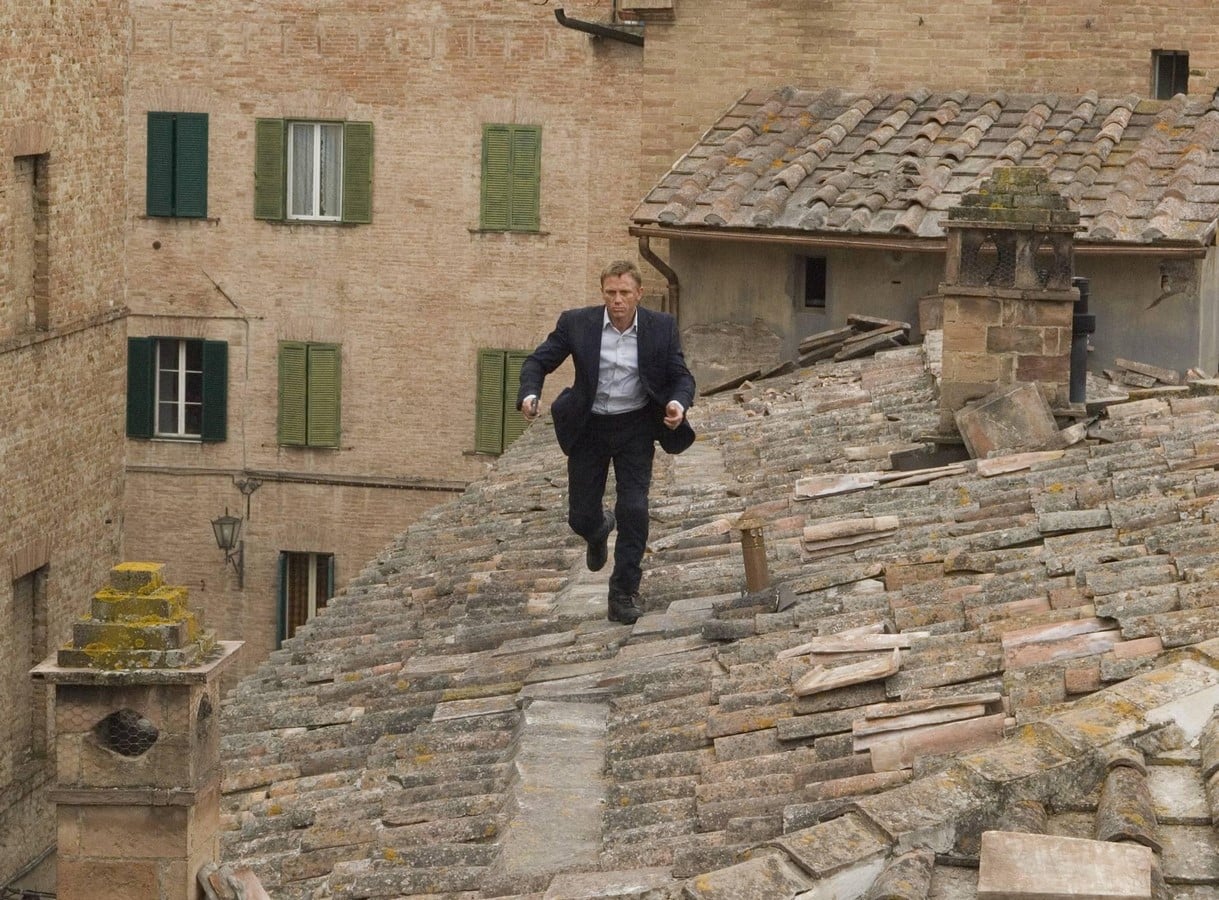
Tuscanyness
Bond films do not merely visit locations – they cast them. Every city that enters the frame carries a brief. When the series needs legible chaos, it reaches for Marrakech or Istanbul. When it needs sterile menace, it reaches for modernist concrete. And when it needs something that sits at the precise intersection of beauty and danger, elegance and violence, restraint and ferocity – it reaches for Tuscany.
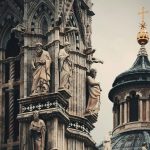
Tuscanyness, as an architectural concept, is not merely about the aesthetics of terracotta rooftiles and cypress-lined roads. It is about the relationship between built form and geological time. The medieval hill towns of Siena, the marble-white quarry landscapes of Carrara, the watchful coastal towers of Maremma: each represents centuries of civic negotiation between human ambition and resistant terrain. The result is an architecture of compressed intelligence: dense, layered, and deeply suspicious of ornament for its own sake. These are precisely the qualities the Bond series has always projected onto its own protagonist.
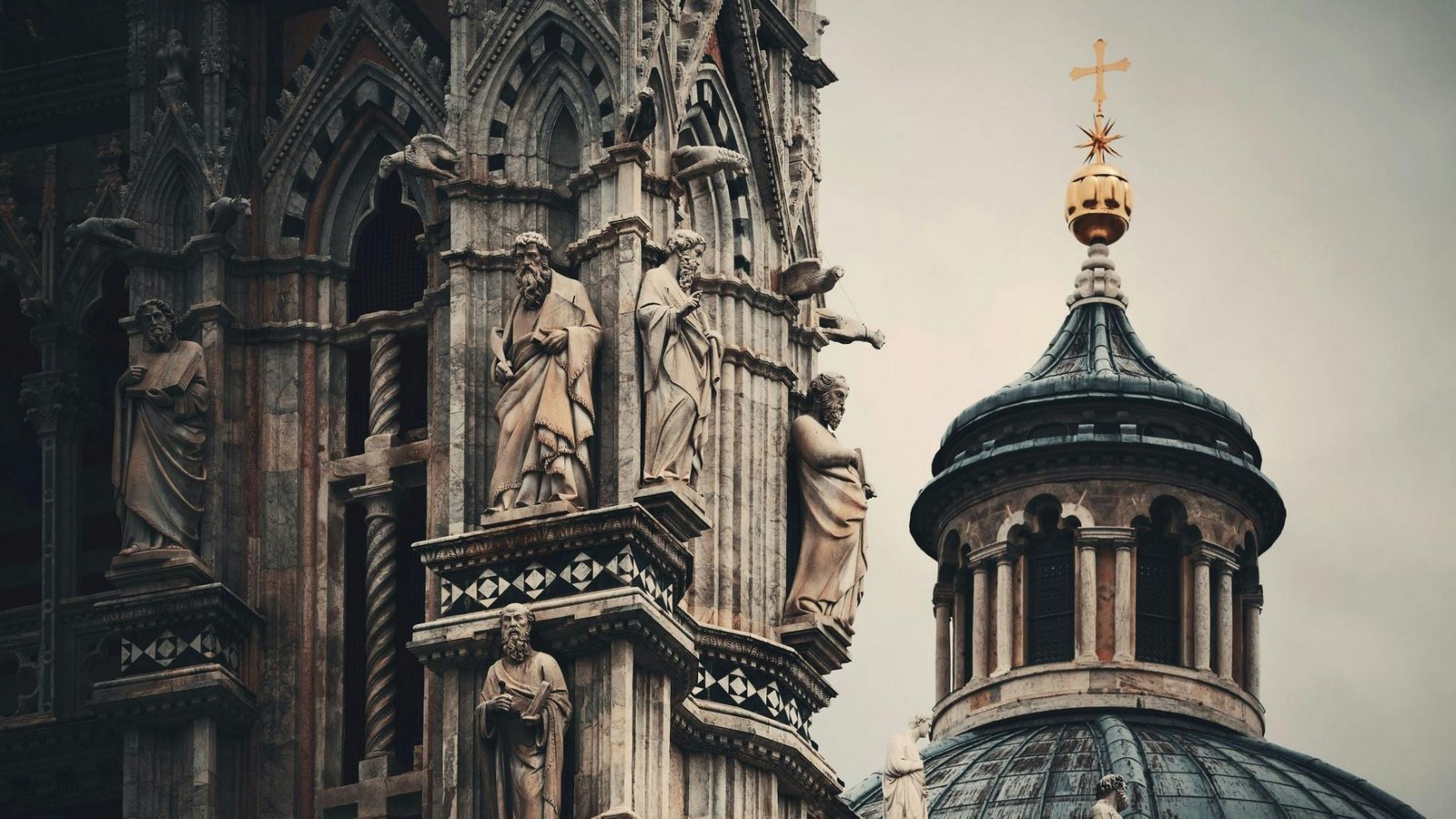
Scene-by-Scene Architectural Analysis: Quantum of Solace
Siena
The most architecturally articulate deployment of Tuscanyness in the franchise arrives in Marc Forster’s Quantum of Solace. Following a car chase along Lake Garda, Bond arrives in Siena – not as a tourist, but as a man navigating a city that seems to be actively conspiring with his adversaries.
Everything starts with the MI6 field HQ entrance at Piazzetta della Paglietta, just southeast of Piazza del Campo. The piazzetta is a compressed, asymmetric urban residue – a fragment of public space formed by centuries. Its walls are load-bearing travertine and tufa – warm-toned, rough-textured, and visually indistinguishable from the surrounding architecture. The space reads as nothing at all – and that is precisely the point.
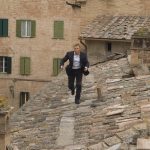
The choice of the Piazza del Campo for a chase sequence is not occasional. Here takes place The Palio di Siena – a horse race held twice annually since 1644. The piazza is literally used as a track, and the buildings become grandstands. Bond chasing an enemy across the rooftops above this space creates a vertical extension of the piazza’s own drama – he inhabits the architecture’s tension. The Tuscanyness of this setting suggests that the conflict here has deep roots. It is not just a chase – it is a confrontation framed by eight centuries of urban memory.
The Carrara Quarries
In the film’s pre-credit car chase sequence, Bond’s Aston Martin DBS threads through the Carrara marble quarries in the Apuan Alps of northwest Tuscany – a landscape that has supplied sculptural marble since Roman times and provided material for works including Michelangelo’s Pietà (movie-locations.com, 2008).
White marble walls rise to heights of twenty metres and more, cut into sheer vertical planes by industrial saws. The Carrara quarries are architecture’s raw supply chain, where everything is visible in its unfinished state. It is, architecturally, the inverse of Siena: the city accumulates, the quarry extracts. Tuscanyness, as a concept, is always about the relationship between the found and the made.
Maremma
Bond also visits Torre di Talamonaccio near Talamone on the southern Tuscan coast (the Maremma), where he calls on his friend René Mathis (bondlocations.com, 2008). The Torre is a restored medieval watchtower perched on the coast – a vertical mass of local stone, with minimal openings and a commanding view across the water and marsh.
The Maremma is not the Tuscany of tourist brochures. It is wilder, flatter, with coastal scrubland, medieval hill towns, and an architecture that retains the Tuscan vocabulary – terracotta, stone, loggia, thick walls – without the polish of cities like Siena or Florence. It is Tuscany’s deliberately underexposed face; it is built for practical life in a specific landscape.
Not Just Aesthetic
The temptation, when surveying the Bond franchise’s use of Tuscanyness, is to conclude that the films are doing what cinema always does – borrowing beauty without interrogating it. That reading is wrong, and it matters that it is wrong. The evidence of Quantum of Solace across its three Tuscan locations (Siena, Carrara, and Maremma) is that the filmmakers understood, instinctively or deliberately, that Tuscanyness is not merely attractive. It is structurally argumentative. Every spatial quality deployed in those sequences – the opacity of the piazzetta, the geological violence of the quarry, the strategic minimalism of the coastal tower – corresponds to a specific dramatic requirement. The architecture is not illustrating the narrative. It is generating it.