“Architect ‘drafts up plans’ as new Prime Minister”

”From architect to India’s new PM: A ‘High rise’ to power”
”’Make room’ for PM Architect”
Most newspapers profiled Prime Minister Devenka as ‘the face of the architectural fraternity across the nation, committed to recognizing architects as the heroes they are and making architecture a glorious profession again’. The story, however, started way back with a small practice for Ar. Girish O. Devenka, or as he liked to call himself, G.O.D. From such humble beginnings to becoming the leader of the nation, no one had seen it coming. But they should have. Architects dabble in everything but architecture.
PM Devenka wasted no time breaking ground on his laser-focused mission. He stepped into office, backed by his party, the Federation of Architects for Indian Leadership (F.A.I.L.). Outside, enthusiastic supporters gathered, chanting “F.A.I.L.! F.A.I.L.! F.A.I.L.!”. He was very clear about his agenda: uplifting architects and polishing their public image. After spending a lifetime in the field, or at least around it, he had come to view architects as the true minority. “Nobody else,” he often said, “faces as many injustices as architects do; from lack of funding, bureaucratic nightmares, to the worst of all: a bad rep in society.”
As inflation soared, religious tensions simmered, and the boiling cauldron of national and global concerns bubbled up to the brim, the first order of work seemed very obvious to the new Prime Minister: creating North signs on every drawing present in the office. “Without direction,” he patronized, “we will go nowhere.” For a week, the country halted its progress in order to find its direction on paper.
The decision naturally attracted some scepticism, although Ar. Devenka seemed to have foreseen it. When cautioned by his staff, he confidently assured them that his next initiative was sure to boost his approval ratings and solidify his agenda. Word got out fast; he was planning something in honour of the nation’s architects. The architects rejoiced in hope. Better work reforms? Revised compensation standards? Streamlined regulatory frameworks? Perhaps, stronger Intellectual Property protection laws. When the day came, the PM cut the ceremonial ribbon and revealed a massive, golden statue. It was a statue of himself. “By honouring myself,” he was quoted saying proudly, “I am honouring all of you.”
For the new Prime Minister’s spokespeople and media advisors, things only went south from there. Despite having found their North. In addition to fielding questions and criticism about his eccentric policies and an agenda with blatant disregard for anything that did not concern architecture, they now also had to take on a fresh batch of detractors who ridiculed his injudicious decision to generously fund a statue of his own self. Headlines labelled it as ‘frivolous and narcisstic’. Opinion pieces condemned it as ‘a meaningless cosmetic treatment for fixing the public image of architects, when their public image is the last thing they need to fix for this country right now.’
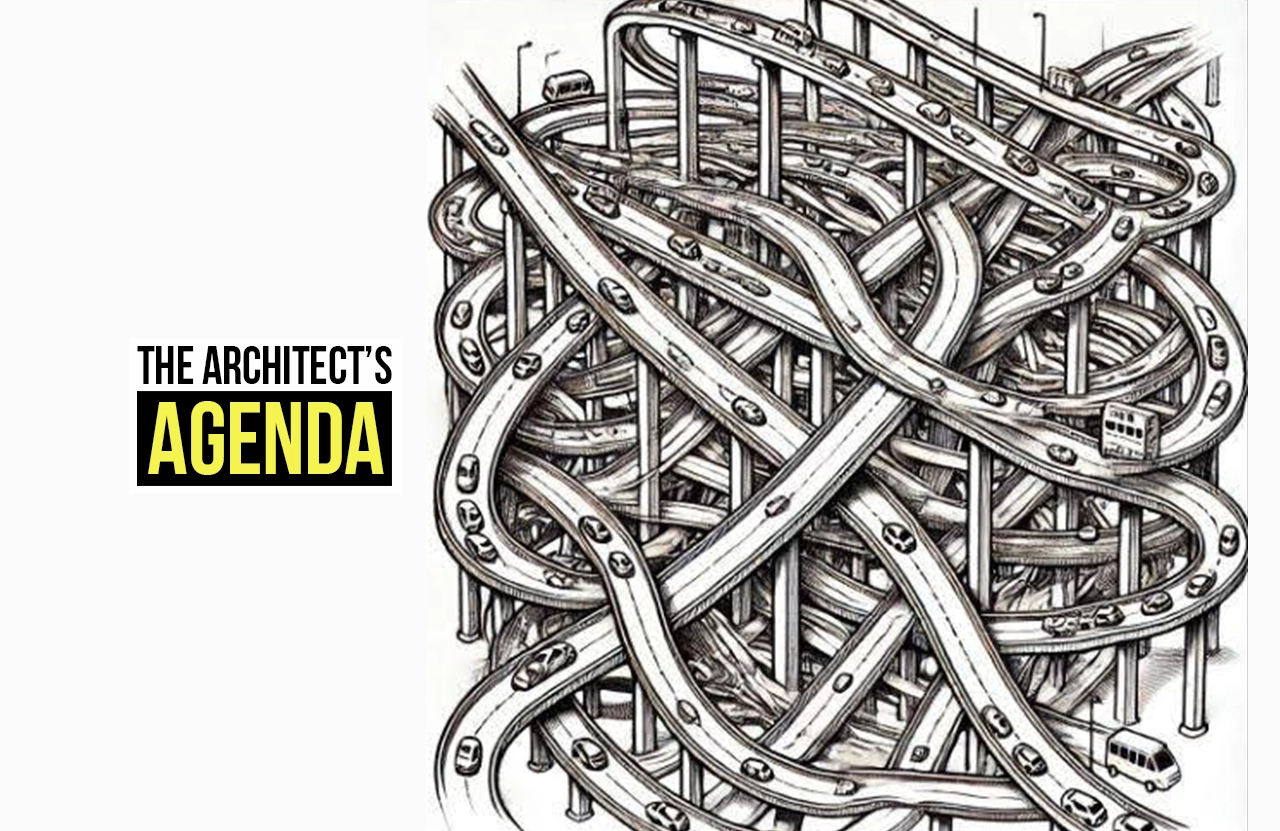
At first, Ar. Devenka came out in fierce defence of himself. “I am a lion- the king of the jungle. I am not a goat in the herd. Naturally, therefore, I stand by my decision to govern differently than my predecessors, to stand out, to lead in my own unique, individualistic and architectural way.” He further justified: “Architecture produces new and different isms all the time.” The only ism his statement produced was more criticism. Consequently, further meetings were scheduled with the overworked Crisis Management team, following which the Devenka administration made one more attempt to salvage their agenda. It was the brainchild of the eponymous architect. “Your reactions have not gone unheard.” The Prime Minister declared solemnly. “After taking heed of your abundant feedback, I pledge to address your issues, and to work towards practical solutions for real problems faced by the people of this country. It is my hope that we architects will be viewed in a positive light for such contributions. As part of this mission, today I announce a new proposal. In order to overcome the widely prevalent issue of traffic congestion, I have proposed the construction of multiple new flyovers, which are designed to divert vehicular traffic from the currently overloaded flyovers, which were designed to divert vehicular traffic from the previously overloaded roads. A flyover over a flyover. Introducing, the fly-over-and-above.”
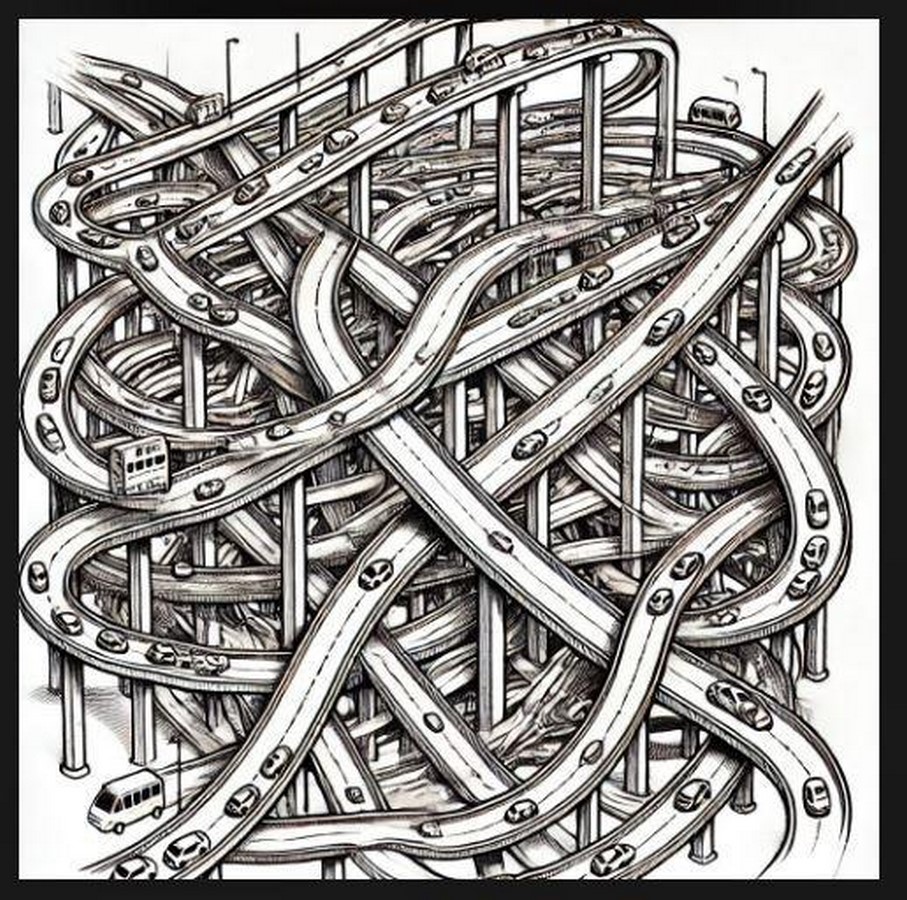
For a fleeting moment, the Prime Minister and his team were able to enjoy a brief respite as the country received the new proposal with slightly more warmth and tolerance than before. While it was happily endorsed by the crowd in Transport, Finance and Urban Development, it could not help but ruffle a few eco-friendly feathers in other ministries like Environment, Railways and Agriculture. This sentiment of dissent resonated across fragments of the architectural community, and soon amplified into yet another backlash. Academics, environmentalists and urban experts questioned the necessity to encourage more private transport instead of strengthening public infrastructure. They voiced concerns about the negative impact that such a proposal would have on parameters like walkability, livability, and ultimately, sustainable and controlled development.
‘PM lays the foundation for another concrete jungle.’
‘The only thing this architect can build is castles in the air.’
So began the outcry.
Nothing Ar. Devenka never seemed to please his critics. No matter how hard he tried, they always found a way to rip his plans to shreds. As he sat pensively in his self-designed chair which resembled Mies van der Rohe’s Barcelona chair in more ways than one, but not in enough ways to attract a lawsuit, he watched figures on the television tear apart his proposals and initiatives. They attacked his beloved agenda with their vicious disapproval and outrageous reactions, some wishing to blow up his designs with explosives, others wanting to revoke his license to build, neither seeking to understand. It almost rivalled the whims of jurors in a design viva. He reminisced over all the flawed yet sincere innovations that he and his peers had fiercely protected from the hellfire of disgruntled examiners, at the cost of their own dignity and pride. Promising young inventions that had over the time lost themselves under ‘real world’ byelaws and red tape. One thought propelled another and he leaped out of his chair as a solution presented itself. “I don’t need to think, I need to listen.”
The Prime Minister was back on his feet again. With restored confidence, he walked into his next venture of redemption: a student exhibition on sustainable designs. What had seemed to be the perfect damage control opportunity for his agenda, also turned out to be a much-needed attempt at bridging the gap between profession and academia. ‘Let me tell you all about my eco-friendly initiative,’ an enthusiastic young student chirped, before unfurling in front of Ar. Devenka what must have been a forest’s worth of paper. It sang about sustainability. The redundant lighting of the room joined the chorus, and the conditioned air tipped its hat off to the cause as it swayed between closed windows. The dignitaries present gave the student just enough time to roll a syllable off her tongue before taking matters into their own hands. The professionals complained that the proposed design was too ambitious, and the academics complained that it was not ambitious enough. Amidst the cacophony, all the Prime Minister saw was an imperfect idea striving to nevertheless establish itself.
On the way back from the event, Ar. Devenka sat in the backseat of his car, lost deep in thought. He looked out from the tinted windows in contemplation. His political journey so far had only raised doubts on his agenda for architects. With so many issues plaguing the architectural community and society at large, how was he going to bring glory to architecture and bestow a better reputation upon architects? Was he going to be able to do that? How many more grand monuments would he have to build? How many more concrete jungles would he have to provide as benchmarks of progress? How many more PR stunts were in the pipeline and how much more lip service was to be paid to the heroism of architects?
The car stopped at a quiet junction where a group of people were working by the roadside. The PM rolled down his window. “Seems like daily wagers fixing the footpath, sir.” His assistant swiftly noted. One of the figures in question rose up and turned around to reveal a smartly dressed young woman. “We are not daily wagers; they still get paid. We are architectural interns.” She greeted the PM. “Students of architecture?” He asked, surprised. “Did your chief architect put you up to this?”
“Not at all, we are here by choice.”
“Really?” Ar. Devenka asked with eyebrows raised. “Capable young minds like yours should be out here building towns and towers. What are you doing fixing footpaths?”
“Following the lead of our chief architect, sir.” The girl smiled. “We could build towns and towers here, and the people wouldn’t care one bit, because they’d be too busy cursing the broken footpath.”
The response seemed to stir something in Ar. Devenka. It played over and over in his head as his car drove away. The next day, he was back at the same junction, but with a bigger press entourage, and a clearer sense of purpose.
“We have gathered here today to applaud the remarkable effort of these young students and their mentors. An effort which has been a better articulation of the architectural agenda than any of my own recent endeavours meant for it. As architects, we often desire recognition of our heroism more than heroism itself. We have become so obsessed with becoming lions that we have turned this kingdom into a zoo. In our quest for validation, we have strayed away from our true agenda: to design for people, not admiration. You know why doctors and lawyers still maintain a reputable standing in our society? They are not preoccupied with reinventing the wheel; you never hear of a doctor rearranging organs in a signature style, nor a lawyer crafting a personal definition of law. They become heroes because their primary aim is not to seek glory but to fulfil their responsibilities irrespective of it. Why should we be any different? Our role as architects is to design for the people, not to accommodate people around our own grand visions. That is the reason we admire our icons. We call it Michelangelo’s David, not because it was Michelangelo who sought to be extraordinary but because it was David whom he sought to make extraordinary.”
Ar. Devenka continued. “When work propels our thoughts, when people are at the centre of it, and when service is the intent behind it, good design automatically becomes great design. It is service, not glory, that makes a hero. Having said that, I would like to take this opportunity to honour these architects with more than just medals and trophies. It is essential that we invest in the future of our profession by providing resources, mentorship, and platforms that allow us to thrive. Together, let us commit to fostering a culture where architecture serves people and enhances the lives of those we design for. This is the true Architect’s Agenda.”
All aforementioned incidents in this satire are inspired by true events and observations.