Technology and tools have always shaped how architects think and produce over the years, from hand drawings to AutoCAD drawings, from hand-made models to the use of parametric software. Today, when we talk about AI, it’s not the efficiency that differentiates it from other tools, but rather the authority. Architects are the authors of spaces; AI can make them mere curators. The ethical concern, hence, is not whether architects should use AI, but how they choose to use it.
Ethical Dimensions of AI in Architecture
Accountability
If AI provides you with multiple design options for a design based on the input data constraints that you feed it, who is actually responsible for the outcome?
The primary question to arise here is that of authorship. Architecture has the potential to affect people’s lives, how they move, interact, and feel. It has long-term social, environmental, and cultural consequences. If a design proposal by AI fails spatially, socially or environmentally, it is not the algorithm but the architect who signed the design responsible for it.
The complete discard of AI is not the wise solution in such a developing world. Ethical practice requires an architect to critically review, interrogate and reflect on every detail before producing the output. AI may be an aid, but it cannot be the sole decision maker. It is important to retain the authorship and accountability as an architect. The danger lies in accepting the output without using our architectural understanding. The process then reduces to mere selection of choices rather than a meaningful architectural judgment, where every detail is thought of. An architect must be conscious of their work and ensure that responsibility is not outsourced.
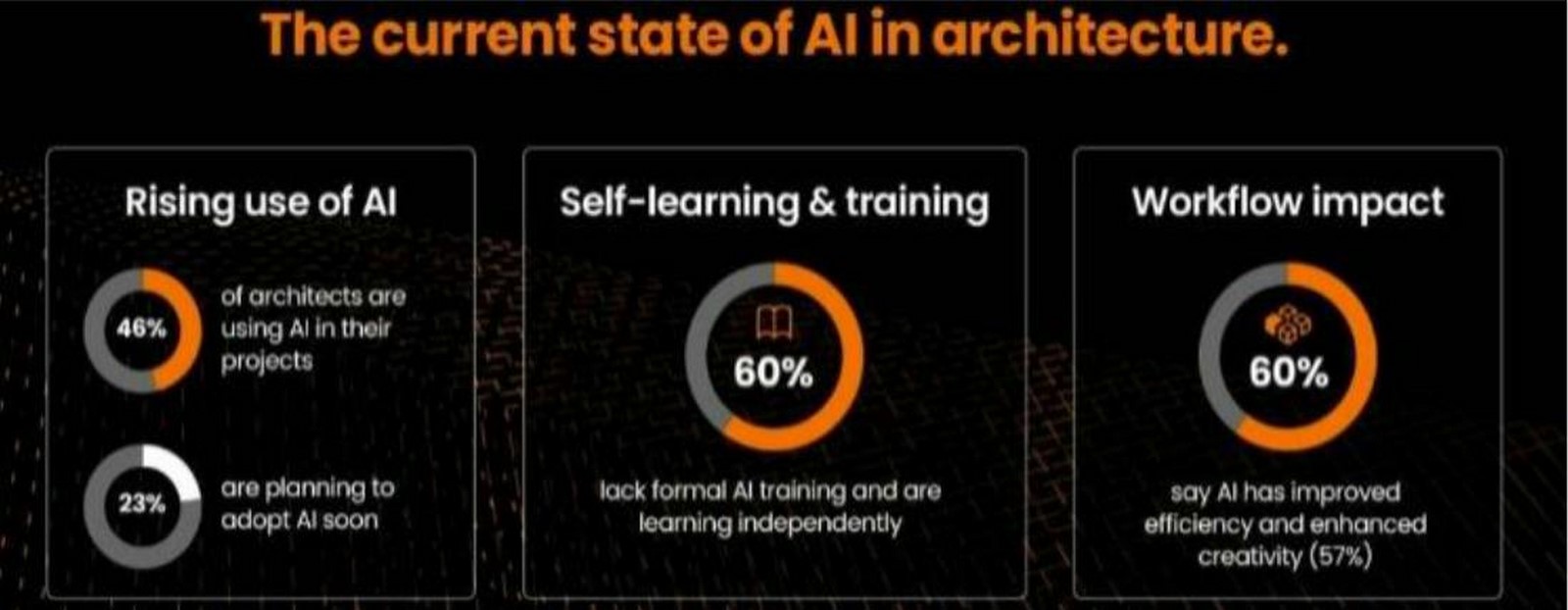
The question of accountability becomes more complex and necessary when the design is guided by bias and selective datasets.
Bias in Data & Design Outcomes
Ai works on an existing dataset that is dominated by personal narrations, western-centric projects that align with the global aesthetics, image drive and capital intentions. Relying on such a dataset, even at the conceptual level, can limit fresh and innovative perspectives. When we are provided with more information than needed in the first go, our brain gets restricted by the data and tends to subconsciously accept it. It’s like we go to an ice cream shop and see vanilla, chocolate and butterscotch on display, our mind will tend to choose from those available options until we know that strawberry is an option that’s not displayed.
While the AI might be providing ‘optimised’ output, it is actually based on a biased and selective dataset. The ethical challenge is to understand that AI does not reflect architectural knowledge; it amplifies some narratives and excludes others.
Beyond the questions of authorship and bias lies an even deeper concern: what is lost when design decisions drift away from lived experiences?

Loss of Contextual Judgment
Observations, dialogue, oral narrations, hesitation, reflection, and intuition are some beautifully important layers of decision-making when designing. Peter Zumthor describes the atmosphere as felt and not calculated. How can someone produce something that they haven’t felt?
The intangibles of architecture are where the beauty of architecture lies. Our minds always differentiate one architecture from the other based on how it feels around and in it! We need human interventions for understanding informal settlements, craft- culture relationships, oral narrations-spatial relationships, and how each material, colour, and intensity of light entering a room can make one feel. This connection and attachment, both sensory and emotional, cannot be produced by quantitative data, parameters and probabilities merely. These contexts are to be experienced. AI works through abstractions and generalisations, which dilute the specificity of place and time.
Will AI ever know and reproduce how I felt when I walked down the street to the vegetable market, early in the morning, with my mom when I was 8 years old? The informal market settlement, people arranging the vegetables, sprinkling water over them, the warm morning sun and coriander aroma around?
AI might optimize the circulation widths and shading devices, but can it intuitively grasp why certain activities spill over the threshold? Or why workspaces must remain flexible?
When context is reduced to data points, architecture risks becoming technically contextual but socially disconnected. Ethical practice here requires architects to retain the contextual judgement, ensuring that technology supports place-based understanding rather than replacing it. A true design is rooted in lived experiences and not merely in algorithmic logic.
Human Experience vs Performance Metrics
Speed is one of the most celebrated advantages of AI. AI can assist, explore and analyse possibilities, and reveal patterns, making it a great tool but not a decision maker. AI tools can generate thousands of design alternatives as per the constraints we provide about form, function, materiality, energy consumption, and environmental impacts. These designs lack emotional intelligence, sensory experience, human judgment, and contextual understanding, which are central to any design. AI can calculate the energy efficiency, daylight levels, circulation logics and other quantitative data, but cannot evaluate the memory, feeling, and comfort of a person associated with the space. Measurable performance overshadowing the human experience without consciousness is where the ethical concern lies.
Homogenisation of Architecture
As AI tools heavily rely on common datasets and popular precedents, the design output can end up converging towards similar outputs. Risk of global standardisation and loss of local identity may take over the diversity of expression across diverse geographies. This convergence might be the most global concern; the architectural richness of diversity and local identity can be diluted and flattened. This needs conscious preservation of differences, uniqueness, specificity and cultural expression.
The ethics of AI in Architecture is a concern of how we choose to use it, rather than whether we should use it. As more tools become embedded in design practice, architects must define values that guide their use, ensuring that design remains central to humans and not to a standardised tool.
References:
Gupta, Mr.U., Khurana, Ms.A. and Kaur, Ar.H. (2025) Exploring the intersection of AI and ethics in architecture: Implication for design, Design Thinking and Built Environment:, International Research Journal on Advanced Engineering and Management (IRJAEM). Available at: https://doi.org/10.47392/IRJAEM.2025.0105 (Accessed: 25 January 2026).
Pallasmaa, J. (2012). The Eyes of the Skin: Architecture and the Senses. 3rd ed. Chichester: Wiley.
Zumthor, P. (2006). Atmospheres: Architectural Environments – Surrounding Objects. Basel: Birkhäuser.
Zumthor, P. (2018). A Feeling of History. Zurich: Scheidegger & Spiess.