Why pattern language needs an update
A Pattern Language by Christopher Alexander suggests that architectural quality evolves from repeating spatial connections rooted in human activity and experience (Alexander, 1977). The book presents patterns as transferable design knowledge, allowing professionals as well as laypeople to contribute to changing the built environment. However, Alexander’s paradigm originated in a sociocultural setting characterized by slower ways of communication and generally consistent spatial use. Contemporary architecture functions under significantly altered conditions, driven by digital connection, faster societal change, and overlapping programmatic needs. These shifts require a reconsideration of how patterns function today. Pattern Language 2.0 is proposed here as an updated interpretive framework that retains Alexander’s human-centered ethics while responding to contemporary conditions of flexibility, participation, and continuous transformation. Rather than fixed spatial prescriptions, patterns must now operate as adaptive frameworks capable of accommodating change over time (Alexander, 1979).
From stable patterns to dynamic systems
Alexander highlighted the validity of patterns by means of repeated usage and long-term observation, assuming consistency in social conduct and geographical occupation (Alexander, 1977, pp. x-xi). However, current theorists have observed that networks, rather than fixed hierarchies, are increasingly shaping today’s urban and architectural contexts. Manuel Castells refers to this scenario as the “network society,” in which social and geographical organization is structured by continuous flows of information and interaction (Castell, 2010). Pattern Language 2.0 addresses this trend by seeing patterns as dynamic systems rather than static solutions. Patterns must be rooted in human usage while also being adaptable to changing contexts. This approach does not contradict Alexander’s technique; rather, it broadens it into circumstances characterized by acceleration, uncertainty, and overlapping applications.
Designing for time, not just space
Time has a limited significance in Alexander’s original formulation, where patterns are primarily envisaged as long-term spatial correlations. However, modern architectural theory increasingly recognizes time as an important design aspect. According to Richard Sennett, open and flexible systems enable buildings and cities to stay socially inclusive throughout time by allowing for progressive alteration rather than strict control. Pattern Language 2.0 incorporates this viewpoint by treating time as an active design element. Spaces are viewed as homes for sequences of usage rather than single functions. By incorporating temporal flexibility into pattern-based thinking, architecture may adjust to changing social behaviors while maintaining coherence and human scale.
Architecture as flow and process
Alexander’s patterns address movement and circulation, but today’s settings are impacted by larger flow systems incorporating energy, materials, trash, and information. Rem Koolhaas defines modern architecture as working under conditions of congestion, intensity, and continual interchange rather than static order (Koolhaas 1995). Pattern Language 2.0 broadens the concept of patterns to encompass these systemic processes. By making flows visible and intelligible, architecture may raise awareness of ecological and social interdependence. This trend is consistent with Castells’ conclusion that spatial structure is now inextricably linked to networks of exchange (Castell, 2010). As a result, patterns serve as both spatial solutions and system interfaces.

Participation and open-ended use
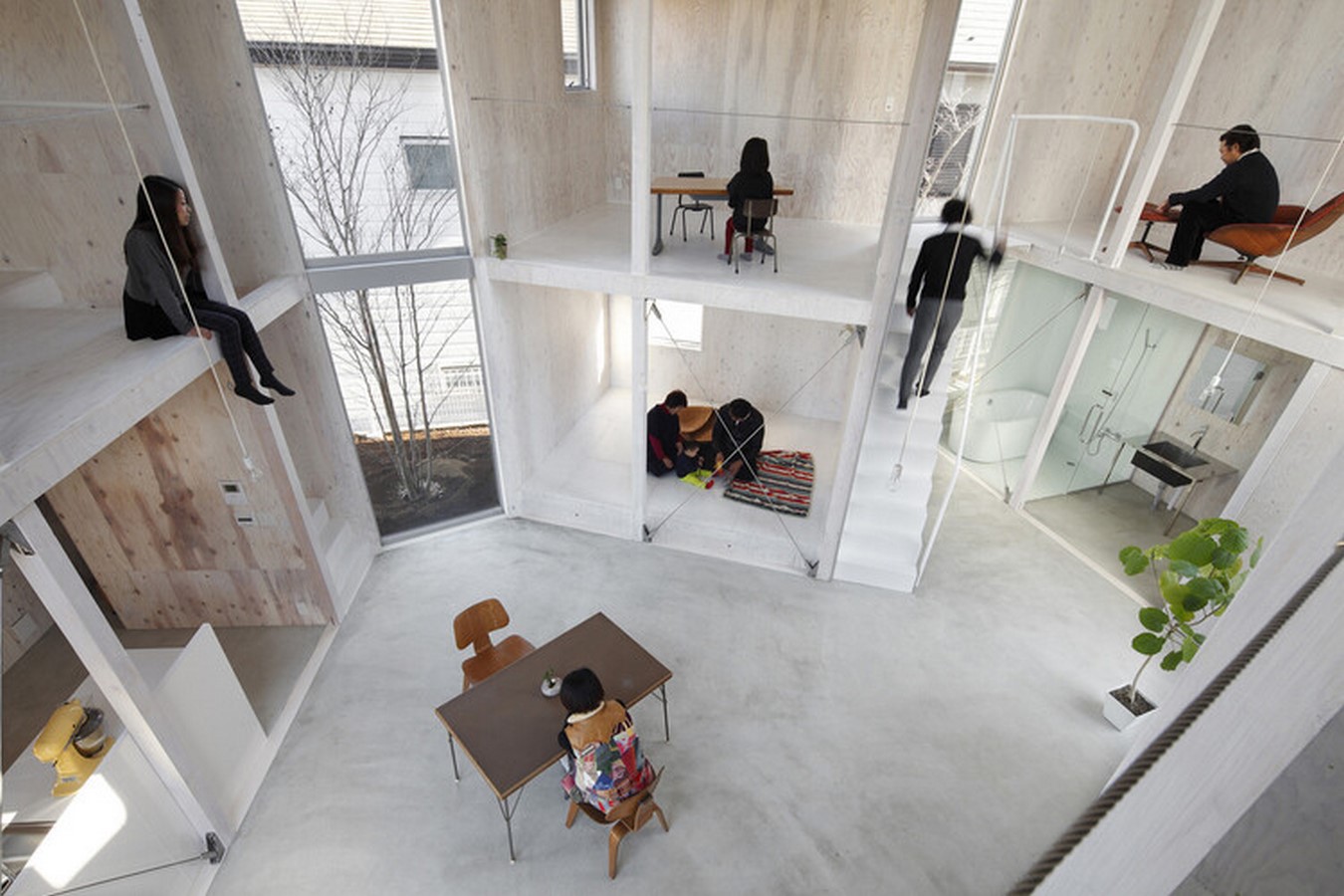
Alexander proposed that people should actively shape their settings, viewing architecture as a collaborative process rather than an expert-driven product. However, the technological and social tools required for continuous engagement were scarce at the time. Current conditions allow for continual user interaction via digital platforms, informal construction, and community-led projects. Pattern Language 2.0 expands on Alexander’s initial purpose, arguing for open-ended architecture—spaces that may be transformed and reinterpreted throughout time. Sennett agrees with this approach, claiming that incomplete forms promote social action and long-term adaptation. Patterns are therefore purposely adaptable, allowing architecture to grow via use rather than opposing change.
Hybrid spaces in the streaming age
While Alexander’s work is firmly grounded in physical space, modern architecture functions in a combination of physical and digital environments. Buildings can be experienced both directly and through photos, documentation, and internet platforms. According to Koolhaas, architecture is increasingly functioning as a cultural medium, influenced by both representation and tangible presence. Pattern Language 2.0 addresses this issue by broadening pattern-based thinking to incorporate visibility, mediation, and digital presence. This does not replace material experience, but rather enriches it, ensuring that architecture stays relevant in a culture characterized by connectedness and constant communication.

A networked approach to design
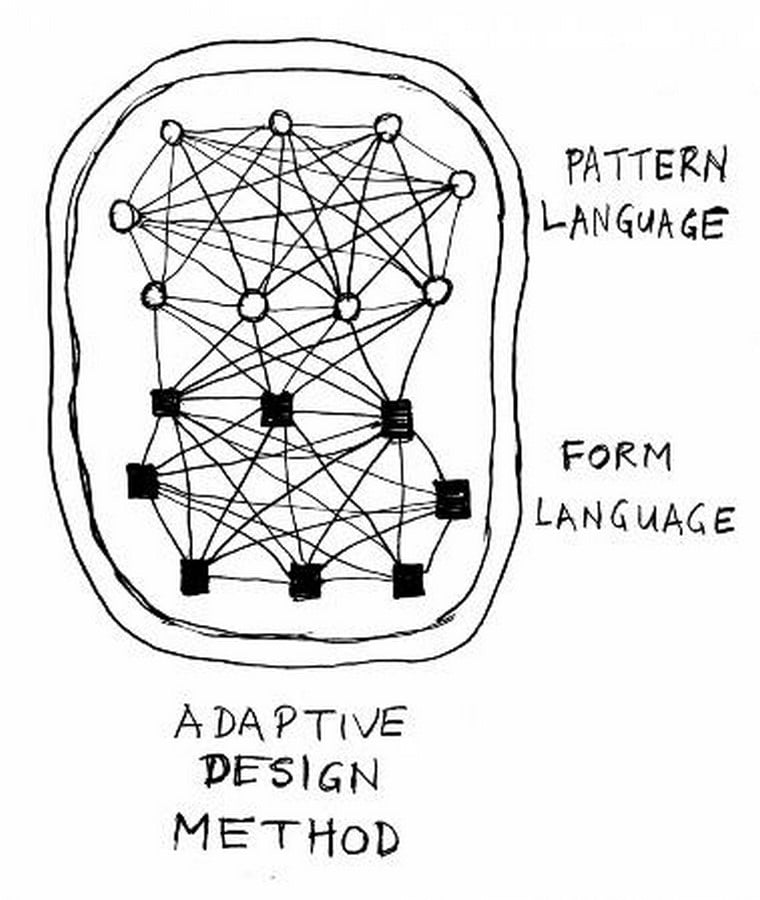
Pattern Language 2.0 functions as a network, in contrast to Alexander’s original book’s hierarchical structure. Patterns interact horizontally, allowing designers to access the system from several locations. This organization reflects modern design culture, which emphasizes iteration, feedback, and open communication. Patterns are evaluated locally, modified internationally, and constantly updated. Pattern Language 2.0 links design with the logic of modern systems, ranging from software development to informal urbanism. Accepting change as a constant improves architecture’s responsiveness and resilience.
Relevance without losing humanity
Rather than deviating from Christopher Alexander’s pattern-based technique, Pattern Language 2.0 is a modern development of it. It adjusts pattern thinking to the circumstances of the streaming era by combining ideas from network theory, temporality, and participatory design. The ethical basis of Alexander’s work is still crucial even as social and technical conditions change. By converting patterns into flexible frameworks that can evolve without losing their meaning, Pattern Language 2.0 guarantees that architecture will continue to support human existence.
References:
Alexander, C. (1977). A Pattern Language: Towns, Buildings, Construction. New York: Oxford University Press.
Alexander, C. (1979). The Timeless Way of Building. New York: Oxford University Press.
Castells, M. (2010). The Rise of the Network Society. 2nd ed. Oxford: Wiley-Blackwell.
Koolhaas, R. (1995). S, M, L, XL. New York: Monacelli Press.
Sennett, R. (2018). Building and Dwelling: Ethics for the City. London: Allen Lane.