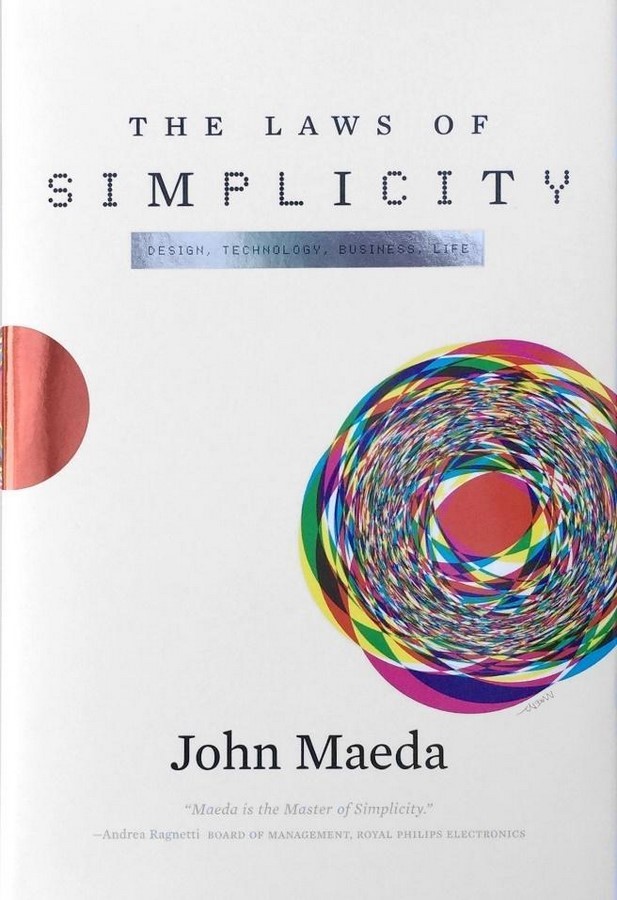
John Maeda is a designer, computer scientist, author, teacher, artist, etc. He was the president of the Rhode Island School of Design and is responsible for “all that stuff flying around on the computer screen while you’re trying to concentrate”, in his own words. This 100-page quick read is a collection of his musings about the concept of simplicity. John Maeda talks about simplicity, and it is usually a thought that doesn’t cross one’s mind on a normal day. But still, it is there, from overloaded menu tabs that make tasks like finding a saved file complex or deciding which song resonates exactly with your mood, which can be pretty overwhelming. As parametricism 2.0, AI Generative Designs, and 3D printed architecture advance, complexity is inevitable. Maeda shows how to embrace it, simply.
Who Is This Book For?
It isn’t a go-to design manual; it primarily revolves around some basic principles that build the foundations of good design and good designers. On a spectrum level, this falls somewhere between a self-help book and a how-to design guide. Its ability to cater to a very versatile audience and situations that go from routine to niche is what makes this book more universal. This and the fact that it’s a 100-page, A5-sized book, and has supporting graphics to still keep up interest. It is an easy read even for people who aren’t very keen on reading. Designers, marketing teams, and students can find actionable insights that can shape their approach to creative challenges. It is equipped with tips and tricks from the design world and insights from designers like Ikko Tanaka and architects like Shigeru Ban. Moreover, it can also be used as a reflection tool to see what some traits of good designers are and how to instill them.
The Structure of The Book
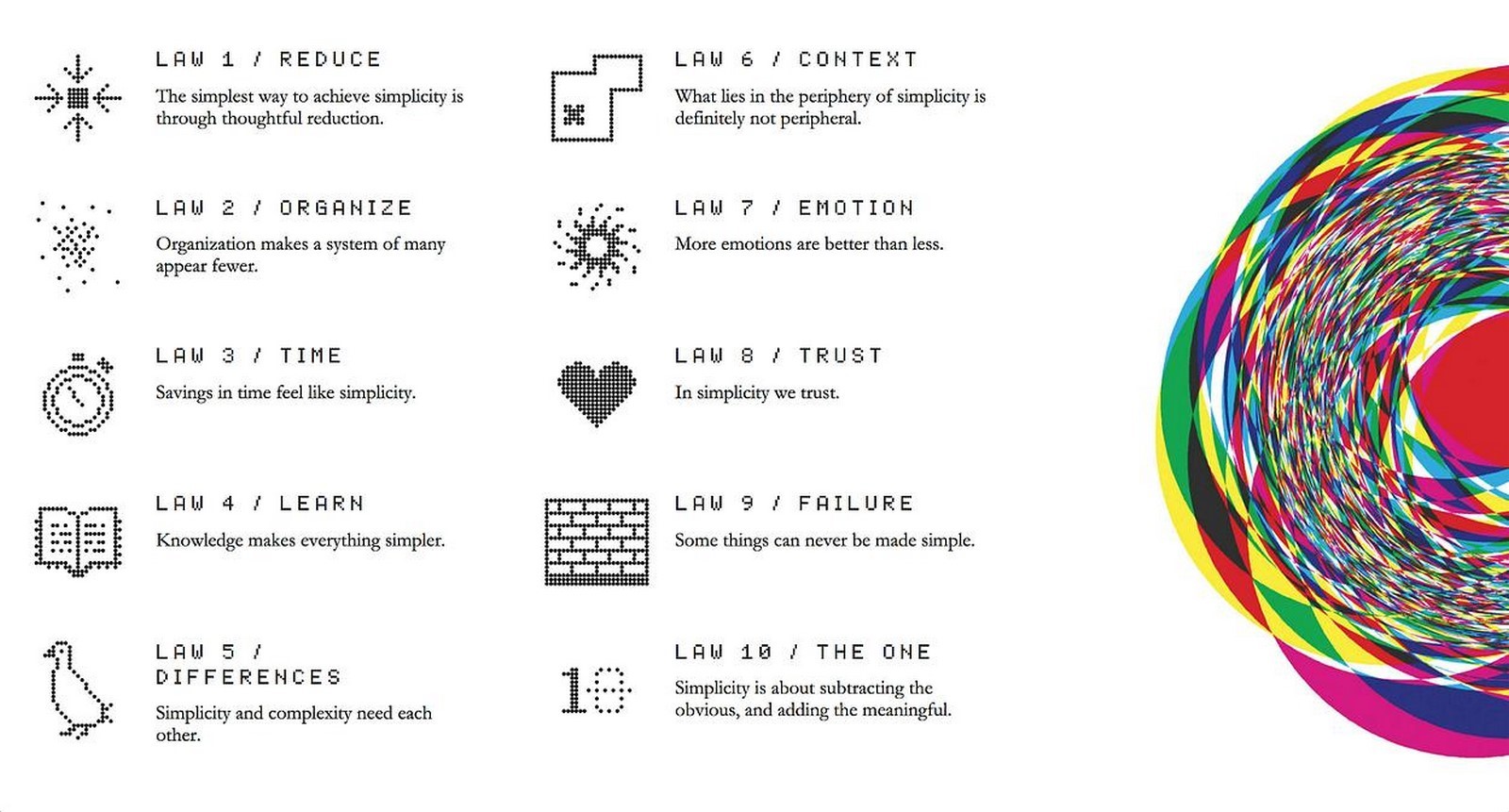
The format is, this book is divided into 10 laws, each one touching a new aspect of how one sees simplicity. After the laws, there are three keys, which are guides to apply these laws. The point is not just to know these laws but also to be able to understand them enough to apply them.
The laws are grouped based on their level of comprehension and direct application. The first three laws are straightforward enough to be applied directly to your situation. Cleaning your room? Yes, Law 2 will be your friend. Designing an Ipod? Yes, Law 2 will be your friend too. Laws 4-6 are more perspective-based and turn slightly philosophical. Law 7-9 even more so, and Law 10 is the final summary. This progressively increasing depth of laws reinforces the ease of reading and makes the deeper ideas feel within reach.
Each law starts with a graphic, which is essentially a condensed form of the law itself. The law is discussed like a casual conversation with an acquaintance, using examples that range from day-to-day activities to industry-specific examples. One example that has popped up multiple times is the Apple iPod, in the context of its visual perception, illusionistic and simplistic design, and evolution over time. Maeda’s interactions with designers, his own experience as a lecturer at MIT have backed up these examples, which do not just feel generic but hit the spot right.
What are the Laws and What Can the Reader Gain from Them?
The 10 laws of simplicity, rather than being rigid commandments, are a dissection of what simplicity really means and how it interacts with life. It starts from the law of reduction, which seems like the most obvious way to simplify anything. This law provides the readers with an insight into how what seems like a very direct answer to simplification in itself has multiple layers and methods to it. It further moves onto the law of organisation, where it is elaborated beyond the simple decluttering we know it as, like abstracting complex workflows into a single dashboard. Law seven onwards, the book gently shifts from physical to emotional simplicity. These laws capture the contradictions and paradoxes we have associated with technology, or how our usual emotions are kept on a pedestal, and how sometimes it’s okay to let them dictate some decisions.
Following the laws, the three keys- Away, Open, Power give these laws a more approachable dimension. They help the reader gain a perspective of what they read and how to apply it holistically by reducing distractions, embracing transparency, and balancing a relationship with technology. They are just broader lenses for users to examine how they manage the same things outside of design, in their lives as well.
Staying true to its philosophy, it does follow the Law of Time. It feels simple since the time taken to read it is not much, and reading it more than once does make it simpler, making it resonate with the law of learning as well. The examples make the concepts go from theoretical to relatable, and that, for me, increases the value of the book. My favourite part of the book has to be the acronyms used across the book; not only do they make it a fun read, but they act as mental bookmarks and ensure that the essence of the laws stays with you long after you’ve closed the book. Like the SHE principle: Shrink, Hide, and Embody, it is used to explain a couple of examples, widening the horizons of its use throughout. As an architecture student, the law of learning feels like a friend, especially the concept of feeling that the time spent learning something is wasted. Overall, it’s a good read, it’s simple, it’s applicable, and most importantly builds a conversation on a ground level.
Citations:
- “Maeda, John.” SFMOMA, www.sfmoma.org/artist/John_Maeda/.
- Maeda, John. The Laws of Simplicity. Cambridge, Massachusetts Etc., Mit Press, 2006.
- Maeda, John . “Web Protection by NETGEAR Armor.” Lawsofsimplicity.com, 2025, lawsofsimplicity.com/.