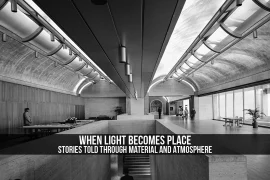
Architecture is often considered visual art, but it goes beyond sight, engaging all human senses. The role of sound often lingers in the shadows of visual aesthetics. However, Sound plays a potent role in creating atmospheres that transcend function and aesthetics, and become places of profound emotional and cultural resonance. Soundscape is a name for the acoustic environment as perceived or experienced by people (R Murray Schafer, 1994). Sound delineates our experience of space, a basic component of architectural design, from the resonant pomp of a cathedral to the stillness of a library. Acoustics in a building, that is, its echoes, ambient noise, and reverberations produce atmospheres as much as the physical form does (Zumthor, 1998).
Soundscapes are as important to spatial perception as visual elements, subtly guiding emotions and behaviours. It isn’t just about the production and presence of the sound but it is about the quality and character of the sound that is produced in that context. Take the example of the Pantheon in Rome, where its dome amplifies whispers, footsteps, and murmurs into a soundscape of reverence, proper to its monumental scale (Thompson and MacDonald, 1966). Three components of the soundscape have been identified, i.e. keynotes, signals, and soundmarks (R Murray Schafer, 1994). It could be the drone of the HVAC (keynotes), the sound of a school bell (signals), or the reverberation of footsteps in a cathedral (soundmarks) in architectural notes. These sounds add to or subtract from the space based on how they resonate with the material, geometry, and spatial configuration of the built environment.

Echo chambers
We can find various architectural spaces that are designed specifically to magnify the sound. This is profoundly seen in religious and cultural structures like churches, mosques, concert halls, etc. Echo chambers or reverberant spaces are crafted with materials and geometrical shapes that help reflect the sound rather than absorb it. These spaces provide the qualities that align with the artistic and spiritual experiences, producing a sense of awe, mystery, and transcendence. For instance, a massive central dome and hard marble surface are spotlighted in the Hagia Sophia in Istanbul, built in the 6th century, and creates a rich and long reverberation. This design approach immerses the listener in a cloud of sound augmenting choral music and religious ceremonies (ChoralFestCostaRica, 2025). In the same manner, contemporary concert halls such as the Berlin Philharmonie were forced to employ reflective materials, ceiling shapes, and projected gradations and balustrades to achieve an optimal reverberation time (ORT) that augmented orchestral richness without sacrificing clarity (Philharmoniker, n.d.).

However, reverberation more than the ORT can make speech less intelligible and increase the background noise. In spaces intended for communication such as lecture halls, this can negatively impact the sound clarity and quality. Therefore, the control of sound is as important as its amplification.
The Sound-Dampening Libraries
Unlike echo chambers, wellness spaces like libraries, meditation halls, and hospitals are likely to be designed with sound absorption and sound isolation in mind. These spaces are designed to reduce background noise, control reverberation, and ensure acoustic privacy.
Materials like acoustic ceiling tiles, carpets, soft furnishings, and perforated wall panels are used to absorb sound energy and reduce sound transmission. Yale University’s Beinecke Rare Book & Manuscript Library, for example, uses thick marble panels to protect its collections from sunlight while soundproofing against external noise (Beinecke Rare Book & Manuscript Library, 2018). Soft furnishings and thoughtful interior design of the layout mute echoes and the sound of footsteps within. The result is a quiet environment in which to read, study, and contemplate.

Sound reduction techniques go further than material selection. The design of buildings plays an important part; separating quiet and noisy activities, separating mechanical systems, and double glazing in urban areas all play a part in creating a managed acoustic environment (modulyss, 2024).
Acoustics and Well-being
Aside from function, a building’s soundscape can also influence mental and physical health. There is evidence that excessive exposure to noise leads to stress, mental fatigue, and decreased productivity (Madvari et al., 2024). Conversely, well-crafted acoustic spaces can foster concentration, relaxation, and even healing. In hospitals, for example, reducing the level of noise in patient rooms can lead to better sleep quality and rates of recovery (Busch-Vishniac et al., 2005). Acoustics is now among the healthy building design criteria in Building Standards, promoting the application of sound-absorbing materials, masking systems, and noise isolation. This is a recognition that sound is not merely a technical issue but sensory and psychological.
Contemporary Approaches to Soundscape Design
Contemporary architecture welcomes technology and simulation to model and optimize acoustic performance. Software such as Odeon and EASE is used by acoustic engineers to model how sound will behave in a proposed design, enabling architects to test materials and shapes acoustically before they are built. The biophilic design also explicitly incorporates sound. Utilization of natural sources of sound, like waterfalls or birds, can positively impact mood and perceived space. Sound masking (i.e., low-level ambient noise) is often used in open-plan offices to increase speech privacy without rendering the environment completely quiet, which is disagreeable to the majority of individuals (Larm et al., 2005). Sound is utilized as a medium of architectural expression in some cases. Tadao Ando‘s Church of Light, even without ornament, becomes a vessel for the subtle sound of rustling wind, the echo of footsteps, and the shifting atmosphere of prayer, all heightened by acoustic quiet.
Cultural Differences in Acoustic Preference
Soundscapes are culturally contextual as well. A vibrant acoustic atmosphere is preferred in some cultures, whereas in others, quietness conveys respect and attention. Japanese architecture, for example, tends to prioritize quietness and understated ambient noises, echoing cultural ideals of mindfulness and minimalism (Ashida, 2024). Italian piazzas, on the other hand, are built for socializing, where conversations and sounds overlap as part of the intended ambiance (StudySmarter UK, 2019). Designing for sound, then, must take into account not just function and material, but also cultural expectation and emotional connection with noise and quiet.

Challenges and Future Directions
Although technology has progressed, acoustic design remains an afterthought in most building designs compared to visual appeal. Financial constraints, lack of cross-disciplinary communication, and a shortage of architects’ awareness can lead to poor acoustic spaces. The difficulty is that acoustics need to be incorporated in the early stages of the design process, as opposed to it being a technical adjustment after building completion. Future directions are moving towards interactive and adaptive acoustic spaces. Intelligent materials that modify their acoustic characteristics, movable acoustic panels, and AI-driven ambient sound control systems are becoming accessible for designing responsive soundscapes to real-time needs.
The soundscape of a building is not an accessory but a fundamental aspect of its spatial and emotional character. Sound dictates how we feel, think, and act in architecture, from the reverberating vaults of religious architecture to the whispering niches of contemporary libraries. As we grow our knowledge and evolve our technologies, architects, and designers need to welcome sound not as a limitation but as a design opportunity that can heighten spatial experience, augment function, and support well-being.
References:
- R Murray Schafer (1994). The soundscape: the tuning of the world. Rochester, Vt.: Destiny Books; United States.
- Zumthor, P. (1998). Thinking architecture. Basel: Birkhäuser.
- Thompson, M.L. and MacDonald, W.L. (1966). The Architecture of the Roman Empire. I. An Introductory Study. The Classical World, 59(9), p.320. doi:https://doi.org/10.2307/4346031.
- ChoralFestCostaRica (2025). International Choral Festival Costa Rica 2026. [online] International Choral Fest Costa Rica For Peace. Available at: https://www.choralfestcostarica.org/the-science-of-acoustics-and-resonance-in-choral-singing/ [Accessed 6 May 2025].
- Philharmoniker, B. (n.d.). Acoustic | Berliner Philharmoniker. [online] www.berliner-philharmoniker.de. Available at: https://www.berliner-philharmoniker.de/en/about-us/philharmonie/acoustic/.
- Beinecke Rare Book & Manuscript Library. (2018). History and Architecture. [online] Available at: https://beinecke.library.yale.edu/about/history-and-architecture.
- Busch-Vishniac, I.J., West, J.E., Barnhill, C., Hunter, T., Orellana, D. and Chivukula, R. (2005). Noise levels in Johns Hopkins Hospital. The Journal of the Acoustical Society of America, 118(6), pp.3629–3645. doi:https://doi.org/10.1121/1.2118327.
- Madvari, R.F., Bidel, H., Mehri, A., Babaee, F. and Laal, F. (2024). Analysis of the Relationships between Noise Exposure and Stress/Arousal Mood at Different Levels of Workload. Sound & Vibration, 58(1), pp.119–131. doi:https://doi.org/10.32604/sv.2024.048861.
- Larm, P., Jukka Keränen, Helenius, R., Hakala, J. and Valtteri Hongisto (2005). Acoustics in open-plan offices–A laboratory study. [online] Available at: https://www.researchgate.net/publication/228864084_Acoustics_in_open-plan_offices-A_laboratory_study#fullTextFileContent.
- modulyss. (2024). Acoustics in Architecture: A Comprehensive Guide. [online] Available at: https://modulyss.com/en-GB/acoustics-in-architecture-a-comprehensive-guide.
- Ashida, Y. (2024). In the Quiet: The Japanese Approach to Silence and Well-being. [online] Medium. Available at: https://medium.com/@y.ashida.jpn/in-the-quiet-the-japanese-approach-to-silence-and-well-being-0d1834f9e21c.
- StudySmarter UK. (2019). Italian Piazzas: Architecture, Social Role | StudySmarter. [online] Available at: https://www.studysmarter.co.uk/explanations/italian/italian-social-issues/italian-piazzas/ [Accessed 10 May 2025].