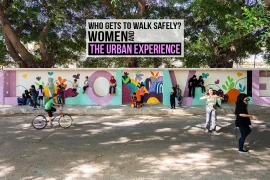
Historically, architecture has been a male-dominated field that has in one way or the other contributed to the formation of the physical environment which supports and sustains traditional gender roles and limits women’s access and experience of the built environment. However, this is changing and feminist architecture is slowly emerging as an important discipline in the quest to design inclusive and equal spaces for everyone. The challenges that have been reported to happen to women in urban areas- safety, access, and discrimination show a serious missing link in the conventional architectural processes, which have been known to perpetuate social inequalities. Nevertheless, feminist architecture may offer a possible solution through the integration of the needs and experiences of oppressed groups such as women in the design processes.

A Movement Born: The Origin of Feminist Architecture
Feminist architecture became a movement in the 1970s when women architects and scholars started to discuss the issue of gender imbalance in the profession and called for a different approach to architecture, one that would address the needs and experiences of a variety of people. There is evidence revealing that feminist architecture challenges gender biases in architecture and urban design, and seeks to develop more inclusive and enabling spaces; there is now a considerable body of work on gender and urban design that examines how the built environment affects gender and other identities.

Challenging the Status Quo: Patriarchal Planning and Its Shortcomings
It is possible to create a future that is more equitable if we challenge traditional urban planning, which has been based on patriarchal values and the centrality of economically active subjects. This approach means that the traditional approaches to designing cities and towns should be rethought with emphasis on equality, inclusion, and sustainability to show how existing planning traditions lead to the production of unsupportable, dangerous, and fragmented built environments for the excluded populations.
While patriarchal values have been persistent in creating public space, feminist urbanism offers a practical alternative to traditional urban planning. This approach is a very basic attempt to redesign the cities with a gender-neutral lens and with an understanding of the experience of everyone in the city. It entails an examination of the traditional planning approaches and a demand for the alteration and dissemination of new, inclusive urban forms.
Principles of Inclusive Design: Guiding Feminist Urbanism
To strengthen the concept of feminist city planning and to put into practice the concepts of inclusive urbanism, the following core principles must be followed in the formulation of future policies and the renewal of the built environment. These principles are:
- Embrace Diversity and Inclusion: It is important to consciously include and accept the various categories of urban people, based on their gender, race, ethnicity, class, sexual orientation, disability, and age. Design spaces that are universally accessible and inclusive.
- Ensure Safety and Security: Make sure that the urban environments are secure by increasing visibility, lighting, and proper access control of public spaces.
- Promote Accessibility and Mobility: To ensure that everyone can travel safely, conveniently, and accessibly, special attention needs to be paid to people with disabilities, the elderly, and children.
- Foster Economic Empowerment: Promote the economic development of women and other marginalized groups through the design and planning of cities to support business and revenue generation.
- Integrate Sustainable Development: Adopt environmentally friendly urban development strategies that are women and marginalized population-focused.
- Enable Community Engagement: Sustain and promote community engagement in city planning and policy-making to include the input of many people in the decision-making process.
The Indian Context: Recognizing The Gendered Natures Of Urban Realities
Indian cities are centers of opportunity, but they are also places where gender-based violence and exclusion are built into flawed urban design. Home is not the only place where safety threats are felt for women, girls, and gender minorities, but also in public spaces and this hinders their access to rights.
Women’s mobility patterns are also different from men’s which are characterized by ‘trip chaining’ or multiple short trips. They walk and use public transport a lot and therefore need good footpaths, lights on streets, and robust, affordable public transport. Current urban infrastructure often ‘gender blind’ has not taken these needs into account and as a result, vulnerabilities are increased and autonomy limited.

A Shift in Approach: From Reactive to Proactive Planning
Traditional criminal law approaches to violence against women are reactive. Feminist urbanism, however, focuses on preventative measures by addressing the spatial dimensions of safety. It recognizes that poorly designed public spaces, lack of gender-sensitive infrastructure, and spatial segregation contribute to women’s vulnerability.
Feminist Urban Planning advocates for a fundamental shift in urban planning, prioritizing gender equality and inclusivity. It acknowledges the intersectionality of identities, recognizing that women’s experiences vary based on class, caste, religion, sexuality, age, and disability. Key features include:
- Compact, mixed-use neighborhoods: Reducing travel distances and enhancing accessibility.
- Pedestrian-centric street design: Prioritizing walking and cycling infrastructure.
- Public provision of infrastructure: Ensuring access to essential amenities like well-lit streets, public toilets, and community spaces.
Recommendations for Change: Building Equitable Cities
Here are a few recommendations that could be followed to make cities more equitable :
- Constitutional Amendments: Amending Article 243W to empower municipalities as institutions of local self-governance.
- Architects Act Amendments: Ensuring representation of women and gender minorities in the Council of Architecture and integrating feminist urbanism into architectural education.
- Planning and Municipal Law Amendments: Mandating representation of women and marginalized communities in planning authorities, incorporating gender and safety audits, and empowering ward committees.
- Creation of Dedicated Municipal Offices: Establishing offices dedicated to women, gender, and sexual minorities’ affairs to provide expertise and ensure sustained service delivery.

The Right to the City: Towards a Vision of Inclusive Urban Spaces
Ultimately, the goal is to create cities for women, where they have the right to public space and the right to the city. For this, physical, social, mobility, and institutional infrastructure has to be developed so that cities are not only safe but also equitable. Therefore, the application of a feminist urban planning approach can transform the cities of India to be inclusive for all. Feminist urbanism is a very good strategy for the development of equitable and inclusive cities. In this manner, the hitherto marginalized voices are brought into the planning discourse, gender biases are demurred, and women’s safety and autonomy are addressed as central concerns. The making of such a change is a continuous process, and, therefore, the responsibility to effect this change must be shouldered by architects, urban planners, policymakers, and communities, so that everyone can lead a fulfilling life in cities.
Refrences:
- Article, Research, and Armita Limaki. “Issue 4 | 1.” Int J Med Net, vol. 2, no. 2995-3286, 11 Apr. 2024, p. 2024, www.opastpublishers.com/open-access-articles/feminist-architecture-and-challenging-genderbiased-urbanization-through-architectural-practice-an-overview-of-equitable-.pdf. Accessed 29 Mar. 2024.
- Palifrovska, Bojana. “Feminist Urbanism Approach to Urban Planning.” Urban Design Lab, Nov. 2024, urbandesignlab.in/feminist-urbanism-approach-to-urban-planning/. Accessed 27 Feb. 2025.
- Visakha, Sneha. “Feminist Urbanism: Smashing Patriarchy in Design.” Urbanet, 8 Mar. 2023, www.urbanet.info/feminist-urbanism-smashing-patriarchy-in-urban-design/. Accessed 27 Feb. 2025.
- —. “Making a Feminist City – Planning Safety and Autonomy for Women.” Vidhi Centre for Legal Policy, 1 Feb. 2021, vidhilegalpolicy.in/research/making-a-feminist-city-planning-safety-and-autonomy-for-women/. Accessed 27 Feb. 2025.