Self-sustaining cities are the way to create interconnected systems that aid economic growth, minimize environmental impacts, and improve quality of life while promoting social equity. As urbanization rate continues to spike, the development of self-sustaining infrastructures and efficient resource management will be key to ensuring the long-term sustainability and livability of urban centers. This vision of self-sustainability is approached through the concept of zero-waste cities in developing nations like India and Brazil. The rapid rate of urbanization drives the need for adopting approaches that balance the growth of these countries without compromising environmental preservation. These countries face similar challenges yet have adopted unique approaches towards achieving urban sustainability. This discussion highlights their practices and debates the feasibility of attaining truly zero-waste cities.

Citizen-driven waste management or incentive-based models?
India’s decentralized waste management, pioneered by cities like Indore, thrives on community participation, localized waste segregation, and organic waste processing. This strategy empowers citizens to manage waste at source, by also steadily creating jobs and not depending on capital-intensive infrastructure. Proponents say it promotes behavioral change and ownership and is a sustainable measure. However, critics assert that even though this approach is highly scalable, cost-effective, and adaptable, its success depends on sustained government-community collaboration and widespread awareness, which might easily fail in larger or less organized regions.

On the other hand, Curitiba in Brazil is a great example of practicing waste management, in which centralized programs under government management were successful. Incentives such as trading recyclables for bus tickets ensured compliance and offered convenience. Additionally, integrating this system with public transport maximized efficiency. Supporters tend to laud its structured approach, delivering holistic results at scale. Detractors, however, point out that such a model heavily relies on the use of advanced technology and government funding, which make it less implementable elsewhere, in poorer or more rural areas.

Which approach is more effective in emerging urban areas—fostering community ownership and participation, or relying on advanced technology for achieving sustainability?
Small-scale biogas systems or Advanced renewable energy technologies?
In the case of India, the cities are integrating renewable energy through small-scale biogas plants. The two most dominant approaches to the construction of zero-waste cities are the use of solar grids and the utilization of organic waste. Such endeavors go beyond satisfying a particular community’s needs and in fact, improve cheap power and solutions that are available to people, thus encouraging self-sufficiency and aiding sustainability. Believers ensure these models are easy to adapt, cost-effective, and can be quickly set up in areas with limited infrastructure. Critics are however concerned that local systems would be unable to meet the energy needs of industries and large urban areas. Moreover, the community involvement that this system requires can be slow and disorganized, making it harder to connect to a scale that has larger energy demands.
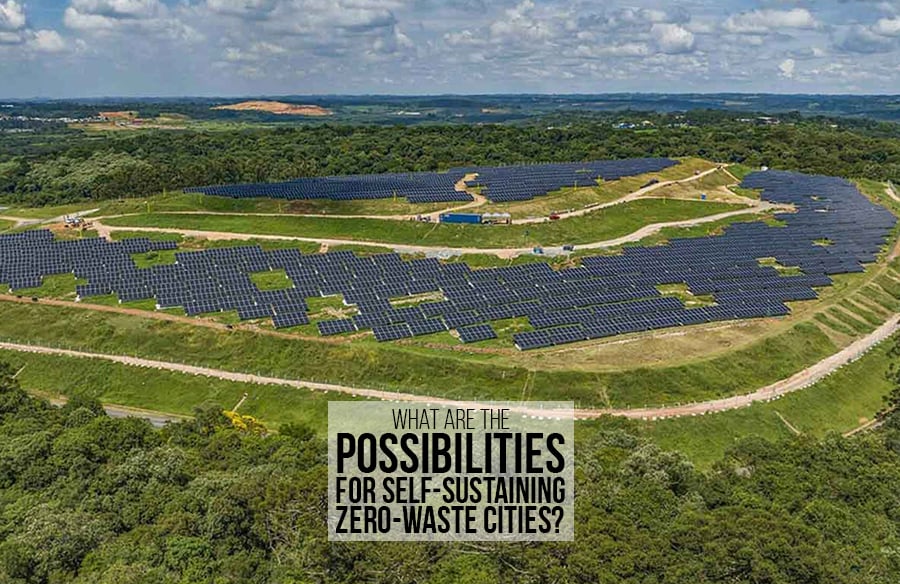
Large-scale renewable energy projects including the vast network of hydropower and centralized waste-to-energy plants is Brazil’s approach towards zero waste cities. Efficiency and reliability are the dominant features of these large-scale systems, powering industrial growth and urban development while reducing fossil fuel dependency by turning waste into energy and minimizing landfills. Detractors, however, argue that such projects come with high environmental and social costs, like deforestation and the displacement of communities, not to mention high upfront investments. Moreover, they believe that reliance on central infrastructure could work to undermine the long-term sustainability of cities that operate on zero waste. Centralized infrastructure makes supplies more vulnerable to natural disasters and sometimes changes in policy, especially in unstable governments.

Can social and environmental sustainability work together to create zero-waste cities? or do the trade-offs between community involvement and large-scale infrastructure cause inherent conflicts?
Informal or Formal circular economy practices?
India’s circular economy relies on informal systems, where waste pickers and small recyclers play a key role in collecting, sorting, and recycling waste. Cities like Pune and Indore benefit from these networks, which help turn waste into useful materials. This system reduces the amount of waste going to landfills, cuts down on pollution, and provides jobs for many underprivileged people. Supporters assert that this model is flexible, affordable, and effective for developing countries aiming to create zero-waste cities. However, critics point out problems such as poor coordination between informal workers and official waste systems, low-quality recycled products, and difficulties in expanding the model due to weak policy support.

However, Curitiba, the world-famous zero-waste city in Brazil, boasts a circular economy model via government-backed recycling groups and large-scale waste-to-energy plants. Advocates point out that it can process huge volumes of waste, generate quality recycled material, and support urban sustainability. Detractors, on the other hand, point out that the systems are expensive to establish and maintain. They also fear that these formal systems tend to exclude informal workers, and consequently, they take away jobs from people who need garbage collection for their livelihoods.
Should a zero-waste city model prioritize inclusivity or should it focus on scaling up for greater efficiency and sustainability?
The path towards creating zero-waste cities in developing nations like India and Brazil remains an intriguing and complex challenge. Both countries offer distinct approaches—India’s decentralized, citizen-driven models and Brazil’s centralized, formalized systems. Each has its advantages and limitations from inclusivity and adaptability to scalability and efficiency. Urban designers should focus on generating solutions that blend these approaches creating models that can be adapted to diverse socio-economic contexts. Ultimately, the question remains: how can urban planning evolve to balance sustainability, inclusivity, and scalability for truly resilient, self-sustaining cities?
Citations for Websites:
- Anon, (n.d.). Smart City Indore | Solid Waste Management. [online] Available at: https://www.smartcityindore.org/solid-waste/ [Accessed 19 Nov. 2024].
- saurabhadmin (2023). Sustainable Waste Management in Indore: A Case Study. [online] Earth5R. Available at: https://earth5r.org/sustainable-waste-management-in-indore-a-case-study/. [Accessed 20 Nov. 2024].
- Khaitan, S. (2019). How Indore Became India’s Cleanest City (And How Others Can Follow). [online] www.indiaspend.com. Available at: https://www.indiaspend.com/how-indore-became-indias-cleanest-city-and-how-others-can-follow/. [Accessed 21 Nov. 2024].
- www.newindianexpress.com (2020). Innovative waste management: How Indore retained its top position in ‘Swachh Survekshan 2020’. [online] The New Indian Express. Available at: https://www.newindianexpress.com/nation/2020/Aug/20/innovative-waste-management-how-indore-retained-its-top-position-in-swachh-survekshan-2020-2186100.html [Accessed 23 Nov. 2024].
- wwf.panda.org. (n.d.). Curitiba waste as resource. [online] Available at: https://wwf.panda.org/wwf_news/?204414/Curitiba-waste-as-resource. [Accessed 21 Nov. 2024].
- www.worldfutureenergysummit.com. (n.d.). Curitiba, Brazil: Waste management pioneer. [online] Available at: https://www.worldfutureenergysummit.com/en-gb/future-insights-blog/blogs/waste-management-pioneer.html. [Accessed 22 Nov. 2024].
- Plastic Expert. (2015). Curitiba, Brazil – Plastic Expert. [online] Available at: https://www.plasticexpert.co.uk/sustainable-recycling-curitiba/. [Accessed 23 Nov. 2024].