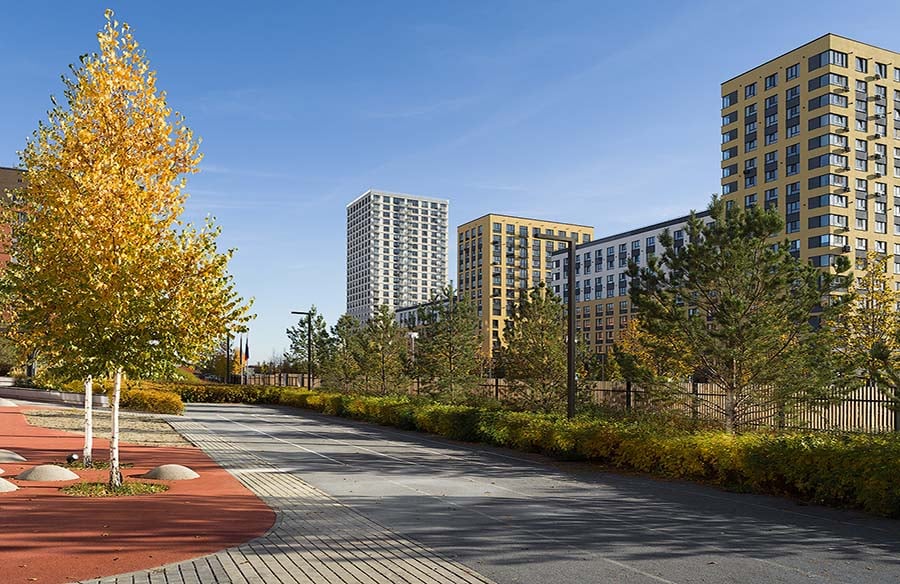
In 2011, the redevelopment of the Ob River embankment in Novosibirsk, Russia, began, marking a significant transformation in the heart of Siberia. This project aimed to convert an industrial zone and a fire station into modern residential districts, linked by an urban bike and pedestrian route forming a green corridor to the river port. One of these areas, the “European riverfront” microdistrict, is being developed by the Brusnika company.
Project Name: Microdistrict European riverfront Dutch urban tradition in Siberia
Studio Name: Brusnika
Location: Novosibirsk, Vladimir Zarnovnogo, 22
Design: 2016 – Present
Completion: 2018 – Present
Photography: Dmitry Chebanenko

Like many socialist cities built or expanded post-World War II, Novosibirsk features a monotonous urban fabric of multi-story rectangular buildings. Since the 1960s, the “microdistrict” concept—groups of residential buildings around a public facility—has been the basic and most common urban form.

The “European riverfront” microdistrict initially followed this Soviet typology but in 2016, Brusnika decided to rethink the master plan towards urban blocks. Here, an urban block is conceived as a closed structure built on a plinth, with an internal communal courtyard located above a parking area. While the microdistrict concept negates the street, the block activates it with diverse retail on the ground floors, aiding in traffic distribution and community function formation.

In 2016, the Dutch firm KCAP Architects & Planners, known for their strategic master plan for Perm, Russia, was invited to develop the new master plan for “European riverfront.” Their concept involves creating several large urban clusters of blocks and towers, interconnected by public spaces — squares with distinct characters. Each square is anchored by a 25-story tower, facing a well-maintained boulevard along the Ob River.

The regular street grid of “European riverfront” connects the river boulevard with the Soviet-era buildings further up the bank, while traditional blocks form within the residential area. To add diversity and a human scale, architects employed several principles: variable building heights with accent towers for navigation, varied facade grids with active massing like balconies and terraces, and a mix of 70% background architecture with 30% landmark buildings that attract attention and introduce new functions. Each plot in “European riverfront” was designed by a different architect, creating a “city within a city.”

Today, “European riverfront” is a large modern residential area with its own embankment, schools, kindergartens, and commercial, recreational, and public infrastructure. Already, 33 buildings have been completed and occupied, with another 12 under construction, housing around 12,000 residents. Brusnika plans to complete the development by 2030.