

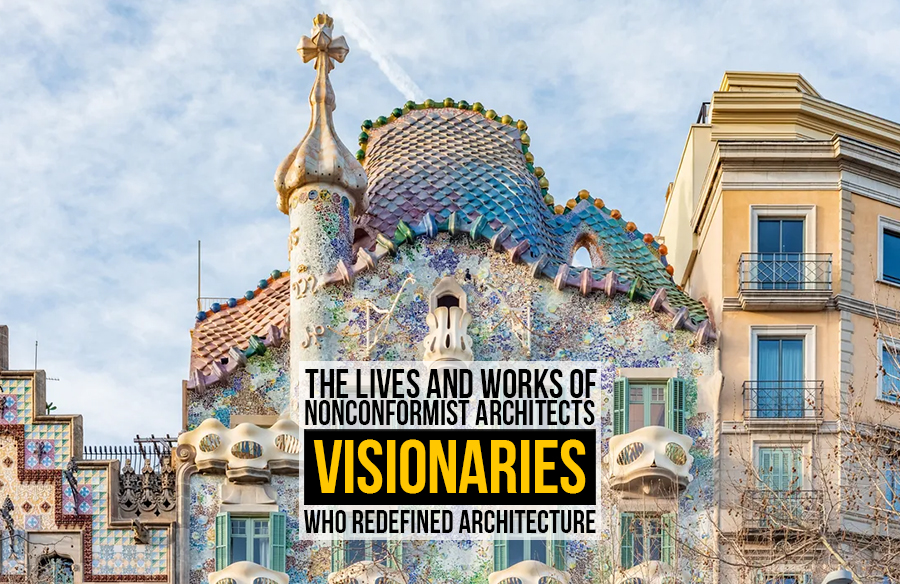
Architecture often brings to mind images of towering skyscrapers, sleek glass facades, or cozy homes that fit neatly within their surroundings. But some architects break the mold, pushing boundaries in ways that challenge our expectations and redefine how we think about buildings. These nonconformist architects have dared to defy conventional design, creating works that feel more like art than structure. Their stories are not just about creating unique buildings; they’re about rethinking how people interact with space itself. In this piece, let’s explore the bold visions of these innovators and see how their work continues to inspire fresh perspectives in architecture.
- Antoni Gaudí: The Architect of Dreams and Nature
Think of Antoni Gaudí, and you’ll likely picture his iconic, whimsical buildings in Barcelona. His style is unmistakable—colorful, organic, and deeply influenced by the natural world. Gaudí was a master of Catalan Modernism, but what set him apart was his bold use of form and texture. Instead of following straight lines or traditional layouts, he designed buildings that seem alive, almost like they’ve grown out of the earth.
His masterpiece, La Sagrada Familia, feels more like a forest than a church, with towering spires that mimic the shapes of trees. Gaudí studied natural forms for hours, carefully mimicking the curves and asymmetry found in plants and rocks. At the time, people found his work eccentric and even a bit odd, but he never wavered from his vision. Today, his creations are celebrated worldwide, inspiring architects to take cues from the natural world and think beyond rigid forms. His work invites us to see that architecture can be as dynamic and organic as nature itself.

- Eileen Gray: The Quiet Force of Functional Beauty
Eileen Gray may not be a household name, but her influence on design and architecture is undeniable. A pioneer of minimalist, functional design, Gray worked in both architecture and furniture. In the early 20th century, when male-dominated architecture circles overlooked her, she continued to create innovative pieces and spaces that blurred the line between art and functionality. Her approach to design wasn’t about making things grand; it was about making them deeply personal and practical.
Her most celebrated architectural work, E-1027, is a modernist villa that perfectly captures her attention to detail. Every piece of furniture in the house was designed to serve a purpose, each element carefully thought out to meet the needs of daily life. For instance, she created an adjustable table for the villa that could be used in multiple ways. This functional approach, combined with a simple elegance, set her apart from her peers. Gray’s life and work remind us that even quiet, understated designs can leave a lasting impact when they center around the people who will use them.

- Peter Zumthor: Crafting Spaces for Reflection and Connection
In a world of flashy skyscrapers and attention-grabbing designs, Peter Zumthor stands out for his simplicity. Zumthor’s work focuses on creating sensory experiences, places that invite people to slow down and feel connected to their surroundings. He isn’t interested in making flashy buildings; instead, he wants his spaces to feel quiet, almost meditative.
His Therme Vals in Switzerland is a spa built right into the mountainside, using local stone and a simple layout to create a sense of calm. The design echoes the natural landscape, making the spa feel as if it’s a part of the mountain itself. Zumthor believes that architecture should be about more than aesthetics—it should evoke emotion and give people a place to pause. His approach challenges the fast-paced nature of modern architecture, reminding us that sometimes, the most powerful designs are those that encourage us to slow down and connect.

Lessons from Nonconformist Architects: The Art of Thinking Differently
These architects each took their path, refusing to conform to traditional expectations. From Gaudí’s natural forms to Hadid’s flowing curves, their works offer a fresh way of looking at architecture. What connects them all is their willingness to think differently and to take risks that others might avoid. Gaudí’s organic designs challenge us to see buildings as living, breathing things. Gehry’s sculptural structures remind us that architecture can evoke emotion and change entire cities. Eileen Gray’s functional beauty and Zumthor’s sensory spaces show that good design doesn’t always need to be loud to be meaningful.
Their work teaches us that architecture isn’t just about making buildings—it’s about creating places that touch people’s lives, inspire communities, and invite us to see the world a little differently. These architects have shown that by pushing boundaries and embracing new ideas, architecture can be both functional and transformative. They inspire us to look at spaces not just as places to live and work, but as experiences that connect us to the world around us.
Bibliography:
- Parametric Architecture. Available at: https://parametric-architecture.com/an-overview-of-antoni-gaudi-philosophy-and-work/ (Accessed: November 2024).
- archdaily. Available at: https://www.archdaily.com/640870/images-from-the-much-anticipated-restoration-of-eileen-gray-s-e-1027 (Accessed: November 2024).
- archeyes. Available at: https://archeyes.com/peter-zumthors-therme-vals-sensory-architecture-in-an-alpine-retreat/ (Accessed: November 2024).







