Religious beliefs have been an inevitable aspect of civilizations that has never been known. It was the belief that a group of people shared that resulted in the establishment of an entirely new town. For a settlement to grow as a city or have an urban outlook, it required natural resources, a labour economy, trust, and a system governed by a superficial body: the god and a story or a myth for its revered persona. The laws of a way of life changed as an urban setup developed to allow people to coexist peacefully, resulting in the formation of culture and customs. Rituals were formed by giving meaning to positive and harrowing events through celebrations and mourning. Hence religion started to rise along with the rise of the city. One’s progression meant the other’s development and vice versa.
Space planning
Religion and culture have been the two sides of a coin in influencing the spatial arrangement of a town through its architectural form, symbolism, ritualistic paths and distinguishing sacred from profane. Religious towns have often been built around a place of worship which acts as a socio-spiritual hub. They have always been enclosed with economic and jurisdiction centres following axial patterns that resonate with the religion’s symbolism. For instance, ancient Egyptian cities like Thebes were aligned with the Nile River and celestial bodies, reflecting religious beliefs about the afterlife. The spiritual and cultural norms brought division in labour and resulted in hierarchy which then influenced the zoning. The placement of sacred buildings versus secular spaces reflected religious hierarchies. Hence, Religious communities were often allocated specific quarters in towns, creating distinct areas with their architectural styles, markets, and social institutions.

For example, Madurai, a city with a rich history and cultural significance, has been shaped by historical periods like the Pandya Empire, Nayak Dynasty, and British colonial rule. The Meenakshi Amman Temple, a significant landmark, is a labyrinthine space with numerous gopurams, courtyards, and shrines. The city’s streets are narrow and twisty, surrounded by shops, stalls, and residential buildings. Madurai’s complex urban fabric reflects the interplay of ancient and modern elements, showcasing its rich history, cultural depth, and urban complexity.
Apart from zoning, the transportation and road infrastructure depended on religious significance. For example, medieval European cities were often designed with streets leading to cathedrals or major religious sites. The Camino de Santiago in Spain, for instance, is a historic pilgrimage route that shaped the growth of towns along its path. Varanasi, one of the oldest continuously inhabited cities, is known for its complex network of streets and alleyways, influenced by its religious significance and numerous temples and ghats. The city’s unique atmosphere and cultural identity are attributed to its intricate layout.
Cultural traditions and building styles significantly influence town organization, with practices like communal living, home design, and nature integration reflecting Shinto and Buddhist beliefs. Asian cultures like Japan incorporate natural elements, while Islamic cities feature mosques and European towns have gothic churches and plazas.
The religious places that emphasise service, cater to a large number of people in need through Dharmashalas, Hospitals, almshouses, Sunday schools, gurukul, gaushala etc., thus, introducing new typologies that have to be considered and influence the planning of the city. Public spaces like parks, plazas, and squares become vibrant venues for religious and cultural festivals, that are integral to urban identity. For example, Prayagraj (Allahabad) where Khumb mela takes place at the Triveni Sangam makes the city ephemeral and adds character.

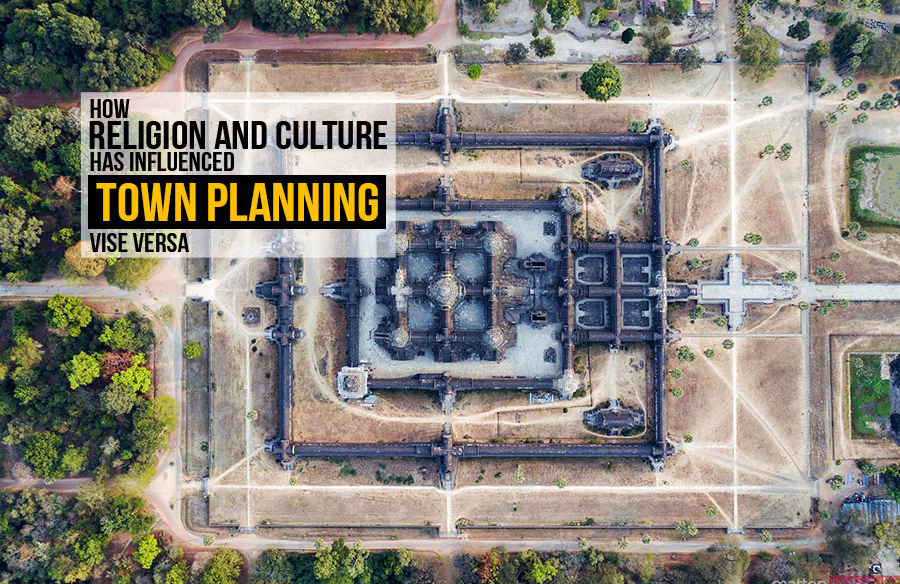
Religious laws and cultural codes play an important role in town planning. In Middle Eastern cities, Islamic law forbids common spaces for women and men. Hence, separate public spaces and guidelines for modesty are given. Symbolism and cosmology in town layouts can be seen in Hindu and Buddhist towns, often reflecting cosmic diagrams or theocratic cities. For example, the ancient city of Angkor Wat in Cambodia. Jaipur, Rajasthan’s capital, follows the Vastu Purusha Mandala, which divides space into grids to align with cosmic forces, encouraging prosperity, health, and well-being.
Religious urban identity
Cities shaped by culture and religion are diverse and dynamic, blending heritage with modern needs. Religious buildings often reflect a community’s cultural and spiritual values, showcasing unique architectural styles. The domes of mosques, the spires of churches, and the gateways of Hindu temples add variety and character to city skylines. Architects frequently incorporate religious symbolism and local traditions, creating buildings that resonate with the community’s heritage. The religious identity promotes tourism and pilgrimage contributing to the country’s GDP. Cities like Mecca, Vatican City, and Kyoto draw millions of visitors annually, leading to the development of hotels, restaurants, and shops around religious sites. This tourism often supports local economies but requires planning to manage crowding and resources.

Istanbul, Turkey, is a prime example of a city that combines Christianity and Islam, with its iconic mosques, churches, and palaces makes it an spot for secularism and tourism
Singapore‘s multicultural cityscape features temples, mosques, and churches, promoting cultural understanding in a secular setting. By incorporating religious and cultural considerations, cities become more inclusive, vibrant, and reflective of their communities.
Kyoto, Japan is home to over 2000 temples and shrines. The city’s layout includes distinct temple districts, where historic buildings and gardens are preserved alongside modern development. Traditional wooden houses, called “machiya,” also contribute to Kyoto’s cultural atmosphere.
Known as the cultural capital of Morocco, Fez is one of Morocco’s holiest cities, home to the University of Al Quaraouiyine, the oldest existing educational institution, originally a madrasa (Islamic school). The city is a centre for Islamic learning and culture.
During the colonial era, missionaries significantly influenced town planning, such as in Latin America where Spanish colonization led to the establishment of missions and churches. This led to cultural and religious syncretism, with hybrid forms of urban planning emerging, such as in the Philippines and Mexico, where Catholic church plazas blended with indigenous practices.
Indian outlook

Religion has significantly influenced urban planning in India, creating cities that reflect the diverse religious practices, spiritual beliefs, and cultural values of their inhabitants. The layout of the cities has been either influenced by a temple as a locus or mostly by a waterbody of significant ritual practice, for example, Varanasi and by mountains, for example, Tirupati which owns its significance due to the seven hills. Festivals and processional routes are designed to accommodate religious festivals and processions, with wide, accessible streets and public squares for safe and efficient gatherings. Symbolic layouts and sacred geography are also used to reflect religious cosmology or symbolism. Geography and waterbody have shaped religion which then moulded the town planning. Religious zoning and mixed-use development in Indian cities often provide space for various religious structures, such as temples, mosques, gurdwaras, and churches, within mixed-use areas that include residences, shops, and public facilities. Multifaith neighbourhoods in Indian cities often host religiously diverse communities within close proximity, reflecting India’s pluralistic ethos.
Religion in Indian urban planning shapes both ancient and contemporary cities, influencing their layout, infrastructure, and public life. Planners aim to accommodate religious diversity within secular, inclusive frameworks, creating vibrant, harmonious cities that reflect India’s rich cultural tapestry.
Multiculture neighborhood

Religious and cultural pluralism in cities involves balancing secularism and inclusion, addressing conflicts, and promoting dialogue and understanding. Cities often incorporate cultural and religious heritage sites into modern developments, preserving heritage while integrating them into infrastructure. Multicultural neighbourhood planning promotes religious diversity by creating close proximity for people of various faiths, discourages segregation, and offers affordable housing options and public amenities. Examples include Toronto, Singapore, and Jerusalem, where zoning laws accommodate places of worship and public spaces for cultural events. Secular cities promote social cohesion by focusing on shared civic values, ensuring equality for all groups, and encouraging inclusivity through policies that respect all belief systems. This approach fosters mutual respect and tolerance, ultimately enhancing a city’s social and cultural fabric.
Religion and culture have historically shaped urban environments, shaping their spatial arrangement, architectural forms, and social functions. As societies become more secular, these factors continue to influence urban environments, reflecting the values, traditions, and practices of the communities. Religious tolerance and urban planning intersect, aiming to create inclusive, harmonious environments that respect and celebrate diverse beliefs. This balance is essential in cities with varied religious demographics, where the built environment can either bridge or heighten social divides.