The dynamics of architecture across the world have been influenced by American and European design. Through the views of such innovative architects of that era, one may gain fresh perspectives on the celebrated architectural style.
European Architects.
Adolf Loos:
Adolf Loos‘s thoughts on practicality and dislike of ornamentation significantly influenced European architecture. He looked into the theory that removing ornamentation from everyday objects is an essential stage in the development of civilization. His attention to detail, love of fine craftsmanship, and sense of ‘Raumplan’, the deliberate arrangement and proportioning of interior spaces according to function remain highly regarded. Adolf Loos’s architectural ideas focused on functionalism, minimalism, and the rejection of adornment. It shapes the modernist movement in Europe. His concepts impacted contemporary architecture, the International Style, and the Bauhaus.
Ricardo Bofill:
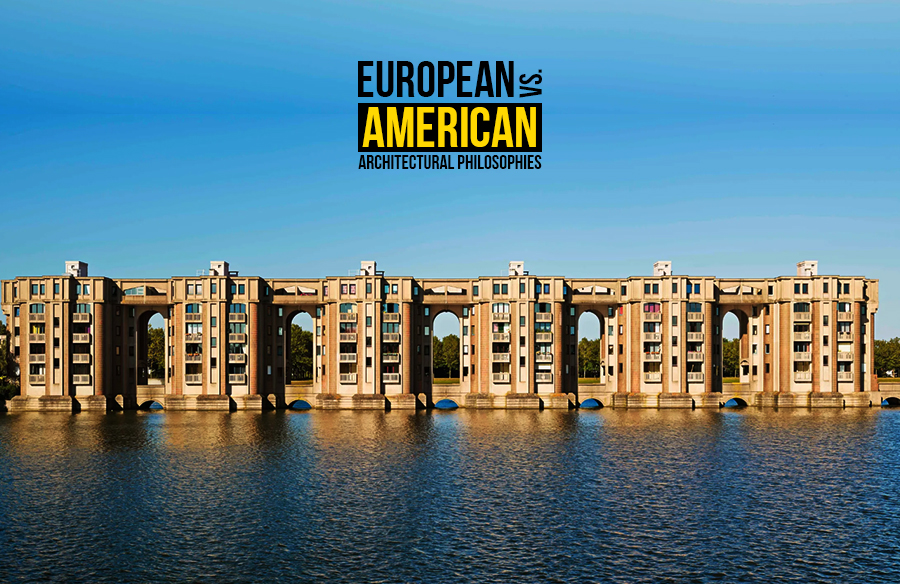
Spanish architect Ricardo Bofill gave European architecture a distinctive and diverse look by fusing postmodern, classicist, and modernist features. His forward-thinking, imaginative concepts influenced Europe’s built environment. The idea that architecture is a social and cultural expression was the foundation for his ideas.
His architectural concepts deviated from conventional modernism by fusing many inspirations to produce imposing, eye-catching structures that connect regional cultures. Bofill believed there were no lost causes in architecture, and that beauty could come from the most unlikely places. He wanted to create spaces that made people who didn’t know about architecture realise that architecture existed.

Charles Garnier:
Garnier’s architectural philosophies combined grandeur, practicality, and creative invention. It had a lasting influence on European architecture despite having its roots in historicism and eclecticism. His method demonstrated a shift from the more elaborate architectural forms of the past to the more varied expressions of modern architecture. Garnier advocated eclecticism, a method of building that doesn’t exactly follow one historical style but instead pulls from a number of them. His creations combine Baroque, Renaissance, and Classical architectural styles. This creates a building that is not just ornamental and large but also indicative of the cultural richness of its time.

Jorn Utzon:
Utzon’s architectural vision was distinguished by a profound reverence for the natural world, an awareness of the connection that exists between form and function, and an acceptance of modernist concepts that were blended with inspiration from a wide range of cultures and traditions. His work had a profound impact on European architecture, inspiring designers who aimed to preserve human-focused and functional designs while escaping the strict confines of modernist architecture.
Antoni Gaudí:
The Catalan architect Antoni Gaudí transformed European architecture with his incredibly original, creative, and natural style. His philosophy blended inventive material and form utilisation with inspirations from local customs, religion, and the natural world. Despite transcending one architectural period, his works, many based in Barcelona, came to represent Catalan Modernisme (Catalan Art Nouveau). This philosophy of biomimicry was revolutionary in European architecture, offering a stark contrast to the rigid geometric forms of classical and modernist architecture. His use of organic shapes helped influence the development of biomorphism in the later 20th century.

Peter Zumthor:
Peter Zumthor’s emphasis on mood, materiality, simplicity, and the human experience has influenced European architecture. Through his focus on the tactile properties of materials, spatial perception, and the interplay between buildings and their environments, Zumthor has inspired a new wave of European architects to design more contemplative, classic, and significant structures. Zumthor’s architecture is fundamentally experiential. He believes architecture should evoke emotions and create a specific atmosphere, engaging all the senses. He believes that architecture should respond to the cultural, historical, and environmental aspects of a site. This sensitivity to context leads to buildings that feel intimately connected to their surroundings, rather than imposing upon them.
American Architects.
I.M.Pei:
The blend of form and function integration, contextual awareness, and modernist ideas influenced Pei’s design ethos. Pei’s strategy balanced innovation and tradition, contributing to the development of American architecture. Pei’s artwork showed an interest in geometric shapes, particularly triangles and other angular forms. He considered light to be a substance in and of itself, therefore using it was another key aspect of his philosophy. Pei valued tradition even as he embraced modernisation; he frequently blended cutting-edge methods with a profound regard for cultural heritage. It was evident that contemporary American architecture could be important abroad and participate in the worldwide architectural conversation. Thus, amid growing urbanisation and modernisation, his influence helped steer American architecture toward a more cosmopolitan, forward-thinking direction.

Robert Venturi:
Robert Venturi played a significant role in influencing the development of American architecture, especially with his contributions to postmodernism and his critique of modernist dogma. His concepts fundamentally changed the architectural scene by subverting the prevailing modernist tenets of functionalism, and minimalism, and rejecting historical allusions. Venturi criticised the modernist ideology “less is more” and instead contended that “less is a bore.” He argued for a design that encouraged complexity, ambiguity, and contradiction. Venturi believes that historical allusions, ornate details, and an array of architectural forms should be included in structures to represent the complexity of the human experience. It was a notable divergence from modernism’s utilitarian, austere designs.

Richard Meier:
Modernist architecture throughout the second half of the 20th and early 21st centuries has advanced significantly through Meier’s work distinguished by an emphasis on light, purity of form, and a stark, white palette. His vision was deeply influenced by the designs of Le Corbusier, and the International Style left an indelible mark on American architecture. Light plays a crucial role in Meier’s architectural philosophy. He perceived light as the essence of space, using it to animate surfaces and volumes. Meier often situated his buildings on elevated sites or strategically within landscapes, creating a dialogue between the built and natural worlds. His steadfast adherence to modernist ideals highlighted the projects’ ageless quality, even in the face of the emergence of other architectural trends like postmodernism and deconstructivism.

Eero Saarinen:
While Saarinen advocated the modernist maxim “form follows function,” he took this principle further by emphasising emotional and symbolic power through architectural forms. Saarinen was known for creating bold, sculptural forms that broke away from the rigid geometric shapes favoured by many modernists. Saarinen pushed the boundaries creating breathtaking architectural forms, often playing with steel, glass, and reinforced concrete. He was a forerunner in the use of new materials and building technology. Eero Saarinen’s bold, visionary designs had a lasting impact on American architecture.

Charles Moore:
Charles Moore, a significant figure in American architecture, is most known for influencing postmodernism. He advocated for a site-specific design that accounted for the local history, culture, and environmental surroundings giving each of his projects a unique architectural style. Moore’s creations contributed to American architecture away from the sterile, austere modernist structures, also known as “glass boxes.” He promoted a more ornamental, diverse, and vibrant architectural style by endorsing postmodern eclecticism, which allowed architects to combine forms, materials, and styles in ways that more accurately represented the cultural variety of America. Charles Moore’s ideas changed the direction of American architecture, emphasising designs that were more whimsical, humane, and sensitive to their surroundings.
References:
- Wikipedia (2024). Adolf Loos [Online] Available at: https://en.wikipedia.org/wiki/Adolf_Loos [Accessed October 8, 2024]
- Journal (2022). How Ricardo Bofill Changed Architecture [Online] Available at: https://architizer.com/blog/inspiration/collections/ricardo-bofill-passes-away/ [Accessed October 8, 2024]
- Modernism/modernity (1994). Charles Garnier’s Paris Opera: Architectural Empathy and the Renaissance of French Classicism, and: In the Theatre of Criminal Justice: The Palais de Justice in Second Empire Paris [Online] Available at: https://muse.jhu.edu/article/22989/summary#:~:text=Concentrating%2C%20unexpectedly%2C%20on%20architectural%20theory,they%20hoped%2C%20would…/ [Accessed October 8, 2024]
- Wikipedia (2024). Jørn Utzon [Online] Available at: https://en.wikipedia.org/wiki/J%C3%B8rn_Utzon#:~:text=successful%20architectural%20design.-,Architectural%20approach,architecture%20will%20look%20after%20itself.%22 [Accessed October 8, 2024]
- About Antoni Gaudí | Life, Philosophies, Works & Quotes | Barcelona Experience (no date). Barcelona’s Antoni Gaudí: Thoroughly Catalán, Thoroughly Unmatched [Online] Available at: https://www.barcelonaexperience.com/sightseeing/about-gaudi#:~:text=He%20believed%20with%20conviction%20his,given%20gift%2C%22%20he%20said. [Accessed October 8, 2024]
- UGREEN (2024). Peter Zumthor: Master of Minimalism and Architectural Experience [Online] Available at: https://ugreen.io/peter-zumthor-master-of-sensuous-minimalism-and-architectural-experience/ [Accessed October 8, 2024]
- Archinomy (2019). Robert Venturi [Online] Available at: https://www.archinomy.com/case-studies/robert-venturi/ [Accessed October 9, 2024]
- WhereIsTheNorth (no date). IM Pei: Famous Works and Philosophies [Online] Available at: https://www.whereisthenorth.com/article/im-pei-famous-works-and-philosophies [Accessed October 9, 2024]
- Famous Architects (2015). Richard Meier [Online] Available at: https://www.famous-architects.org/richard-meier/ [Accessed October 9, 2024]
- Modern Homes Portland (2023). Eero Saarinen & The Purpose of Architecture [Online] Available at: https://www.modernhomesportland.com/eero-saarinen-the-purpose-of-architecture/ [Accessed October 9, 2024]
- Designerlythinking (2023). Design principles of Charles Moore: Living in and speaking of places [Online] Available at: https://designerlythinking.wordpress.com/2011/04/21/design-principles-of-charles-moore-living-in-and-speaking-of-places/ [Accessed October 9, 2024]