Initial
“Originality consists of returning to the origin” quoted by Antoni Gaudi. He was a Catalan architect born on 25th June 1852 in Reus, Spain. He was the youngest of all 5 children in his family. His life was full of death and sorrow. From his childhood, he suffered from rheumatism (a disorder that affects muscles, joints, and bones) therefore, he was a quiet and reserved child from a young age. In summer when other kids played he had to rest and at that time he used to observe nature for hours discovering different fascinating patterns in it, which stayed with him in his progressive years and guided him to become a world-known unconventional architect.

Middle
Antoni Gaudi is regarded as the “Father of Modernisme” (Catalan Modernism). In 1878 he graduated in architecture from Barcelona and while giving him the degree the director said- “We have given this academic title either to a fool or a genius. Time will show.” And time did show Gaudi got his first project from Barcelona City Council to design lamp posts. Yes, you heard that right. After this, his architectural journey began and people started following Gaudi’s aesthetics. He was extremely good at understanding the structures because he studied geometry at a young age. His work frequently shows the usage of celery curves, hyperbolic paraboloids, hyperboloids, helicoids, etc. He experimented a lot with dynamic and organic structures but rarely did sections and elevations for his designs. He believed in scaled models or casts or even improvisation on-site as work progressed.
He says that nature is the greatest teacher. Gaudi found abundant examples in nature such as – there is no better structure than the trunk of a tree or a human skeleton to understand how a structure operates. As these are functional and fulfil the criteria of aesthetics simultaneously. He has mastered the art of nature’s understanding of structures. Also, as he belonged to a family of boilermakers the art of working with space and volume was in his blood which helped him to carve 3 dimensional creations.
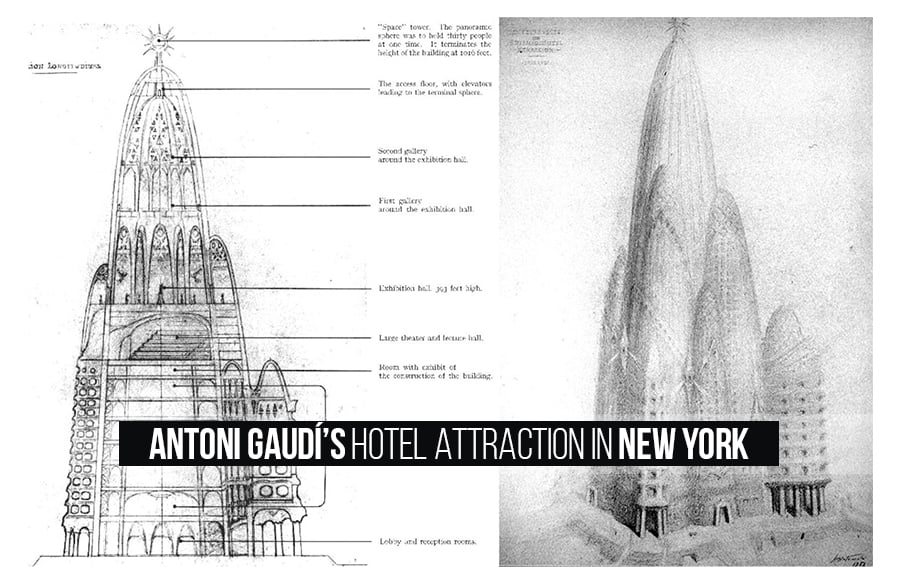
At this point, Antoni Gaudi was commissioned to design a lot of structures for different projects one after another within Spain and even across the world. In 1908, two American businessmen approached Gaudi to design a structure for lower Manhattan. Here comes the unknown, infamous futuristic structure designed by him known as the “Hotel Attraction” for New York City. The structure was about 360 mts. high (1181 feet tall). It was a combination of restaurants, a theatre hall, an exhibition, a gallery, a hotel, and a panoramic view at the top known as the “Space Tower”. The space tower can take 30 people in one go to see the aerial view of the city. Being a Gaudi’s structure, it was unconventional and had an organic shape similar to a mountain. Imagine how giant the structure would be if built in place of the present-day World Trade Centre in America as planned.


The End
The structure was planned up of a central body with a circular plan surrounded by 8 lower lateral structures, with 4 entrances. It also has 5 dining rooms indicating 5 continents of the world. The building would occupy 115 x 140 mts. of space and is sketched to be in a parabolic shape. Another interesting fact about Gaudi’s proposal was that the first 6 floors were restaurants and the remaining others were dedicated to the cultural spaces. Also, similar to a human body the tower has a mundi-axis with its plan, centred directly below the spherical lookout on the top. At last, it all remains on paper as Gaudi being a socialist values culture more than revenue generation. He was very famous for designing religious buildings namely- Sagrada Familia, Colonia Guell, etc. Gaudi envisioned utilising all his knowledge of indigenous crafts, his experiments done with different styles, and his learnings to design a very futuristic structure for America. But, one story says Gaudi fell ill in 1909, therefore the project was cancelled while the other said that the Americans wanted the hotel to cater only to the city’s wealthiest and elite group. Gaudi did not align with the target audience and stayed true to his communist ideals, he abandoned the project.
In his lifetime Gaudi has struggled a lot because of the early and consecutive deaths of his loved ones and finally, when he passed away in 1926 on 7th June in an accident nobody was able to recognize him. His appearance was different and many times confused him with a beggar. Now, what has survived is his legacy of unconventional thoughts and ideas as giant structures that are honoured as World Heritage sites majorly in Barcelona speaking about themselves.
Gaudi always believed and quoted that one who collaborates with nature can create while another can only copy thus, the conclusion is- “Nothing is invented, for it is written in nature first”.
Online sources:
Citations for websites:
Christopher James Botham. Antoni Gaudi New York Skyscraper. [online]. Available at: https://www.onverticality.com/blog/antoni-gaudi-new-york-skyscraper [Accessed 22 Sep 2024].
Unbuilt Arch (2021). Attraction Hotel. [online]. (Last updated 16 Sep 2021). Available at: https://unbuiltarch.org/en/03-attraction-hotel/ [Accessed 22 Sep 2024].
Images/visual mediums:
Citations for YouTube videos:
BlessedArch. (2022). The life and designs of Antoni Gaudi. [YouTube video]. Available at: https://youtu.be/ebfbFAoo9aA?si=MDGNe3eF1Y87Dxr6 [Accessed 22 September 2024].