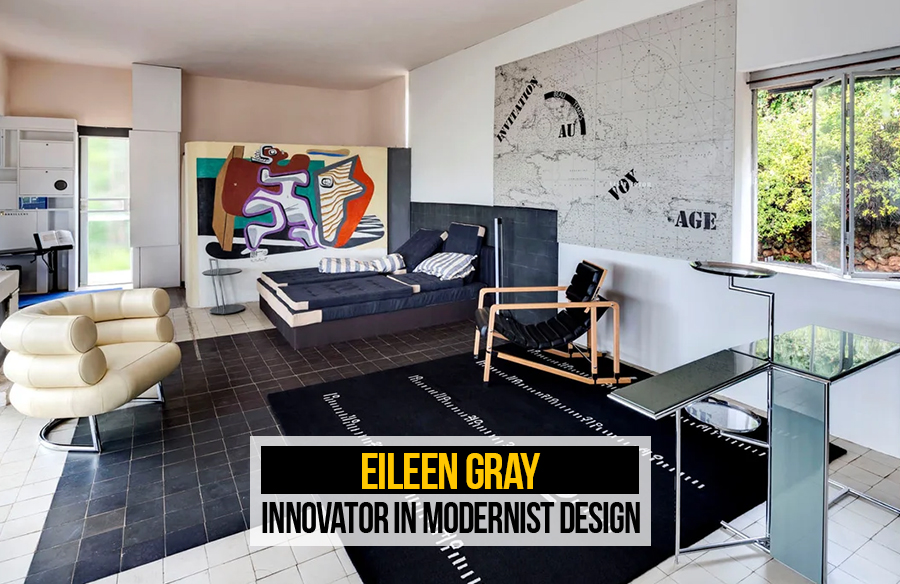
Eileen Gray was an early pioneer architect and furniture designer who transformed modernist design. Lacquer work was one of her first experiments, but with bold architectural works, Gray created a huge contribution to modernist aesthetics that has largely gone unnoticed. Analysing her design philosophy, major works like E-1027 and how she exerts influence over modernist architecture and design, this article provides insight into her work, her perspective as a woman in this mostly male sector even more underlines an innovative approach, incorporating functionality with aesthetic sensibility.

Eileen Gray’s Legacy in Modernism
Eileen Gray is one name that will come up repeatedly in discussions of modernist design. However, her true influence stems far beyond those few iconic pieces on which she left her mark. Born in 1878 in Ireland, Gray’s art and design interests took her to Paris where she pioneered furniture design and architecture (Adam, 2009). A figure who would make weirdness mainstream, Gray was a deviant in a male-dominated world of early 20th-century modernism, with a design language that continues to influence.
Eileen Gray’s life, work, and importance: this paper focuses on a good emphasis on her role as an innovator; modernist principles merge with a deep sense of individuality in her. An analysis of furniture design, architecture, and lesser-exposed projects of Gray establishes her not just as a follower of modernism but an essential contributor to the evolution thereof (McCarty, 2007).
Early Years and Influences of Eileen Gray
Gray was exposed to many forms of artistic tradition during her formative years. She was a member of the aristocracy in Ireland and thus had access to education and travelling good fit in her development as a designer (Adam, 2009). Her study at the Slade School of Fine Art helped Gray secure an advantageous position in London before moving off to Paris to be affiliated with the Art Deco movement. However, Gray’s work was soon to be freed from such stylistic constraints with evidence of her further inclinations towards modernism (Wilk, 1980).
Her early infatuation with lacquer work, oriented towards the Japanese, showed her early entrance into design. This craft, so minute in itself and merged with the aesthetic eminence and practical application, represented the dualism that became characteristic of her later forays into modernist architecture (Adam, 2009).

Furniture Design: Craftsmanship Meets Modernism
Gray’s most iconic contributions, perhaps, to modernism remain her innovative furniture pieces. Those are simply iconical in design today. Her work was useful but fundamentally artful with sensitivity to material and form (McCarty, 2007). Two of the best examples representing her methodology include the Bibendum Chair and the Adjustable Table E-1027.
The Bibendum Chair, created in 1926, would be considered the modernist ideal of pure lines and minimalism, but apply those to include the element of playfulness in the form that this chair exhibits. Named after the Michelin Man, the inflated leather cushions of this chair are thus an eye-catcher and pretty comfortable at the same time. The Adjustable Table E-1027, created in 1927, displays how Gray cared about user experience with its adaptability to change height and adjust to various needs.
What characterised Gray’s furniture design was her ability to balance modernist principles with a sensitivity toward human experience, placing her far beyond the reach of most of her contemporaries. She was able to anticipate many later trends in furniture design, such as modularity and adaptability (Overy, 1991).
Architectural Innovation: The Case of E-1027
Gray’s venture into architecture resulted in one of the most famous achievements she made: the Villa E-1027, which she designed between 1926 and 1929 on the French Riviera. The building has turned out to be one of the classics in the modernist architecture exposition of how the functionalist principles are carried out while maintaining an impulse of warmth and livability.
Gray designed E-1027 for herself and her lover, architect Jean Badovici. The name itself reads as a cryptogram of their initials (E for Eileen, 10 for J, 2 for B, and 7 for G). The house is an exemplary classic typification of Gray’s humane approach to design. Most modernist architects who placed abstractions before comfort were not concerned with how individuals would live in and negotiate the space; Gray did (Constant, 2000).
E-1027 is characterised by its integration into the surrounding space and the use of light and ventilation. Modular furniture used in the house could be rearranged according to the need, an idea that precedes later developments in open-plan living (Wilk, 1980). Additionally, her use of built-in furniture and multipurpose spaces was revolutionary for a time when homes were still partitioned into rigid, functional zones (Adam, 2009).
However, the history behind the house is quite complex. From his departure from the project, Badovici’s friend Le Corbusier is known to have painted murals on its walls in opposition to Gray’s will. The act was also seen by many as an intrusion into Gray’s creative space and had much to do with the gender dynamics that ran within the architectural world at that time. It was this intrusion which sometimes overshadowed the commendable work Gray did on the house (Constant, 2000)

Gray’s Impact and Overlooked Contributions
Eileen Gray’s legacy was eclipsed by the work of male contemporaries, notably Le Corbusier, writes Adam in the year 2009, despite her monumental collection of work. Many years passed wherein her contribution toward modernist architecture and design was either rejected or attributed to others. Only in the late 20th century did her work gain acclaim for innovation, according to McCarty in the year 2007.
Gray’s design approach of a holistic nature in which architecture, furniture, and interiors were part of a seamless whole was visionary. Simultaneously, her focus on the sensory and emotive aspects of living spaces separated her from the more harsh displays of modernist architects (Wilk, 1980). Her designs targeted not only tastes but also the needs of the human body and psyche (Overy, 1991).
Gray’s Late Works and Rediscovery
Still in her later years, Gray continued to design furniture and interiors, albeit much more in obscurity compared to when she was younger. The last major undertaking was Tempe à Pailla, again playing with modular living, taking interior living into subtle balance with exterior surroundings (Adam, 2009).
It was during the decades following her death in 1976 that interest in Gray’s work picked up again, catalysed by exhibitions and scholarly works that acknowledged Gray as one of modernism’s pioneers (Constant, 2000). Other significant factors include perhaps the restoration and preservation of E-1027 were one of the reasons why Gray’s work was brought back to the limelight (Wilk, 1980).
Conclusion: Lasting Legacy of Eileen Gray
Modernism is an important chapter in innovation and the commitment by Eileen Gray towards designing human-centred. Her ability to infuse beauty and aesthetic appeal into practical functionality has made her one of the most innovative designers of her time. With her magnificent furniture and architecturally oriented masterpieces, Gray remains an inspiration to architects and designers even today (McCarty, 2007).
Gray’s story, above all else, was a testament to resilience in an area that was rarely open to women’s work. Today, her designs are valued for their aesthetic worth but now also for their importance in transforming modern living spaces. Appreciating Gray’s work, we appreciate the breadth of modernist design and its potential to advance our living conditions, our working space, and our general interaction with the physical world around us (Adam, 2009).
References:
Adam, P. (2009). Eileen Gray: Her work and her world. Thames & Hudson.
Constant, C. (2000). Eileen Gray and the design of E-1027. Journal of Architectural Education, 54(4), 232-239. https://doi.org/10.1162/104648800564659
McCarty, C. (2007). Eileen Gray: Designer and architect. Princeton Architectural Press.
Overy, P. (1991). Eileen Gray: Designer of modernity. Architectural Review, 189(1135), 64-72.
Wilk, C. (1980). Eileen Gray: Pioneer of modern design. Design Quarterly, 115, 1-48. https://doi.org/10.2307/4091157
Grufferty, S. (2023, June 18). Eileen Gray: a pioneer of modern furniture, lighting, and architecture. Gruffertys. https://www.gruffertys.com/blogs/the-journal-interiors-unleashed/title-eileen-gray-a-pioneer-of-modern-furniture-lighting-and-architecture
Natacha. (2023, December 27). Eileen Gray, the precursor of modern design. Limobel. https://limobelinwo.com/en/eileen-gray-the-precursor-of-modern-design/