

Role of Ornamental Architecture

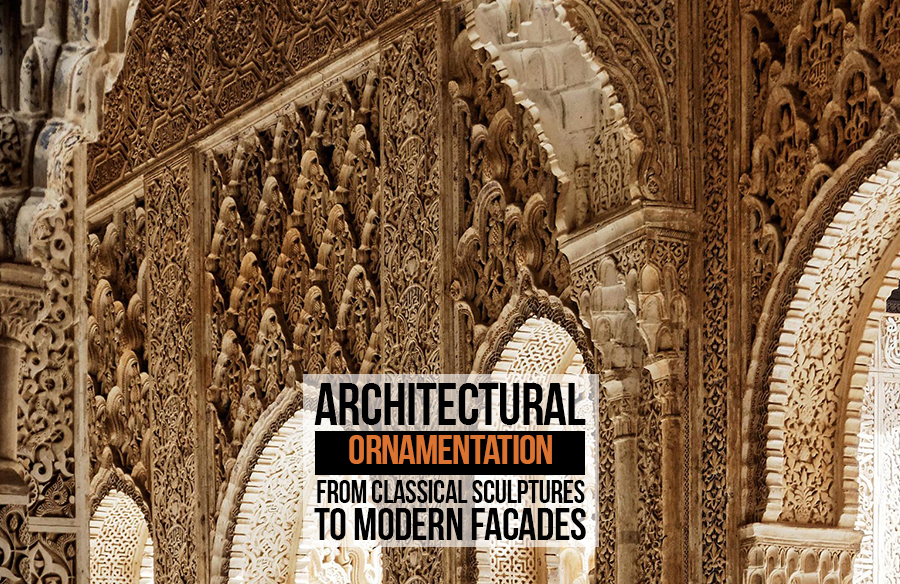
‘The absence of ornament had brought other arts to unsuspected heights’. A famous Australian Architect has written essays and a Book about how Ornamentation is a crime. Contrary to that, all historical and modern-day examples have proven how interdependent ornamentation and architecture are. Classical architecture formed the basis for all ornamental maximalist architecture, but around the 20th century, the rise of modernism led architecture to a different path. The architecture reflected the social, political, and technological landscape, and a simplistic, functional approach was adopted. Over the years postmodernism took the stage and major movements such as Neo-Eclecticism brought attention back to the decorative arts.

Historical Overview
More than a century has passed discussing the impact of ornamentation on the two extremities: its apprehension and its appreciation. Art in its vague description has acted as an ornamental addition forever and in the recent ages, it has been accepted largely due to its vast design opportunities. The earliest examples of ornamental art can be captured in the earliest civilizations. Egyptian art, hieroglyphics, and carved symbols can be seen running through the ancient pyramids showcasing the human need to represent society, culture, and religion through art and architecture.

Classical Architecture
Ancient Greece and Rome emphasised aesthetics and beautification of Architecture. All major structures of this period are crucial examples of the vital utilisation of art and ornamentation in Architecture. Classical Architecture was an embodiment of untold stories, of grandeur and sophistication. The assimilation of highly decorated friezes, detailed sculptures, and frescoes all helped dictate those stories. The flagship amongst these was the introduction of the classical order of columns which paved the path for ornamental architecture.

The Triumphal Arches of Ancient Rome are yet another hallmark. The arches are adorned with intricate relief carvings, each with a meaning behind it. The textual carvings add to the artistry of the structure while the Corinthian columns add to its elegance.

Renaissance Revival
The Renaissance period produced some iconic structures characterised by their interlinked adaptation of ornamentation, art, and architecture. Architects like Filipino Brunelleschi and Andrea Palladio were the key architects of this period creating structures that revived classical elements with an additional understanding of art and aesthetics. This era’s structures established a foundational paradigm between cultural representation and ornamental architecture. The Sistine Chapel is a prime definition of how art acts as an ornament in architecture. The masterpiece by Michaelangelo incorporated highly detailed frescoes that redefined architecture. The complex iconography has set a mark for architects through the ages.

Baroque and Rococo
Known for its lavish take on ornamentation, Baroque and Rococo movements were witness to the peak of decorative architecture. Playful and Dramatic are two words that describe this era. The elaborate stucco work. Extensive use of gold ornaments, a sense of playfulness, and exuberant use of flowing forms led to a new direction of art and architecture. Ornamentation was revolutionised during this period, movement was created with the use of bold structures, and curvilinear forms. These structures were laid with volutes, scrolls, and intricate carvings.

The Decline of Ornamentation- Rise of Modernism
With the Industrial Revolution creating its impact all over the world, architecture, and ornamental architecture took a huge turn. The architecture was then based on functionality, simplicity, cleaner forms, and defined structures. Ornamentation utilisation was reduced to a minimum, even for the most iconic of structures. Movements such as Bauhaus, De Stijl, Structuralism, and Functionalism rose under the umbrella of Modernism which eliminated ornamentation right from its roots.

Despite the lack of extravagant construction, movements like Art Deco and Art Nouveau re-introduced the world with organic forms, and decorated structural forms using elements from the industrial revolution itself. Architecture was treated as a ‘Total Work of Art’ where all arts blend in harmoniously. A synthesis of ornament and structure with materials such as Ironwork, glass, ceramics, or brickworks. Casa Mila by Antoni Gaudi, Hotel Tassel by Victor Horta, and many such architects’ works strove to give architecture its classical essence back.

Postmodernism and Contemporary Architecture
In the current context, ornamentation plays a very different role than just an aesthetic inclusion. It is used for structurality, functionality, and efficiency. Ornamentation now has undergone technological upgradation and these progressive ideologies are visible in modern-day facades, parametric forms, and dynamic structures.
Another parameter affecting the contemporary take on ornamentation is sustainability.
Materiality and Form are the new ornamentation. In the world of visual and augmented reality, imagery has created the framework for contemporary ornamentation. Cultural, social and economic sectors of society form the architectural understanding which in turn affects people’s perceptions of art, ornamentation, and design at large. As societies evolve, so do their architectural languages. What was once just a decorative element is now an integral segment of architecture. Similarly, multiple components of ornamentation are now considered otiose. This evolution marks the relationship between humans and architecture, explaining how architecture runs beyond just a mere structure instead is an active reflection of the environment around it.
REFERENCES:
- Balık, D. and Allmer, A. (2016a) ‘A critical review of ornament in Contemporary Architectural Theory and Practice’, A/Z : ITU journal of Faculty of Architecture, 13(1), pp. 157–169. doi:10.5505/itujfa.2016.73745.
- Balık, D. and Allmer, A. (2016b) ‘A critical review of ornament in Contemporary Architectural Theory and Practice’, A/Z : ITU journal of Faculty of Architecture, 13(1), pp. 157–169. doi:10.5505/itujfa.2016.73745.
- Elrayies, G.M. (2018) ‘Architectural ornaments in the twenty-first century: An analytical study’, Cities’ Identity Through Architecture and Arts, pp. 9–25. doi:10.1201/9781315166551-2.
- Nilam, W. (2023) ‘Fusion of ornamental art and architectural design: Exploring the interplay and creation of unique spatial experiences’, Studies in Art and Architecture, 2(3), pp. 10–27. doi:10.56397/saa.2023.09.03.







