The essence of architectural practice fundamentally lies in the precise execution of the vision conceived by the architect. The successful translation of an architect’s initial concept into a tangible, built environment is largely dependent on a strong set of visualisation skills. From the moment a client’s requirements are outlined to the development of preliminary ideas and subsequent drawings and 3D visualisations, the entire process is predominantly visual. Each step, from conceptualization to final execution, hinges on the architect’s ability to effectively envision and represent their ideas.
The rigorous five-year academic curriculum of architecture plays a pivotal role in honing these skills. During this formative period, aspiring architects are trained to design, visualise, calculate, and analyse spaces simultaneously rapidly. This comprehensive training fosters a developed mental framework crucial for successful architectural design. Once a design is finalised, architects often create detailed 3D mockups or renders to convey their vision more concretely and to facilitate clearer communication with clients and stakeholders.
However, it is very rare for the finished product to match the initial design exactly as conceived. Architectural plans are frequently subject to modifications and revisions due to various factors such as client feedback, budget constraints, or unforeseen technical challenges. As a result, the designs must continually be adaptable throughout the project’s lifecycle. Given these dynamics, it is essential for architects to undertake a reflective review upon project completion. This involves assessing what was initially planned, examining the nature and reasons for revisions made during the project, and evaluating the outcome in relation to the original vision.
This reflective process is where photography becomes an invaluable tool. Documenting the completed project through professional photographs allows architects to capture and analyse the end product in detail, providing a visual record that highlights both the successes and the deviations from the initial design. Photography thus plays a crucial role in the comprehensive evaluation and closure of an architectural project, offering insights that contribute to the ongoing refinement and improvement of architectural practice. The following points discuss in detail as to how photography plays a vital role in architectural practice:
- Visual Record of a Project
The process of construction is a multifaceted and extensive journey, encompassing a series of meticulously coordinated stages. From the initial excavation required for laying the foundation to the intricate work involved in shaping the structure and finally, the development of its interiors, each phase plays a vital role in the overall outcome. In this context, photography plays an essential role in the documentation of this journey from start to end.
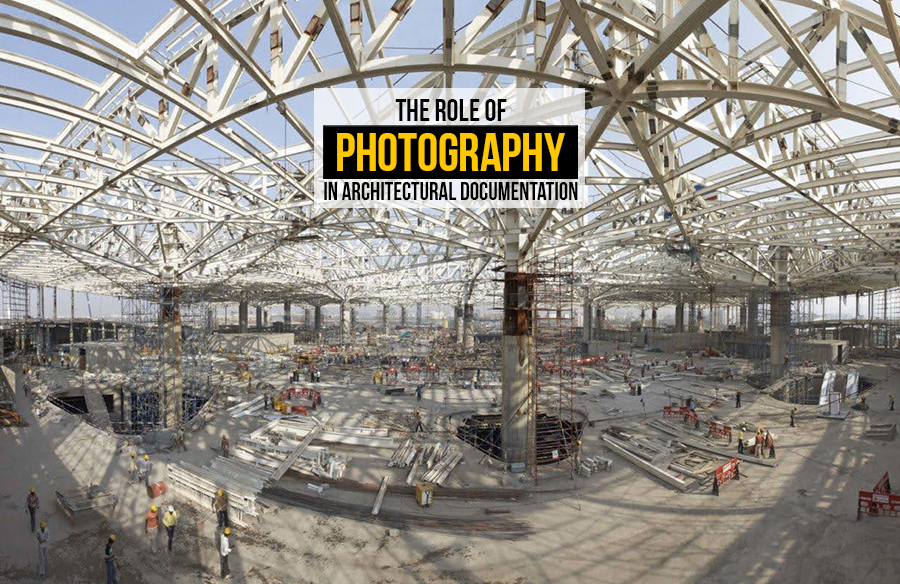
A fitting example is the photographic record of the construction of Chhatrapati Shivaji Maharaj International Airport in Mumbai, a project designed by SOM (Skidmore, Owings and Merrill). The following photographs are taken amidst the construction process.

As passengers pass through the airport today, they carry with them the memory of a fully operational, bustling hub. However, photographs offer a glimpse into a different phase: the structure in progress, revealing the massive framework and the steel columns before they were clad with glass fibre-reinforced gypsum components. The images showcase the enormous scaffolding and the precise craftsmanship required to bring the design to life. These photos not only serve as a record of the construction techniques used but also stand as a guide for future projects for everyone.

2. Capturing Final Product
Learning is a never-ending process. True learning in architecture begins once one starts practising and fully immersing oneself in the execution of a project. Throughout this journey, there is always something new to learn, as every project is unique- not only in terms of design and planning but also in factors such as site location, client requirements, deadlines, and budget constraints. These elements largely influence the project’s outcome, giving architects a fresh experience with each new venture. Every project offers valuable lessons, sharpening the architect’s design mindset and enhancing their capabilities for future projects.
This is where photography plays a crucial role. Photographs document the final designs, allowing architects to revisit and analyse their work, helping them identify areas for improvement.
In addition to the above, when captured professionally, photographs of the outcome become powerful tools for effectively communicating the design vision and showcasing the true intent behind the planning. The Bahá’í Temple of South America in Santiago, Chile, designed by Toronto-based Hariri Pontarini Architects, serves as a compelling example of how photographs of the finished structure play an important role in conveying the true essence and intent of the design.

The shell of the structure is composed of two distinct cladding materials: translucent marble from Portugal’s Estremoz quarries for the interior layer, and cast-glass panels for the exterior. This cladding choice resulted from extensive research conducted by the architectural team, aiming to reflect the intended experience the structure was designed to offer its visitors. As highlighted, it is through photography that the full essence of this concept is best communicated to the world.

3. Capturing Perspectives Beyond the Human Capability
Humans, despite being the most intelligent beings on Earth, have their limitations when it comes to perceiving the world around them. While it is often said that no camera can truly replicate the depth, clarity, and dynamic range of the human eye, the reverse is also true. The human eye, though remarkably sophisticated, cannot capture certain angles, heights, or perspectives that modern technology, particularly through drone photography and videography, makes possible. These advancements have revolutionised how we view and document the world, offering unprecedented vantage points that were once beyond our reach.
As a result, they have opened up new ways to observe, analyse, and appreciate designs, landscapes, and structures from entirely fresh perspectives. This ability to see things from unique and elevated angles has reshaped not only how we interact with our environment but also how we understand the potential and impact of architectural creations and natural landscapes. It allows us to experience our designs in a way that is not confined to human limitations, ultimately broadening our creative and observational horizons.

4. Worldwide Reach
Professional photographs of a completed project, when paired with the widespread reach and influence of social media, can be a powerful tool to significantly enhance and promote one’s business. High- quality images capture the essence and craftsmanship of a project, showcasing its details, aesthetics, and unique features in a way that words alone cannot. These images serve as a visual portfolio that not only highlights the quality of work but also communicates the brand’s identity, values, and creativity to potential clients.
When shared across social media platforms, these photographs have the potential to reach a global audience, far beyond the reach of traditional marketing.
Moreover, professional photographs lend credibility and professionalism to a business, creating a lasting first impression that can set it apart from competitors. Ultimately, investing in high-quality photography combined with the marketing power of social media can lead to increased brand awareness, stronger client relationships, and most importantly, new business opportunities.
5. Drawing Potential Clientele
Photographs of completed projects can be one of the most effective tools for attracting potential clients. High-quality images showcase not only the final outcome but also the craftsmanship and design vision behind the work. A well-curated portfolio of photographs serves as a tangible proof of their expertise and reliability, giving clients confidence in their abilities.
Visuals are particularly useful for clients who may struggle to fully understand architectural data. Through photos, they can clearly grasp how designs translate into real life spaces, helping them feel more secure with their choice of architect. A diverse portfolio demonstrates versatility, showing that the architect can handle a range of design challenges.
Ultimately, these photographs bridge the gap between a client’s imagination and reality, allowing them to visualise the quality they can expect. In a field where trust is critical, images play a key role in turning interest into new business opportunities.
Disadvantages of Lack of Photographic Documentation
Many historical buildings from the past which no longer exist in real life and lack any photographic documentation, survive only through written descriptions. This absence of visual record means that modern viewers are deprived of the ability to fully experience these lost structures. While texts may offer detailed accounts of their design, significance, and cultural impact, they can never replicate the immersive experience of seeing these structures firsthand. Without photographs, much of the architectural beauty and historical context is left to the imagination, leaving a gap in our ability to connect with the past visually. As a result, today’s audiences miss out on the opportunity to fully grasp the scale, craftsmanship, and ambiance of these bygone landmarks.

A notable example of this is the Crystal Palace, designed by Sir Joseph Paxton and completed in 1851. The structure was a groundbreaking structure featuring the largest area of glass ever used in a building. Originally built in Hyde Park, London, for the Great Exhibition, it was dismantled and relocated to Sydenham Hill in South London in 1854. The palace, a major cultural venue, was destroyed by a devastating fire on November 30, 1936. While the structure was widely recognized for its architectural innovation, there is a notable lack of extensive photographic documentation of the structure. Although some photographs and illustrations exist, they are relatively few and often limited in scope, making a comprehensive visual record of the palace somewhat scarce.
References:
- Chhatrapati Shivaji International Airport – Terminal 2 (2024) SOM. Available at: https://www.som.com/projects/chhatrapati-shivaji-international-airport-terminal-2/ (Accessed: 21 September 2024).
- Hariri Pontarini Architects. Available at: https://hariripontarini.com/projects/bahai-temple-of-south-america (Accessed: 21 September 2024).
- Hariri, S. (no date) How do you build a sacred space?, Siamak Hariri: How do you build a sacred space? | TED Talk. Available at: https://www.ted.com/talks/siamak_hariri_how_do_you_build_a_sacred_space?subtitle=en (Accessed: 21 September 2024).
- Crystal Palace (2024) Encyclopædia Britannica. Available at: https://www.britannica.com/topic/Crystal-Palace-building-London (Accessed: 21 September 2024).
- The Crystal Palace (2024) Wikipedia. Available at: https://en.wikipedia.org/wiki/The_Crystal_Palace (Accessed: 21 September 2024).