Art, independently, is an umbrella term that represents a copious number of forms of expression; including but not limited to painting, dancing, music, cinema, and writing. Although it is often associated with crafts that develop around drawing and painting, art has much more to bring to the table. Any profession that deals with designing is usually related to arts and can intertwine fields of work that may not come across as connected otherwise. Just take graphic design as a modern example – as the core to every visual form of branding and marketing, graphic designers have become essential parts of companies worldwide regardless of what field of work they might be specialising in.
The existence of art dates back to approximately 40,000 BC, way before humans started keeping track of records,1 and as architecture started shaping up around 10,000 BC through the need for shelter;2 it is to be kept in mind that the possibility of art having influenced humans in expressing themselves through architecture was bound to come forward sooner or later. Alongside the discoveries in the world of sciences and technology, humans have been exploring and experimenting with arts for literal ages, the impact of which can be seen in their architecture as well.
Indian Art in Architecture: Foundation and Religion
Arguably, a lot of Indian art has its roots in the mythological or religious beliefs of the population of India. While the Kailasa temple and the caves of Ajanta & Ellora share the tales of Hindu scriptures, the Stupa of Sanchi represents Buddha in his moment of enlightenment. There’s the Taj Mahal, one of the seven known wonders in the world of architecture as it represents Mughal king Shah Jahan’s undying love for his late wife Mumtaz Mahal; and it is undoubtedly the most widely known monument of India on a global scale.


As religion operates as a driving force in the evolution of architecture in India,a lot of the ancient Indian architecture was created to serve the purpose of finding calm and meditative spaces for the believers. Places of worship like temples and mosques, as well as chapels and pilgrimages; a majority of the notable architectural monuments are connected to a variety of religious beliefs that Indians continue to follow to this day – which also explains why all of these monuments still hold their importance and their legacy in the history of India.
Modern Interpretation of Indian Art in Architecture

Through different periods of time, the architectural world saw stages of progress with Byzantine, Renaissance, and Modernism being a few of those. Post-modern architecture in India saw direct influences from Western techniques, especially involving Gothic, Victorian, and Neo-classical elements.4 Post-colonial India was focused on reviving its artistic traditions while still carrying the impacts of the British colonies. As a result, post-modernist Indian architecture presents pleasing and complex combinations of Western and Asian artistic methods, heavily relying on practical aspects while still holding onto historical morals.


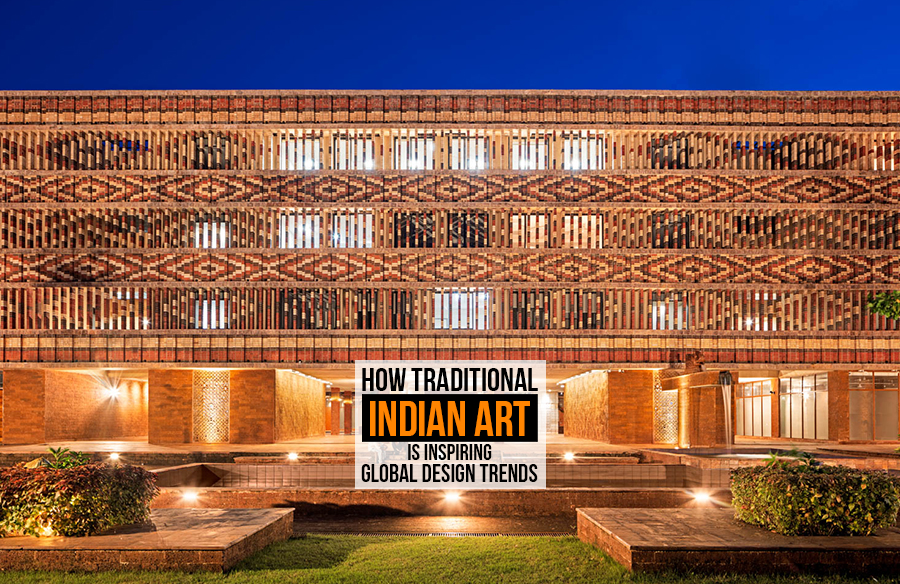
Paving the way for an impressive blend of Western and Eastern art styles, architects in India have been incorporating elements of both while making sure to bring forward the advantages of both. Case in point: the proposed designs for the Headquarters of Punjab Kesari include Jali pattern screening in the exterior façade of the overall building. As explained by the architects at Studio Symbiosis, “A hexagonal pattern was used as a base and through iterative process various porosity patterns were generated from it to create different light conditions. This resulted in a variable opacity condition in the facade that had a dual purpose of creating performative architecture and also created variable openings on the facade in various orientations generating a design for the facade that is animating and has an inherent meaning.”5 Leading back to the basic principle of Jali in architecture, it reduces heat gain while also ensuring that maximum natural light can penetrate through the building on a normal day in Delhi, India.
The Legacy Continues

As we move forward in an era where spacious contemporary residence designs pay homage to Indian traditions by adding small details like using motif patterns in flooring inlay or Madhubani wallpapers on double-height walls, architecture in India continues to lead the global design trends while successfully intertwining the western and eastern art styles in the most appealing manners. In the current age of having the luxury to share and learn information anytime and anywhere, the forever developing combinations of traditions in architecture are proof that art, truly, never dies.
REFERENCE LIST
IMAGES :
- Dalbéra, J. (2015). La grotte jaïne “Indra Sabha” (Ellora, Inde). [Photographs]. (https://www.flickr.com/photos/dalbera/17238778356/in/album-72157651648726172/)
- Fanthome, J., Ghetti, S., Dabas, S. (2018). Krushi Bhawan. [Photograph]. (Odisha : https://www.studiolotus.in/projects/krushi-bhawan)
- (2016). Traditional Indian Architecture Meets Contemporary Office Space in This Naturally-Lit Design by Studio Symbiosis. [Photograph]. (Delhi NCR : https://studio-symbiosis.com/project/punjab-kesari/)
- Millman, M. Bold Statement. [Photograph]. (USA : https://www.jayjeffers.com/projects/bold-statement/)
BIBLIOGRAPHY/EXTERNAL LINKS :
- Morriss-Kay, G. (2010). The evolution of human artistic creativity. Journal of Anatomy, 216 (2), pp. 158-176. Available at: https://www.ncbi.nlm.nih.gov/pmc/articles/PMC2815939/
- Architecture’s History in a Nutshell. Jonite. Available at: https://insights.jonite.com/architectures-history-in-a-nutshell
- (2024). Influences on Indian Architecture: Religious, Cultural and Historical Factors. Kaarwan. Available at: https://www.kaarwan.com/blog/architecture/religious-cultural-historical-influences-indian-architecture?id=546
- (2024). Modern Interpretations of Indian Art in Architecture and Design. Rooftop. Available at: https://rooftopapp.com/modern-interpretations-of-indian-art-in-architecture-and-design/
- Santos, S. (2016). Traditional Indian Architecture Meets Contemporary Office Space in This Naturally-Lit Design by Studio Symbiosis. ArchDaily. Available at: https://www.archdaily.com/791383/traditional-indian-architecture-meets-contemporary-office-space-in-this-naturally-lit-design-by-studio-symbiosis?ad_medium=gallery