Art and architecture are interconnected mediums that have constantly influenced each other throughout history, fostering open discussions about their mutual impact. Art can be seen as a form of production to transform the mundane into the sublime medium of visual representations, additionally, often it exists without strict rules. Conversely, architecture is a three-dimensional physical construction, and even though it holds an artistic view, it mostly presents and represents a practical force behind it.
As an interrelated discipline, architecture, and art support each other and can bring beauty and daily explorations into our everyday lives. Architecture can be seen as an experimental art form with functions that may be social, political, or purely artistic. Over the years, both sides profoundly influenced and changed each other, while creating new pathways for expression and representation.
In this ongoing dialogue, the documentation of new forms of representation has evolved, with photography being the most common medium. Photography has advanced similarly, offering various technologies capable of immortalising the mundane. From film and digital cameras to cell phones and other devices, we now have numerous tools to document our artistic explorations. Throughout photography, it is possible to focus on specific details or simply present a broader view, opening the word in a frame and aligning the composition to showcase the urban performance.
This article will explore how photography has evolved alongside the artistic and architectural movements throughout history, highlighting its role in documenting and immortalising artistic explorations.
Historical Preservation and Documentation
Photography can play a critical role in maintaining, diffusing, and preserving historical moments capturing moments that otherwise would be lost in time. Ironically, one of the first photographs ever taken by Nicéphore Niépce in France can be considered architectural—a view from his window. However, architectural photography only became established around the 1860s.

Documenting the final product and the process it took to reach the final point is crucial. As for the process we have all the artistic explorations and failures that took the artist to create the artistic representation. This media became a valuable set for the amount of detail, easily shared, and produced, and that visual representation could be made, something that paper and pencil couldn’t provide.
Along with many good examples of the importance of photography to the development of architecture and artistic movements, we have the Bauhaus era. The movement founded in 1919 in Weimar, Germany, aimed to be a revolutionary approach to art, architecture, and design that looked to unify all artistic movements. In general, it emphasised functional design with simplicity and integration of technology with craftsmanship, and by the eyes of Lucia Maholy and László Moholy-Nagy, it is possible to say that it is also reflected in the photograph documentation of this process.

Maholy played an important role in the Bauhaus movement and has one of the most known photographs of the Bauhaus Dessau building, representing through her lens the inner spirit of the movement, mostly she would highlight the interplay of light and shadows, aligning the building form. It is important to mention to the matter of this article that, Gropius promoted the school with Maholy’s photography without crediting or compensating for her work, and the photographer had to fight over the years to gain the attention she deserved for her work.
László Moholy-Nagy was another central figure in the documentation of the Bauhaus School, he believed in the potential of art as a vehicle for social transformation, and generally, he is known for his experimental approach to photography. He explored techniques such as photograms which is the process of exposing light-sensitive paper with objects laid upon it.
Influence of public perception
Photographers documenting architectural and artistic movements possess the power and techniques to guide viewers’ eyes, telling stories and transporting them to specific moments in time. That can be said that it can influence the public perception by using composition, light, shadow, and colours to bring the effect they want to tell.

This type of media can be disseminated through various channels, including social media, magazines, exhibitions, galleries, books, and newspapers. Through that, the photographer will try to complement and represent that artistic movement by highlighting the best characteristics and textures that will stick to the view perspective and represent the art.
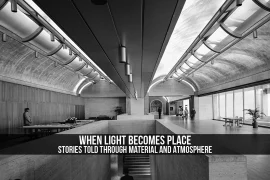
As an example, the renowned architectural photographer Helene Binet had a severe impact on the way we perceive and interpret architectural spaces. Binet stands out with her techniques that bring a new dimension to architectural documentation, representing the intimate relationship between light and form; she mostly uses black and white film to bring out the subtleties of the architectural elements. Through her lens, she brings the viewer into an intimate exploration of the architectural forms, encouraging the user to settle down and pay attention to the details and nuances of the building.

Helene Binet‘s contribution to the architectural and artistic movements exemplifies the power of photography to guide the viewer, creating an invitation to not only document but interpret and enhance the details and understand the architectural spaces by their particular features.
Additionally, photography can be used as a critical tool to analyse and interpret architecture and artistic movements. As mentioned by the Portuguese architectural photographer Fernando Guerra “Architectural photography has always been a response to a problem, which is, how to promote a work, and help preserve its memory,” it comes to the photographer to decide if they want to eternalize the built environment, experience, reality, or density and through pictures, the professional can criticise architecture and art.

As the architect Mike Christenson notes, ‘images also operate to produce architecture,’ as they hold memories for future debates and discussions. Even if buildings are demolished, their forms and internal connections can last forever through photographs.
The dynamic interplay between photographs, architecture, and artistic movements aims to propose an evolving dialogue that significantly shaped our eyes about these fields. Throughout history, art has transformed the mundane into the sublime, while architecture provided practical and aesthetic structures to shape and enhance our daily lives. Photography, as a medium, played a primordial role in documenting and preserving the nuances and processes of these artistic and architectural movements.
Photography’s evolution from early film to advanced digital photography allowed the detailed and accessible visual representation of art and architecture, by capturing the final products, but mostly documenting the process and failures, allowing for a comprehensive view of the artistic explorations. The work of photographers like Helene Binet and Fernando Guerra exemplifies the power of photography to guide the viewer’s eye, enhancing the understanding of the architectural space and preserving the essence of artistic movements.
Through their lens, photographers invite us to explore the intimate relationship between light, form, colours, and materiality, encouraging a deeper appreciation and analysis of the built and artistic environment. Additionally, it serves as a critical tool for criticism and research, by providing support for comparative analysis and providing the needed documentation for future debates and discussions.
In conclusion, the interconnection between art, architecture, and photography enriches our cultural heritage and influences our interaction with our surroundings. By documenting and immortalising artistic and architectural explorations, photography connects the past, present, and future, ensuring that their fields continue to inspire and inform generations to come.
References:
The art of architectural photography with Hélène Binet (2022) Salvatori Official. Available at: https://www.salvatoriofficial.com/en/gb/stories/helene-binet/ (Accessed: 11 August 2024).
History of Photography, Volume 37, Number 2, May 2013 http://dx.doi.org/10.1080/03087298.2013.769773 # 2013 Taylor & Francis
Cheriyan, M. (2023) Photography and architectural critique, RTF | Rethinking The Future. Available at: https://www.re-thinkingthefuture.com/architectural-community/a10543-photography-and-architectural-critique/#:~:text=Exterior%20Architecture%20Photograhy&text=They%20often%20convey%20the%20project’s,and%20surroundings%20of%20the%20building. (Accessed: 07 August 2024).
Christenson, M. (2017) ‘Critical dimensions in architectural photography: Contributions to architectural knowledge’, Architecture_MPS, 11(1). doi:10.14324/111.444.amps.2017v11i2.001.
Lee, P. (2016) Architectural photography – between documentation and interpretation, Widewalls. Available at: https://www.widewalls.ch/magazine/architectural-photography (Accessed: 07 August 2024).
Martin (2024) Architectural photography: Capturing the essence of the built environment, about photography. Available at: https://aboutphotography.blog/basics/architectural-photography#google_vignette (Accessed: 07 August 2024).