When we think about Santi, the first and foremost question that comes to mind is: what is the meaning of Santi? For Individuals, even for me, it means Peace.
Yet, the question is how can the built environment offer a sense of peace? The answer is Santiniketan because it is an experiential architectural journey which has been created by the Tagore Family. It has been recently added to the UNESCO World Heritage forum which is not just an educational establishment, it is a physical impression of Rabindranath Tagore’s Philosophies.
Santiniketan: An Archive of Peace
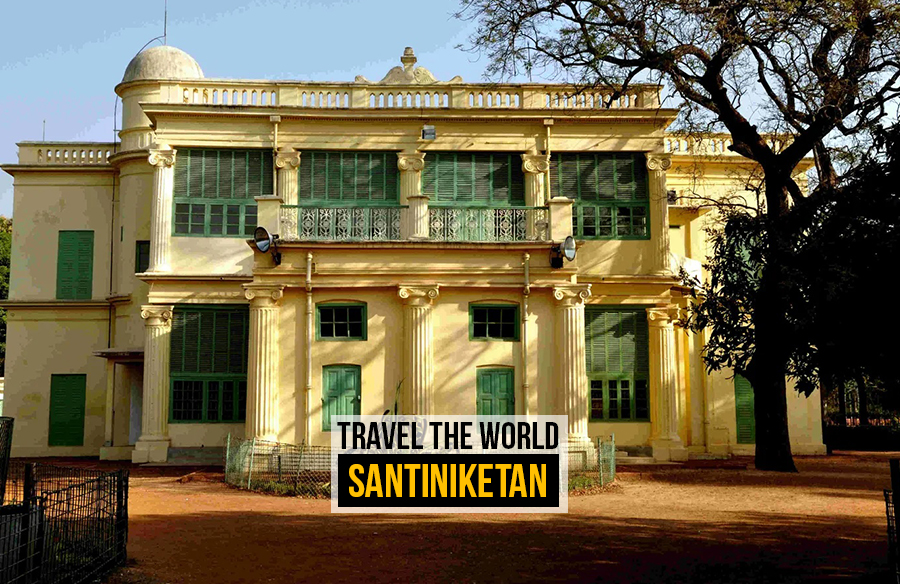
Santiniketan is located in Bengal, which is situated in the eastern region of the country along the Bay of Bengal. If we talk about Bengalis, they are significantly connected with their culture and tradition. Predominantly, their philosophy of built environment is reflections of their Art, Literature, Poetry and Music, it is also Influenced by the colonial architecture as observed in figure.

Nobel Award Rabindranath Tagore- with the intention of breaking the ordinary tradition of education, In 1901, he started the Journey of Santiniketan for the betterment of India.
Historical Legacy
In the early days of 1860, Santiniketan as a “Home of Peace” was recognized and initiated by Maharshi Debendranath Tagore. After having years of experience, travelling and thoughtful process he built a small guest house known as Santiniketan and that’s where the journey of home for all has been started and it has been continued by the renowned poet and history admirer Rabindranath Tagore, He started his first educational session with five students. Furthermore, he has played a vital role in this journey where Ashram became a university in 1922. This journey is not just a process of creating a university but it is a masterpiece in itself.


The Built Environment: Santiniketan
The physical environment of Santiniketan is an amalgamation of traditional Indian elements, Modernity and strong connection to nature. The complex’s design is based on the educational philosophy of Tagore sir which has been translated into physical manifestation. The conceptual thoughtful design consists of an environment of education, freedom of mind, spiritual education, flexible curriculum rounded by nature, teacher-student relationship, art, music and dance, Cultural synthesis, global interaction and harmony with daily life.
In synthesizing its distinctive architectural character, the spatial organization of different buildings is in a way that encourages human interaction between community members. Most interestingly, the circulation of the campus allows multiple human attention and buildings have been arranged around the courtyard which forms activity areas in between. Most importantly, the main feature of the campus is that it consists of various learning spaces such as space under tree, open air platform, climate responsive elements, natural light which endures the place as “Heterogeneous Architecture”.


If we talk about one of the building kala bhavan particularly, this building has significant reorganization for visual arts and music which is considerably connected to the vision of Rabindranath Tagore for an education. This serves an alternative approach toward learning; he thinks that it has to be connected to nature where an individual could make a contact with it tangible or intangible.

Why Choose Santiniketan for global reorganization?
- Tagore’s Legacy
The Santiniketan complex is a physical manifestation of Tagore’s life experience and it is directly connected with his life philosophy and wisdom which associates education with art and culture.
- Safeguarding the History
The complex – Currently, Santiniketan also known as Visva Bharti university is a land to exchange culture and foster the vibrant community by socialising which is dedicated to knowledge and art. This has been started since 1921 by the renowned Rabindranath Tagore and it still continues in the forum of education and art.
- Architectural Legacy
The Physical Environment of Santiniketan consists of idiosyncratic architectural style which showcases the vernacular and international designs, this integration shows the interpretation of Tagore sir’s imagination towards global interconnectedness.
- Cultural legacy
Considering the cultural aspect of Santiniketan for UNESCO it stands out as dominant where the inclusion of Art with nature in the built environment is commendable. Interestingly, this environment does not only preserve the ancient sites but it endures the cultural importance globally.
In essence, the abode of peace is an amalgamation of art, culture, and nature where it shows the timeless journey and understanding of architecture for education. Predominantly, the way Tagore sir has created the threshold for learning, Socialisation, and experiential education which sets the best example for the education system of India to mould the future generations’ mind. Additionally, it also promotes to remain connected with nature, surrounding Landscape, and ancient roots.
References:
- Dasgupta, A., 2021. Life at Santiniketan. Bauhaus Imaginista. Available at: https://www.bauhaus-imaginista.org/articles/3337/life-at-santiniketan?0bbf55ceffc3073699d40c945ada9faf=cebcda774c682ba7797ccf90d5c666a9.
- Chandrasekhar, S., 2007. The idea of Santiniketan: A personal understanding. Journal of the Krishnamurti Schools, Issue 11. Available at: https://journal.kfionline.org/issue-11/the-idea-of-santiniketan-a-personal-unde
- Art, Culture and Society, 2024. How Rabindranath Tagore nurtured Santiniketan to become a cultural landmark. The Hindu. Available at: https://www.thehindu.com/thread/arts-culture-society/how-rabindranath-tagore-nurtured-santiniketan-to-become-a-cultural-landmark/article67361207.ece
- Banu, U., 2022. The Shades of Santiniketan. Shanti Sadan. Available at: https://shanti-sadan.net/the-shades-of-santiniketan/