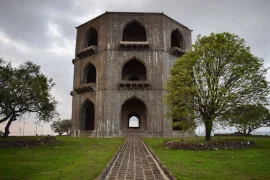
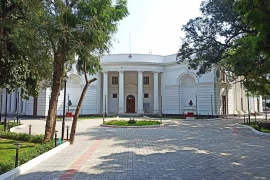
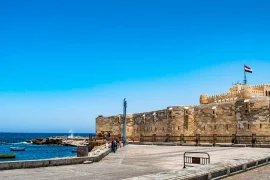
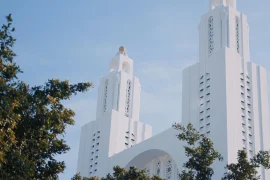
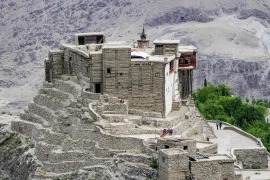
Sujanpur is a small hill town enjoying the scenic views of river Beas on one side in Himachal Pradesh. Historical records claim that it was ruled by Raja Sansar Chand Katoch, the king of Kangra during the 18th century. After independence Kangra was split into two separate districts (Kangra and Hamirpur) there and Sujanpur Tihra became part of the Hamirpur district. The king made Sujanpur the capital and hence installed a lot of temples, forts, and a palace in the town to enhance its beauty and make it a commercially important village. His son Abhay Chand Katoch also built a fortified palace on a hill called Strip in AD 1748. Thus, the city acquired its name as Sujanpur Tira (Tira is called strip) after the name ‘‘strip’’(Tihra) was attached to its original name of Sujanpur as Sujanpur Tira. This marvel adorns the hills of Sujanpur and stands as a testimony against time-fighting to maintain its identity.
Designing of the Palace
The architecture is like any other fort, but one distinction feature is the excellent planning of spaces and the scale at which they were made. Huge arches and massive walls still standing upright make this place unique.
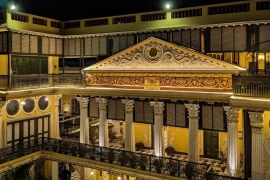
The palace complex is ornamented with richly carved murals, arches, and arcades. Highlighting every detail from the interior to the exterior. On entering the fort, one is welcomed by a huge arch supported by massive walls. Rumour has it that the King would enter on his elephant from there without any disturbance. The entrance foyer is called Chowki (security post).
The palace also comprises a Darbar hall known as ‘Baradari’. It can be seen still from the land of ‘Chougan’ (A green square shaped ground in the middle of town has been created which was used to train soldiers for war. This ground remains green throughout the year and is used for cultural festivals and public gatherings). The splendid structure is supported by arched walls. The arches of these structures are highly ornamented. This whole structure was supported by a dome with small baked bricks but now it has been destroyed due to repeated earthquakes.
The fort also has an office complex called ‘Navgriha’. It is unique from other places inside the palace as it has a double-story central arch. The balcony of the area is enhanced by a carved elephant.
A temple of Goddess Gauri (Gauri Shankara Temple) has also been constructed in the complex. The main temple has a square plan. The floor, walls, and pillars supporting the arches of the temple are highly embellished with carvings and elegant paintings. Carved stone statues of the deities have been placed in the garbagriha (the internal part of the temple). Garbagriha is adorned with four beautiful and decorative pillars, supporting the dome-shaped roof.


On the path of survival?
If we examine the palace through the lens of materials, it was entirely through locally available materials like stone, mud, bricks, etc making the structure resilient and sustainable.
But then if we look at it through the perspective of culture and tradition, the palace has fallen to its doom. Due to the damage caused by repetitive earthquakes and the negligence of the people and the government the fort now is breathing its last breaths. This traditional royal heritage could have been a beautiful tourist attraction increasing the income of the city as well. However, the careless attitude of the curious visitors, the fort is now destroyed to its core.
The strong walls of the palace now seem to be a canvas for misplaced lovers, graffiti artists, etc not realising that they are destroying the last shell of culture that might be left in the place. As if the people are living in oblivion, they don’t cast any eye towards the dilapidated structure and feel their inability to restore the last drop of culture that their ancestors left for them. It’s a pity to witness that such a marvel is now counting its last days.
Some lost whispers of memories are feeble not yet forgotten still fighting to survive. Would anyone ever listen?
Source:
https://link.springer.com/article/10.1007/s40030-015-0111-5