

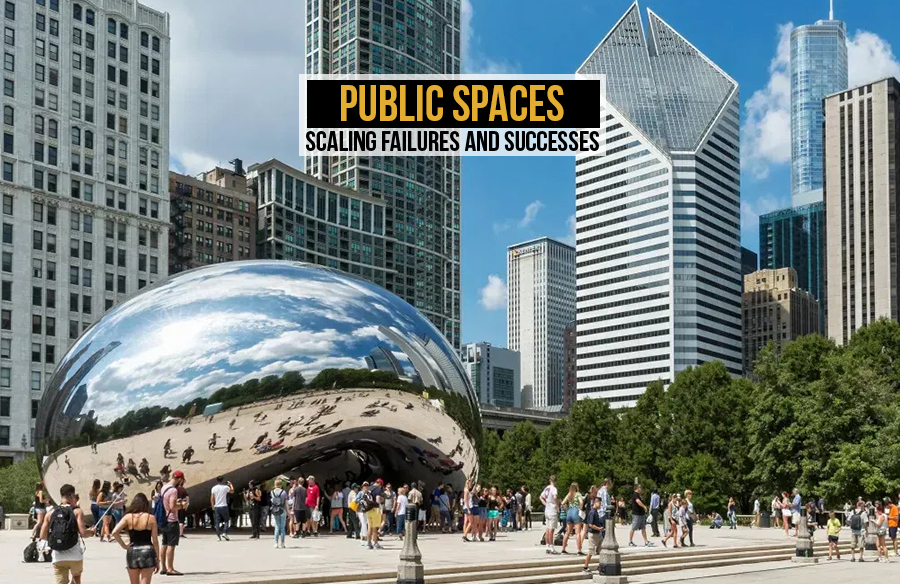
One of the most common misunderstandings across all communities and societies is the difference between the two sets of terminologies: Public vs. Inclusivity, and Place vs. Space. A Space is defined as the physical territory at a specific geographic location. It is measurable and will become a place when it generates a sense of belonging, and sentiments to people (MFink, 2019). On a parallel line, Inclusivity is taking into consideration all people to be involved in public life regardless of their socio-economic classes, physical capability, religion, and gender: This is what leads to properly designing a space to be accessible for all (Brave People, 2023).
Public spaces are important in human settlements as they boost engagement, productivity, sense of community, and belonging. However, these spaces are a subject of scaling in terms of failures and successes. These scales could be narrowed to the Sustainable Development Goals and The Four Components of A Good Public Space.

The Four Components of A Good Public Space
To make successful public spaces, designers should implement spaces that are comfortable, accessible, sociable, and welcoming for events and activities (Projects For Public Spaces).
Successful public spaces are easily accessed by clearly identifying entrances, edges, walkways, high parking turnover, and proximity to public transportation. Moreover, the scale of success in taking into consideration the image of a public space and its comfort. For instance, the cleanness of the space, safety, security, and the availability of seating areas make a public space successful.
The rate of usage and activities in a public space are what increase the repeated visits. As long as a public space is active and engaging, people will densely visit and revisit it.
Social parameters are vital for successful public spaces. Good public spaces enhance social engagement, neighbour interaction, and stranger integration.

The Sustainable Development Goals in Public Spaces
Declared by The United Nations as The 2030 Agenda for Sustainable Development, these goals are also known as SDGs and they are 17. Sustainable Cities and Communities – SDG 11, has a target related to public spaces. Target 11.7 states that safe and secure green and public spaces should have universal access by 2023: these spaces should be safely and easily accessed by children, women, older persons, and persons with disabilities (ICCROM). Furthermore, other SDGs may contribute to successful public spaces by raising awareness and socio-cultural actions such as Gender Equality (SDG5), and Reducing Inequalities (SDG 10).

The Positive Impact of Green Public Spaces
According to Patrick Sipp, “People did not know the real importance and positive impact of public spaces until the COVID pandemic”. This positive impact is expressed through five criteria. First, public spaces improve physical and mental health since they offer an opportunity to reconnect with nature, reducing stress and improving the overall mood. Second, strengthening social cohesion by smoothly making people connect. Third, public spaces conserve the environment by promoting biodiversity that fights climate change. Fourth, boosting education when people and beyond classrooms can explore, discover, and learn about the green world. Fifth, public and green spaces attract visitors and tourists making the local market grow sustainably and passively.

Failed Public Spaces
On one hand, numerous public spaces have shown failures all over the world such as Viger Square, Empire State Plaza, and Millenium Square Leeds (Landscape Architects Network, 2013).
The Millenium Square Leeds, located in The United Kingdom is a good example of a public space that expressed failures in long-term use. During events, temporal German Markets, and concerts, this public space performs well. Indeed, when these activities ended, the space turned to be a ghost area.
The Empire State Plaza in New York City is another example of failure in public space design. Despite its architectural importance and majestic perception, the area does not show any space on the ground for people to gather, meet, and interact.
Finally, Viger Square in Canada failed due to its uninviting central brutal architecture. This made the square by the time a place for homeless people to live and for unethical and threatening activities to take place there.

Succeeded Public Spaces
On the other hand, many public spaces showed success. For instance, Mission Dolores, NYHAWN, and Luxembourg Gardens are pretty good proofs of successful public spaces (Projects For Public Spaces).
The main success feature of Luxembourg Gardens is that they are self-managed! In addition, these gardens offer flexible seating alongside activities for kids, adults, and elderly people.
The NYHAVN canal is an important illustration of cultural promotion in public spaces. This public space evolved from a red light district to a pedestrian public space offering architectural aesthetics and mesmerising views and is considered a cultural hub that attracts visitors and tourists in Denmark.
Mission Dolores Park in the United States is a successful prototype for public spaces: Good lighting, sports courts, amazing views, and a prime location between markets and bus lines.

Reference:
Mfink. (February 22, 2019). Everyday Anthropology: Space vs. Place. The Cultural Courier. [Online]. Available at: https://theculturalcourier.home.blog/2019/02/22/everyday-anthropology-space-vs-place/#:~:text=Space%20is%20 location%2C%20 physical%20space,meaning%20given%20to%20a%20space.
Brave People. (October, 2023). What Is The Difference Between Accessibility and Inclusive Design? Medium. [Online]. Available at: https://medium.com/brave-people/what-is-the-difference-between-accessibility-and-inclusive-design-fde35cd90e7b#:~:text=Inclusive%20and%20 accessible%20design%20 both,usable%20and%20accessible%20for%20all.
Projects For Public Spaces. What Makes A Successful Space? [Online]. Available at: https://www.pps.org/article/grplacefeat
ICCROM. Toolkit. Our Collection Matter. [Online]. Available at: https://ocm.iccrom.org/sdgs/sdg-11-sustainable-cities-and-communities/sdg-117-provide-access-safe-and-inclusive-green-and
Patrick Slipp. 5 Reasons Your Community Should Create More Green Spaces. Route Fifty. [Online]. Available at: https://www.route-fifty.com/infrastructure/2023/02/five-reasons-your-community-should-create-more-green-spaces/382574/#:~:text=These%20 natural%20 oases%20can%20i improve,linked%20to%20lower%20crime%20rates.
Landscape Architects Network. (August 30, 2013). Top 10 Square Fails. [Online]. Available at: https://land8.com/top-10-square-fails/
Projects For Public Spaces. You Asked, We Answered: 6 Examples of What Makes A Great Public Space. [Online]. Available at: https://www.pps.org/article/you-asked-we-answered-6-examples-of-what-makes-a-great-public-space
List of Images:
1_Jason Mrachina. The Bean. [Photograph]. Available at: https://penniur.upenn.edu/publications/some-reflections-on-urban-public-art-today
2_ Project For Public Spaces. What Makes A Great Public Space? [Illustration]. Available at: https://mobycon.com/updates/how-to-make-streets-into-great-public-spaces/
3_United Nations. Sustainable Development Goals. [Illustration]. Available at: https://arabstates.unwomen.org/en/what-we-do/sdgs
4_Programmed. Green Public Spaces. [Photograph]. Available at: https://programmed.co.nz/the-benefits-of-greening-urban-spaces/
5_Jacques Nadeau. Viger Square. [Photograph]. Available at: https://reporter.mcgill.ca/square-viger-ne-precipitons-pas-les-choses-aux-depens-de-la-qualite/
6_Jacob Schjørring. NYHAM Public Space. [Photograph]. Available at:
https://www.visitcopenhagen.com/copenhagen/planning/nyhavn-gdk474735







