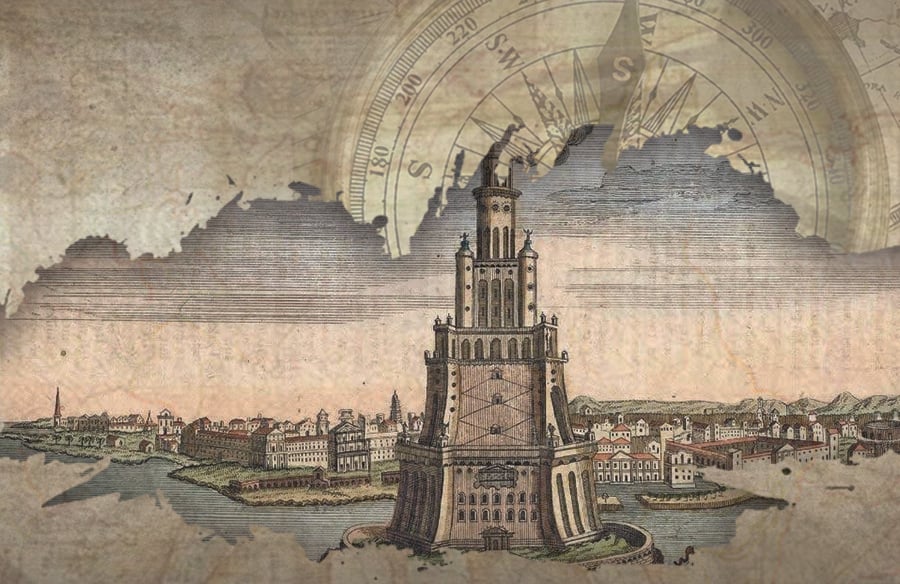
A navigational beacon that existed for 1600 years, through three major political systems, and that was repaired and restored several times- The lighthouse of Alexandria- one of the seven wonders of the ancient world, is also known as the Pharos of Alexandria. Believed to have been built by the Ptolemaic kingdom of ancient Egypt during the reign of Ptolemy II Philadelphus, this lighthouse is one of the tallest man-made structures of the time, with a height of around 100m. It has been considered a technological triumph and archetype for lighthouses since then. It is said to be located on the island of Pharos in Alexandria.
The Pharos was loved by those who saw it. Ceaser who marveled that it was “of great height, a work of wonderful construction, which took its name from the island” (Civil Wars, III.112), paraded a replica of it with a semblence of flame during his triumph in Rome (Florus, Epitome of Roman History, II.13.88; Appian, Civil Wars, II.101).
The lighthouse was meant to give warning of shoals and to indicate the harbour, but was mistaken to be a shining star in the horizon, according to Pliny. In the second century AD, Achilles Tatius described it as the most extraordinary structure, like a mountain almost reaching the sky in the middle of the sea. These descriptions represent that this shining beacon has been a landmark of Pharos for centuries.
Historians are curious about how the flame was fired since wood was scarce in Egypt. It is said to be either papyrus roots or naphtha-fueled. Dried animal dung was out of the question as it would not have burned so brightly. The fire might have been intensified by a bronze mirror, which would have reflected the sun during the daytime. In AD 641, Alexandria fell to the Caliphs. They found jewels in the sea and copper statues along the parapets. Convinced that there was some treasure hidden inside the top tier, it was destroyed along with the mirror at the summit. Another realistic description that is available accounts that the destruction of the lighthouse was caused by natural disasters like earthquakes and extreme weather events. By then, it was restored and had 3 tiers- The top cylindrical, the middle octagonal, and the lower square-shaped tiers. The lowest part was made of masonry and the second one of brick and stucco. The second story might have been octagonal, related to the eight directions of wind as in the Tower of the Winds in Athens.
The travelers of the 11th and 12th centuries added a few more details, like the numerous chambers and a passageway wide enough for the horseman to climb. There were twenty-two openings to diminish the wind. According to Al-Balawi, a traveler who visited Alexandria in 1165 and measured the tower, it had a doorway approached by a long ramp and supported by 16 arches. There was another passageway for two pack animals to pass, spiraling around a central core. This might have been the way for the fuel to be carried to the second floor from where it might have been carried upstairs.
By 1195, several eyewitnesses commented that the lighthouse was a very ordinary structure, and the early descriptions were outright lies or exaggerations. By then, it was an ordinary rectangular tower with parapets, supporting a similar smaller storey mounted by a dome structure. It was no longer accessible by land due to the absence of the causeway.
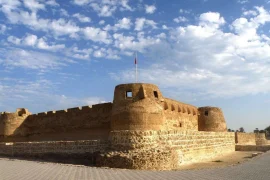
Ancient coins and inscribed gems provide some details. In the earthquake of AD 796, only the square section was left, and the remaining were destroyed. In AD 875, a cupola was built on top of it, making a watchtower. Another series of earthquakes in the 14th century led to the destruction of the watchtower. In 1479, Sultan Qaitbay built a fort on the foundation of the lighthouse.
In 1944, archeologist Jean Yves Emperur found hundreds of huge masonry blocks from the waters of Pharos Island. At least some of these blocks are believed to have fallen into the water during the earthquakes of the 14th century. Other artifacts found along with these include a colossal statue of a king and a companion statue of a queen. Based on these findings, the Egyptian government planned an underwater park to view the statues, the sphinx, and the remains of the lighthouse.
Reference:
- Books
(Florus, Epitome of Roman History, II.13.88; Appian, Civil Wars, II.101).
(Civil Wars, III.112),
- Articles
Uchicago.edu. (2018). Pharos: The Lighthouse at Alexandria. [online] Available at: https://penelope.uchicago.edu/encyclopaedia_romana/greece/paganism/pharos.html.
- Online sources
The Editors of Encyclopedia Britannica (2019). Lighthouse of Alexandria | History, Location, & Facts. In: Encyclopædia Britannica. [online] Available at: https://www.britannica.com/topic/lighthouse-of-Alexandria.
- Images/visual mediums
Pharos of Alexandria. (n.d.). Encyclopædia Britannica. Available at: https://www.britannica.com/topic/lighthouse-of-Alexandria#/media/1/455210/187239 [Accessed 30 Mar. 2025].
The (1998). Lighthouse of Alexandria | History, Location, & Facts. [online] Encyclopedia Britannica. Available at: https://www.britannica.com/topic/lighthouse-of-Alexandria#/media/1/455210/209032 [Accessed 30 Mar. 2025].