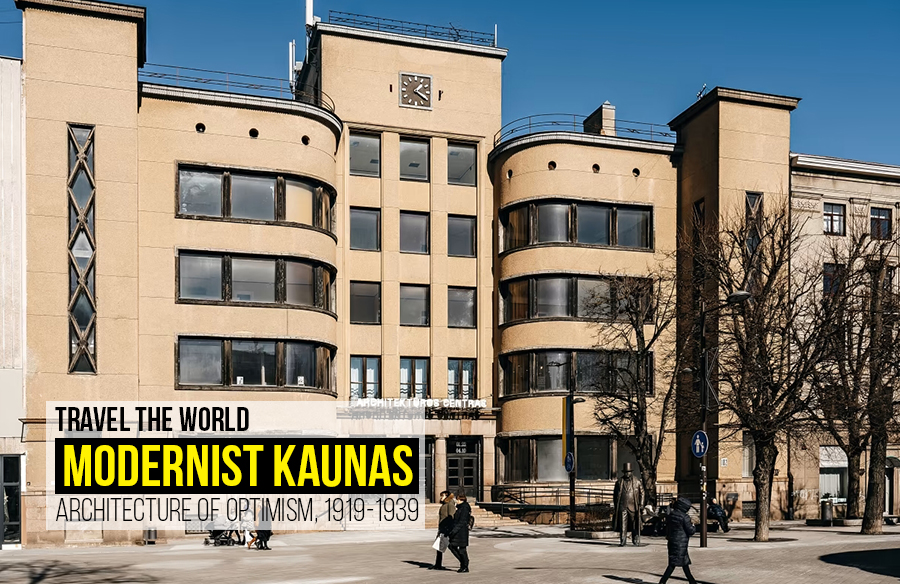
Ever since classical antiquity, the model of a modern city has played a substantial role in defining political and cultural communities. The narratives of Modernist Kaunas and the phenomenon of the rapid and rather radical urban transformation in the period between the two world wars from 1919-1939 is an important chapter in the political and architectural history of the European realms of the Baltic Sea. This revolutionary movement in the state of Lithuania has been coined as an ‘Architecture of Optimism.’

‘The Seed of Faith and Hope’
The Baltic War of Liberation in Europe commenced in Moscow, Russia in 1905, separating the Baltic States – Estonia, Latvia, and Lithuania in 1917 from the control of the Bolsheviks during the Russian Revolution following World War I. The independent Republic of Lithuania proclaimed the city of Vilnius as their capital; however, it was soon re-captured by the Red Army of Soviet Russia to expand their province during the Socialist Revolution (Britannica, 2019). Following this period of pandemonium and the bangarang in the lands of Europe, a seed of faith and hope was sown in the city of Kaunas, after proclaimed as the provisional capital of Lithuania. Thereafter, the intense changes and transformations that broke out in Kaunas with the vision of optimism, self-sufficiency, democracy, and the consolation assured by swift urban development, is a consequential futuristic model of a modern city in the history of architecture.


War, Politics and Architecture
The relationships between war, politics and architecture are indispensable. There are many instances in the history of Europe where planning and designing buildings has been one of the most significant approaches to linking the national sentiment of a political region. Hitler made several changes to the architectural style of Germany having a flat roof, horizontal expansion, lack of ornamentation, and uniformity to expose his great realms. Furthermore, the Prussians constructed buildings that alienated the city’s architectural style to impose the impressiveness of Bismarck’s Prussia (Daniel John Vinsand, 2004). The Architecture of Optimism was a central objective for the city of Kaunas for the renewal of their newly reformed status during the aftermath of a revolutionary period. It was a challenging role as a state and the people to liberate themselves from the imposing pasts and conceive architectural legacies, and symbols, construct new government facilities and a massive urban development. Kaunas Deputy Senior Engineer states, “Kaunas was no different than other pre-war, provincial Russian garrison cities. Nearly every sidewalk was made of wooden planks, the primitive pavement was full of pot-holes, and many streets were still not paved at all, even the city centre. One could often see cows and pigs walking about on the streets. In other words, the most basic affairs of the city needed immediate attention” (Ruzgiene et al., 2018).
‘The Architecture of Optimism’

‘Optimism’ is an expression of thousands of people transitioning through the revolutionary phases of events and that their efforts the outcomes will reap in positive and advantageous developments. Being optimistic is a strong state of mind to drive the enthusiasm of several people to unite a state and work unanimously towards a more stable and peaceful state. Over the next two decades, the city of Kaunas took a massive territorial and demographic feat by expanding its boundary seven times and the population growing to 1,55,000 (Ruzgiene et al., 2018). The diverse cultural group of people including Lithuanians, Jews, Russians, Germans, and Polish participated in various organisations of professional, creative, and civic societies. Around 12,000 structures were built using elements having modernist characteristics, such as adequate natural light, the openness of the space and maintaining hygiene in the environment (Ruzgiene et al., 2018). It was indeed, the city of Modernist Kaunas, that was progressing with a remarkably expeditious urban expansion with schools, banks, commercial units, a new model of housing, and places of worship.
Shaping the National Modern Style

The modernist style of the newly developing city of Kaunas and the vision to modernise the provisional capital had various exposure to the architectural influences from Russia, Germany, and America. Lithuania’s Architecture of optimism that lifted the Kaunas had its design orientation mainly from the west, i.e. America and the other parts of Europe. While the senior technicians had their training during the Russian Empire, the younger generation of engineers and Architects born between 1900-1910 had their education in America, Italy, and France. With the diverse inspirations from the West and Europe influencing the architecture of Kaunas, then President Antanas Smetona shares his dissatisfaction with the lack of Lithuanian heritage in framing the national style (Ruzgiene et al., 2018). Eventually, instead of experimenting with avant-garde architectural style, it embraced a rather intermediate path between modernism and classical tradition. Thus, the Architecture of Optimism in Kaunas was broadly influenced by orienting its national identity to two contradictory ideas: the ethnicity of the Lithuanian cultural group, and the magnificence of the medieval aristocratic state (Ruzgiene et al., 2018).
Urban Planning and the ‘Brick-Lithuania’


The concept of urban planning in the city was based on the ‘garden city concept,’ which was planned on a regular form of urban grid. This concept of planning is attached to the state of Lithuania as the country of farmers and its agrarian culture with the principle of urban growth being outwards and not upwards. The urban planning of the city demanded the new developments of parks, city squares, hospitals, sports complexes, resorts and other places of recreation and residential neighbourhoods. The change in residential facilities became one of the prominent ways to lead the architecture of the city to modernist ideas and change the local cultural fabric. According to the study of Vaidas Petrulis (2018), the buildings having economic usage of space, centralised water supply and sanitation system, and proper natural light were the main objectives of the modern style of design that resonated with other modern European styles. Old wooden houses were replaced with brick multi-storey units and tiled roofs with new construction techniques adhering to the existing basic requirements. A national campaign to construct ‘brick-Lithuania’ existed to protect the structure from fire and to recognise it as an act of modernist architectural style. Moreover, the image of ‘Grey Lithuania’ was replaced with the vividness and the pleasantness of the red colour of the roof tiles. Co-operative Housing as a form of a residential unit for government officials was accepted prominently, whereas, for private residential construction, various forms of units such as multi-unit, one or two-storey units, cottages and urban villas were built in the inter-war Kaunas (Ruzgiene et al., 2018).


Modernist Kaunas was reborn from the idea of romanticising patriotism, having the urge to unite as a separate state and free oneself from the decades of imposed soviet principles and grey structures. Having said that, the Architecture of Optimism helped the inhabitants of Lithuania preserve their cultural identities and sustain the Lithuanian legacies while creating a modernist model of a city. Thus, the phenomenon of Kaunas is undeniably the product of a spontaneous plan of functional modernisation that symbolises the heritage of the inter-war Kaunas yet even today.
Reference List:
- Ruzgiene, V., Cerniauskas, N., Dremaite, M., Jankeviciute, G., Laurinaitis, P., Petruliene, V. and Petrulis, V. (2018). Architecture of Optimism – The Kaunas Phenomenon, 1918-1940. Lithuanian National Commission for UESCO.
- Britannica, T.E. of E. (2019). Baltic War of Liberation | European history | Britannica. [online] Encyclopædia Britannica. Available at: https://www.britannica.com/event/Baltic-War-of-Liberation#ref1074391.
- Daniel John Vinsand (2004). Architecture and politics in Central Europe. pp.1–99.