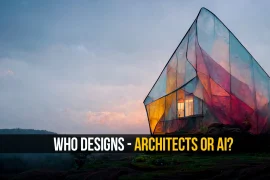
Today, architecture is viewed as an amalgamation of culture, style, and identity. Thus, architecture’s evolving nature coincides with the evolution of human activity. In general, the field of architecture has always responded to contemporary demands and integrated innovations and technological developments into its practice. AI is one such latest addition. AI can automate creative work, such as designing complex structures.

Statistical approach
Translating society’s shifting needs into real, workable and long-lasting solutions is a massive challenge for architects. The need for a new architectural practice, one that is not scared to challenge the status quo and is ready to take on the challenge, is driven by the need to address pressing challenges such as climate catastrophe, rising urbanisation, population density and housing shortage. To address pressing challenges such as climate catastrophe, rising urbanization, population density, and housing shortage problems, the sector today needs to adapt, develop and innovate urgently. Data availability is altering this game, and as technology evolves, new avenues for conception, creation and interaction will open up. That is where the digital age has broadened the possibilities for architecture by allowing people to see, interact with, and refine unattainable utopias. The discipline of architecture of cyberspace or liquid architecture, is a result of a statistical approach to AI in architecture that combines science and art.
A simulator and Automator
The development of AI and technologies has made decision-making increasingly dependent on the availability of the latest data. But AI can address these challenges. It effectively makes sense of massive amounts of data and can extract data, analyse it, and make decisions based on the information gathered. As a result, the software may be used to swiftly compare a variety of

One can experiment with different aspects of this using a design approach called parametric design, to develop several outputs, including forms and structures. In a matter of minutes, the application enables the architect to select the design output, define the constraints, plug-in data and make countless iterations of their building or product. This is made possible by the programming of advanced algorithms (AI) that enable architects to optimize and change a structure to meet their needs.
Complex 3D models can be produced fast and easily by AI-powered architectural software, which can then be used to create in-depth blueprints and drawings. AI can simulate multiple design scenarios, enabling architects to test different concepts and see how they work in real time. The potential uses of AI-powered architecture are virtually endless as long as technology keeps advancing. The use of computer programs by architects aids in the translation of their ideas and helps users and creators understand the built environment better. Output generation has gotten simpler as more visualisation applications emerge.

AI can simulate various situations, such as earthquakes and climatic conditions, allowing for the safety and disaster reduction factor of a built space. This data can be used to pre-determine building safety and stability, preventing catastrophic accidents. However, there is a technological gap between new construction materials and Building Information Modeling (BIM), which often doesn’t take the context’s culture into account, leading to the built form becoming alienated from its surroundings.
Digital manipulator
These cognitive intelligent machines constantly make practical mistakes and lack precision because they lack a sociocultural awareness of their environment. Because of this, it changes an architect’s potential from being a designer to a skilled digital manipulator or programming architect and mere input or parameter feeder, raising concerns about their capabilities and limitations. It also contributes to a creative collaboration that blurs the line between nature and technology where computers and architects continue to supplement each other.
“Computers are not good at open-ended creative solutions; that’s still reserved for humans. But through automation, we’re able to save time doing repetitive tasks, and we can reinvest that time in design,” says Mike Mendelson, instructor and curriculum designer at the Nvidia Deep Learning Institute.

Creativity and intuition tend to go hand in hand in the design process, which is an intricate and complex human activity. However, AI’s lack of emotional intelligence and human experience prevents it from fully mimicking human creativity. While AI is capable of gathering data, analyzing, and producing results based on the totality of current data, it is not capable of creating new data, even though it may be trained to develop original ideas and produce creative work.
Although a BIM or other parametric software can compute data about materialistic factors, the computation of psychosocial behaviours has not yet been studied. The input from the feeder is still used in interactive media art and machine hallucinations. AI can create customized plans; however, they tend to be modular and require little to no design effort. AI cannot create the sensory-experiential spaces that figuratively bind nature and the minds of humans. When cognitive computers perceive elements of the real world as limitations and boundaries, they are unable to comprehend the sublimeness of space. A soul that can feel and experience is needed to achieve remarkable results; otherwise, the whole notion of human evolution would be defeated.
Authorship
The neutral network has advantages but architects’ worries haven’t been alleviated despite this. As the debate on architects and AI intensifies, concerns about the originality of designs and authorship in AI-aided designs arise. Most AI programs, such as DALL-E, Stable Diffusion, Disco Diffusion, MidTrip and even ChatGPT, function by using data drawn from freely accessible cyberspace to generate replies based on text prompts provided by the user, thereby giving a concept physical shape in a matter of minutes. Due to its extreme reliance on recycling data in cyberspace, AI is susceptible to copying architectural designs, putting the objectivity of upcoming design languages in peril.

Architecture is a discipline with umpteen references. It is difficult to determine whether ideas, whether they involve ruins known as machines for life or contemporary biophilic high-rise designs, are innovative or have already been conceived of. While generating images of the future or the future of architecture, AI could think about flying drones, skyscrapers, and a more digitalised environment with less or no landscape. These have been the consolidation of futuristic worlds portrayed in movies and books. The human-centric perspective of the world is lost when AI is allowed to think or produce outcomes, proving that it’s a filtered search of existing data or ideas.