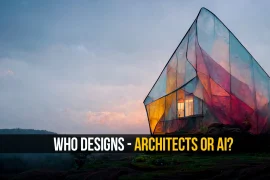
In the need to adopt sustainability in architecture, Optimising the building envelopes plays a significant role in minimising energy consumption and enhancing the lifestyle of every living being on this planet. Building envelopes act as the physical barrier between indoors and outdoors which significantly influences the building’s occupant comfort, thermal performance and lighting.

In recent times, Biomimicry and Generative Design have gained attention.
As we read through, this article explores the methodologies, Digital tools and Technologies, Examples and Challenges of it are described.

Biomimicry: Nature’s Illustration
Biomimicry is the inspiration from nature to mimic in creating various designs in architecture. Through millions of years of evolution, nature has obtained forms and functions to achieve high efficiency and resilience. By understanding and analysing these natural occurrences, humankind- Architects can develop building envelopes that resemble the energy-saving and adaptive features of biological organisms.
Some Examples of Biomimicry in Building Envelopes are:
- Lotus Effect for Self-Cleaning Surfaces: The micro-structure of lotus leaves allows droplets of water to roll off with the result that any soil/dirt on them is washed away. As a result, self-cleaning building materials have been designed that will not need regular cleaning hence reducing the maintenance cost and improving the quality of these structures.

2. Termite Mounds for Passive Cooling: Though external changes are rampant, the indoor temperatures of mud-hills housing termites have remained remarkably constant. Architects have drawn on this wisdom and created systems of ventilation structures fostering passive cooling hence less necessity for mechanical air-conditioning.

3. Butterfly Wings for Light Diffusion: The microscopic structure of butterfly wings scatters light efficiently. This has been utilised to design materials for facades that diffuse natural light, and improve indoor illumination while working great in minimising glare.

Power of Generative Design

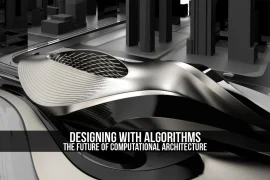
Generative design uses algorithms and computational power to explore a variety of design possibilities. By defining parameters and constraining architects the software can make numerous design iterations while aiming at factors like energy efficiency, material usage and aesthetics.
The Process of Generative Design
- Defining Constraints and Objectives: Architects give input design goals((e.g.., minimising heat loss, maximising natural light) and constraints (e.g.., site location, site conditions, budget limits) into the software-generative design.
- Algorithmic Exploration: The software uses algorithms to explore different permutations, evaluated against predefined objectives.
- Optimization and Selection: The selective designs are further sent to refinement. This iterative process ensures that the last design is not only aesthetically pleasing but highly functional and efficient.
The Integration of Biomimicry and Generative Design
The Integration of biomimicry and generative design provides a powerful synergy. The integration of biomimicry and generative design offers a powerful synergy. The principles of Biomimicry give a rich source of inspiration and experimental strategies, while the generative design tools enable rapid exploration and optimization of these concepts.
Digital Tools and Technologies
Optimising building envelopes becomes more manageable with each passing day as a result of developments in digital instruments that make biomimicry and generative design possible through software that includes Rhino, Grasshopper, and Autodesk’s Fusion 360 enabling even lay persons who are not professional architects to make models with complicated geometries simulate environmental performance.
- Parametric Design: Tools like Grasshopper enable parametric design, it dynamically alters the design using parameters, with rapid prototyping and iteration.
- Environmental Simulation: Advanced computer programs like EnergyPlus and Ladybug Tools are used to do elaborate environment simulations that analyse characteristics like thermal efficiency, daylighting,and energy use.
- 3D Printing and Digital Fabrication: Innovations in 3D printing and digital fabrication make it easier to create highly real biomimetic forms that would not be possible/would be difficult with conventional building techniques.
Challenges and Future Directions
Despite the potential and integration of biomimicry and generative design into the building envelope optimization faces challenges. It includes high initial costs of digital tools, needs, and interdisciplinary collaboration, and the complexity of translating digital drawings into real physical structures.
Overcoming Challenges:
- Education and Training
- Collaborative Platforms
- Cost-Effective Solutions
Biomimicry and generative design offer a promising frontier in sustainable architecture when it comes to optimising building envelopes. By making use of the longstanding strategies of nature and computational design prowess, it enables architectural creations that are not only attractive and efficient but also eco-friendly. Technologically, the sky’s the limit in the innovation of this sector with the continuous development of digital devices promising a future where our built environment harmonises with the natural world.