Take a moment to envision the future filled with technology and advancements. What does it look like? For most a place where coexistence with nature isn’t what comes to mind. However, we can only speculate about how the future will unfold rather than fully understand it. That said, sustainable design is a significant trend, emphasizing the importance of considering the environment in everything we create. Some wish to take this idea even further by designing spaces that reduce environmental harm and work towards restoring and rejuvenating the natural surroundings.

Sustainable design primarily focuses on minimizing environmental impact through the use of eco-friendly materials and reducing carbon footprints. But looking further than that regenerative design aims to restore and replenish natural resources, creating environments that promote both human well-being and ecological health, while contributing positively to the environment. This is an article aimed at exploring the intersections between sustainable architecture, the mindset shift, and the future.
Embodying Values in Actions and Physical Form A Learning Model For How We Need To Live Our Lives
The Omega Centre For Sustainable Living
The Omega Center for Sustainable Living (OCSL) aims to change the wastewater disposal system through alternative treatment methods. Created to house the primary treatment cells along with a classroom and laboratory to educate visitors, staff, and the local community about innovative wastewater strategies. Treated water is utilized for garden irrigation and greywater recovery. The system and building serve as educational tools in programs focused on the ecological impact of wastewater treatment, offered to campus visitors, school children, university students, and local communities.

The project’s design prioritizes a waste-free approach, focusing on the efficient harvesting of solar energy for passive heating and lighting. Creating a comfortable interior environment for both people and plants was crucial, leading to a careful blend of passive and mechanical comfort systems. The building’s design includes precisely placed windows and skylights to meet the solar energy needs of plants in the interior lagoons while also providing a memorable experience for its users. The project’s use of reclaimed materials which were procured from 5 demolition and reclamation contractors of which the materials had to be tested first to see whether they were fit for reuse. The Omega Center incorporates a variety of reclaimed materials, including dimensional lumber, plywood, interior doors, beech wood paneling, and toilet partitions. This approach helps divert tons of materials from landfills.


This project demonstrates how a built environment can support nature while effectively managing wastewater and water resources. The approach is designed to benefit both ecosystems and communities, promoting a clean and sustainable strategy. It aims to create an environment that is conducive to the thriving of both plants and humans, fostering not only educational experiences but also the holistic improvement of individuals
Compromising Without Compromising Values to Achieve Self-Reliance.
The Bullit Centre
Completed in 2010, this building has been dubbed the greenest commercial building in the world, laying the foundation for the most sustainable or net-zero structures. Its thoughtful design combines sustainable practices with regenerative design principles. The building’s goal of becoming self-sufficient was largely driven by the need to produce more energy than it consumes, with the surplus being contributed to the general grid, all while minimizing its environmental impact. This necessity forced the designers to think innovatively to achieve the established standards.

The building generates energy primarily from the roof, complemented by geothermal well systems operating beneath it, fulfilling all its energy needs. The facade is designed to maximize natural light, allowing it to penetrate deep into the interior, thus reducing the need for artificial lighting during the day and lowering energy demand. Additionally, rainwater harvested from the roof is stored in the basement; part of it is used in the building’s bathrooms, while the rest is treated with a UV filtration system for drinking water.

The drive for self-sufficiency also influenced the choice of materials used during construction. One of the biggest challenges was to avoid materials listed on the Living Building Council (LBC) red list, which includes 14 categories of harmful chemicals. The building’s structure features a combination of concrete for the lower floors and steel beams with heavy timber framing from the first floor upwards. The timber used had to be certified by the Forest Stewardship Council, ensuring that the wood came from responsibly managed forests that offer environmental, social, and economic benefits.

To further reduce energy needs, the design compromised on the use of elevators, instead featuring a staircase to encourage users to exercise a compromise most people can accept that enhances both human and ecological health. This regenerative approach was also reflected at the basement level, where traditional parking spaces were replaced with areas for solar energy storage, water storage and filtration, and sewage treatment.
Image 10_The combination of large windows and timber enhances the indoor experience by allowing natural light to penetrate deep into the building’s interior spaces_©Nic Lehoux.
Going Beyond Restoring and Rejuvenation|Regenerative design at the helm
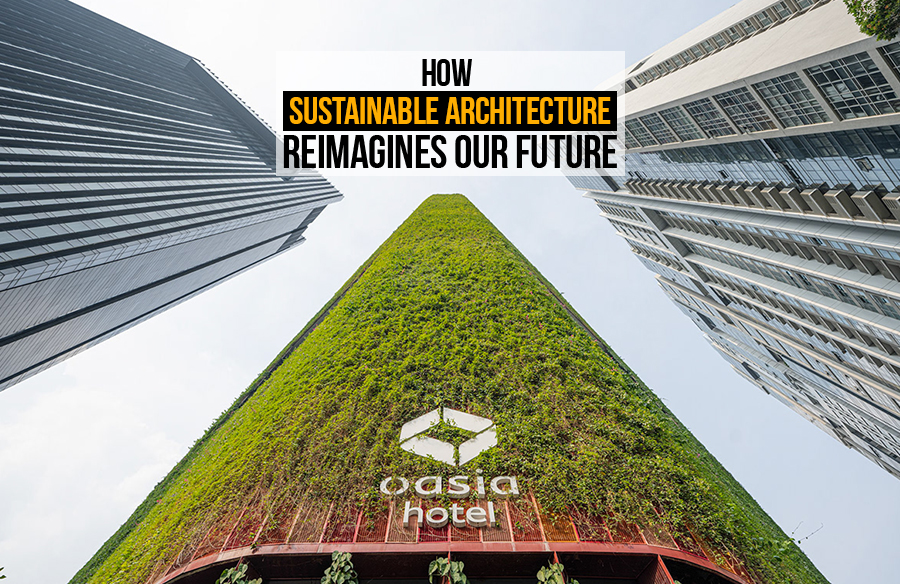
The Oasia Hotel Downtown
This building significantly compensates for the lack of greenery in its surrounding developments by providing 1000% more green space on-site than was originally present. This increase is equivalent to adding at least ten additional sites of the same size. Moreover, it serves as a haven for birds, animals, and insects, reintroducing biodiversity into the city, which would otherwise be lacking.
Image 11_The Oasia Hotel rises into the sky, bringing greenery with it_©Dominik Gehl.
Designed with a living façade filled with greenery and sky gardens, this building fosters close encounters with nature, contrasting sharply with the typical urban environment nearby. This unique design creates an experience of being surrounded by nature within the city. The thoughtful layout of the sky gardens allows for cross-ventilation, contributing to a comfortable indoor environment. The façade also features a mesh design that promotes airflow.


This project exemplifies how a building can positively impact its environment by alleviating the lack of green spaces and offering a refuge for local wildlife. It enhances biodiversity in the city center and features climbing plants that not only provide an ever-changing aesthetic but also contribute to the building’s cooling effects. The project’s sustainable and regenerative nature demonstrates how the building can benefit both its users and the surrounding neighborhood.

Letting Nature Take Center Stage Over Everything Else
The Opera Park-Cobe
The Cobe is described to be the green lung of the city. Due to the influx of people and the city’s busy, noisy nature, few places offer an experience of quietness, reflection, and alignment with nature. Based on its location in the harbor, this place serves as a refuge from the city’s chaotic nature. Its richness in nature, biology, and species offers an immersive and therapeutic experience that is also therapeutic as evidence-based research shows the combination of gardens with winding paths and defined views has a healing or rejuvenation effect.


This project shows us how buildings can be interdependent by benefitting from one another while being sustainable. Creating spaces where nature is put at the forefront and isn’t overshadowed by what has been built but at the same time being able to meet the spatial requirements of the project. Like an opera stage, the park is a composed landscape with a foreground, a middle ground, and a background. The plants and trees are placed, so their natural heights create the scenic setting facing the harbor. All this was done to allow nature to take center stage and appreciate the aesthetic arrangement and how it stands out.


This project’s interdependence with the adjacent Opera House ensures that rainwater from the roofs of the opera house is harvested and therefore acts as a reservoir, a source of water for the plants and ponds as well as supplying the much-needed water for the Opera House. Nestled beneath the park is underground parking which can be used by the visitors of the Opera House. A covered landscape walkway bridge provides a connection between the park and the Opera house projects. This shows how sustainability can change our mindset into seeing the bigger picture where building development can support each other’s spatial requirements.


Taking Nature With Us On The Progression Journey.
The Trudo Tower -Social Housing Vertical Forest
How can we integrate nature into our future while avoiding confinement to specific areas? Instead, we can incorporate it alongside our advancements. This project provides a glimpse into how we can carry nature with us as we design and construct sustainable buildings of the future. While traditional methods were limited to ground-level development, this innovative approach allows us to build vertically, effectively bringing nature into urban environments.


The Trudo Tower was designed to enhance the quality of life and attract a diverse range of plant and animal species, revitalizing a historic and vibrant district in the Dutch city. By reducing the heat island effect, the cooling benefits of the trees become evident. The water vapor produced by the plants extracts heat from the surrounding area, thereby decreasing reliance on mechanical air conditioning. The vegetation functions as a natural filter, reducing temperature differences between indoor and outdoor spaces during the summer while also lowering temperatures on the building’s exterior. This results in significant energy savings and improved climate conditions, environmental benefits, and air quality.


This building is a social housing project aimed at low-income individuals, such as young professionals and students, making sustainable architecture accessible to everyone. Cost reductions were achieved through technologies and design solutions like rainwater recycling, modular balconies, and prefabrication. This approach underscores the importance of inclusion, as it thoughtfully considers both human and natural elements in its design. This project exemplifies how we can reconcile current building practices with innovative methods, ensuring that sustainability in design goes hand in hand with progress, all while carrying nature along on our journey.
Sustainable architecture reimagines the built environment by not only aiming to minimize negative impacts but also actively working to improve and heal both the site and its surroundings. This approach focuses on integrating nature into the built environment in innovative ways that have not been previously considered, such as scalable sustainable solutions, emerging technologies, and the development of new materials. It emphasizes that buildings can achieve self-reliance by reducing energy consumption and creating spaces where nature takes precedence. The goal is to develop uplifting environments while meeting all other spatial requirements.
The intersections shown through the projects involve changing perspectives that influence architectural choices, integrating natural systems with modern technology, and examining how a single structure impacts the larger system. Moreover, as humans, we are an integral part of nature, and our connection to it is special; a world devoid of nature would make us feel mechanical. Sustainable architecture also involves leveraging advancements in technology, research, and design to incorporate nature into our progress, whether on land, in the air, at sea, in our minds, or even in space.
References:
2. Articles
‘Council on Tall Buildings and Urban Habitats’ (2013) Choice Reviews Online, 51(05). doi:10.5860/choice.51-2477.
Bullitt Center – Uli Case Studies (2015) ULI Case Studies. Available at: https://casestudies.uli.org/wp-content/uploads/2015/02/TheBullittCenter1.pdf (Accessed: 20 November 2024).
Global Trends in SUSTAINABLE CONSTRUCTION 2024 Building a Greener Future: Innovations and Insights in Sustainable Construction. (n.d.). Available at: https://www.stonehaven.ae/sherpa/pdfs/stonehaven-sustainability-report-2024.pdf [Accessed 20 Nov. 2024].
The Making of the Omega Center for Sustainable Living BNIM. (n.d.). Available at: https://www.eomega.org/sites/default/files/resources/bnim_omega_flow_book_0.pdf.
3. Online sources
Architetti, S.B. (2023) Trudo Vertical Forest, a living green heart: The plan, Stefano Boeri Architetti. Available at: https://www.theplan.it/eng/award-2023-Housing/trudo-vertical-forest-a-living-green-heart-stefano-boeri-architetti (Accessed: 20 November 2024).
Center for Sustainable Living (no date) eomega.org. Available at: https://www.eomega.org/center-sustainable-living/home (Accessed: 20 November 2024).
Oasia Hotel downtown Woha (no date) World. Available at: https://www.world-architects.com/ca/woha-singapore/project/oasia-hotel-downtown (Accessed: 20 November 2024).
Omega Center for Sustainable Living (2010) Omega Center for Sustainable Living | AIA Top Ten. Available at: https://www.aiatopten.org/node/109 (Accessed: 20 November 2024).
Omega Center for Sustainable Living (2024) BNIM. Available at: https://www.bnim.com/projects/omega-center-for-sustainable-living/ (Accessed: 20 November 2024).
The opera park (no date) Cobe. Available at: https://www.cobe.dk/projects/operapark (Accessed: 20 November 2024).
Revitalizing urban spaces: Opera Park by Cobe in Copenhagen (2024) Urban Design lab. Available at: https://urbandesignlab.in/revitalising-urban-spaces-opera-park-by-cobe-in-copenhagen/ (Accessed: 20 November 2024).
Trudo Vertical Forest: Eindhoven (2024) Stefano Boeri Architetti. Available at: https://www.stefanoboeriarchitetti.net/en/project/trudo-vertical-forest/ (Accessed: 20 November 2024).
Zettel, B. (2024) Copenhagen Opera Park by Cobe, DETAIL. Available at: https://www.detail.de/de_en/opera-park-in-kopenhagen-von-cobe?srsltid=AfmBOoqmPeEe1VmmROJzhfZ0yb8AREeEGC4dTmlWdA2bTpQnjZ3NSKeX (Accessed: 20 November 2024).
4. Images/visual mediums
www.youtube.com. (n.d.). The Bullitt Center: A Living Building. [online] Available at: https://www.youtube.com/watch?v=6TvlwAgi-vQ [Accessed 25 Jul. 2022].
Harvard GSD (2024). Dan Stubbergaard, ‘City as a Resource – Cobe’s Current Works on the City’. [online] YouTube. Available at: https://www.youtube.com/watch?v=M58qlwAd4wg [Accessed 20 Nov. 2024].
FRITZ HANSEN (2024). Fritz Hansen x Cobe Architects | 3 Days of Design in Copenhagen | Fritz Hansen. [online] YouTube. Available at: https://www.youtube.com/watch?v=4zc84loI-GE [Accessed 20 Nov. 2024].
www.youtube.com. (n.d.). Building Portrait: Oasia Hotel Downtown, WOHA Architects. [online] Available at: https://www.youtube.com/watch?v=6GAu5JyiCFI [Accessed 18 Jun. 2021].
Harvard GSD (2015). Wong Mun Summ and Richard Hassell of WOHA, ‘Garden City, Mega City…’ [online] YouTube. Available at: https://www.youtube.com/watch?v=J9hLHF8lpvg [Accessed 20 Nov. 2024].
Stefano Boeri Architetti (2021). Trudo Vertical Forest: the first Vertical Forest in Social Housing. [online] YouTube. Available at: https://www.youtube.com/watch?v=Ecd62sL6qvI [Accessed 5 Nov. 2024].