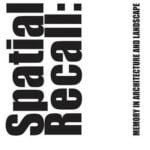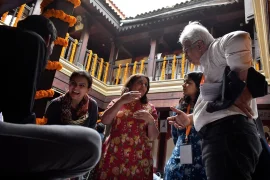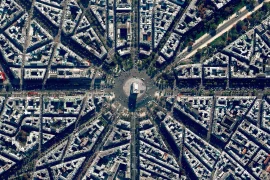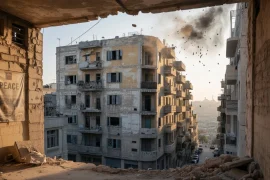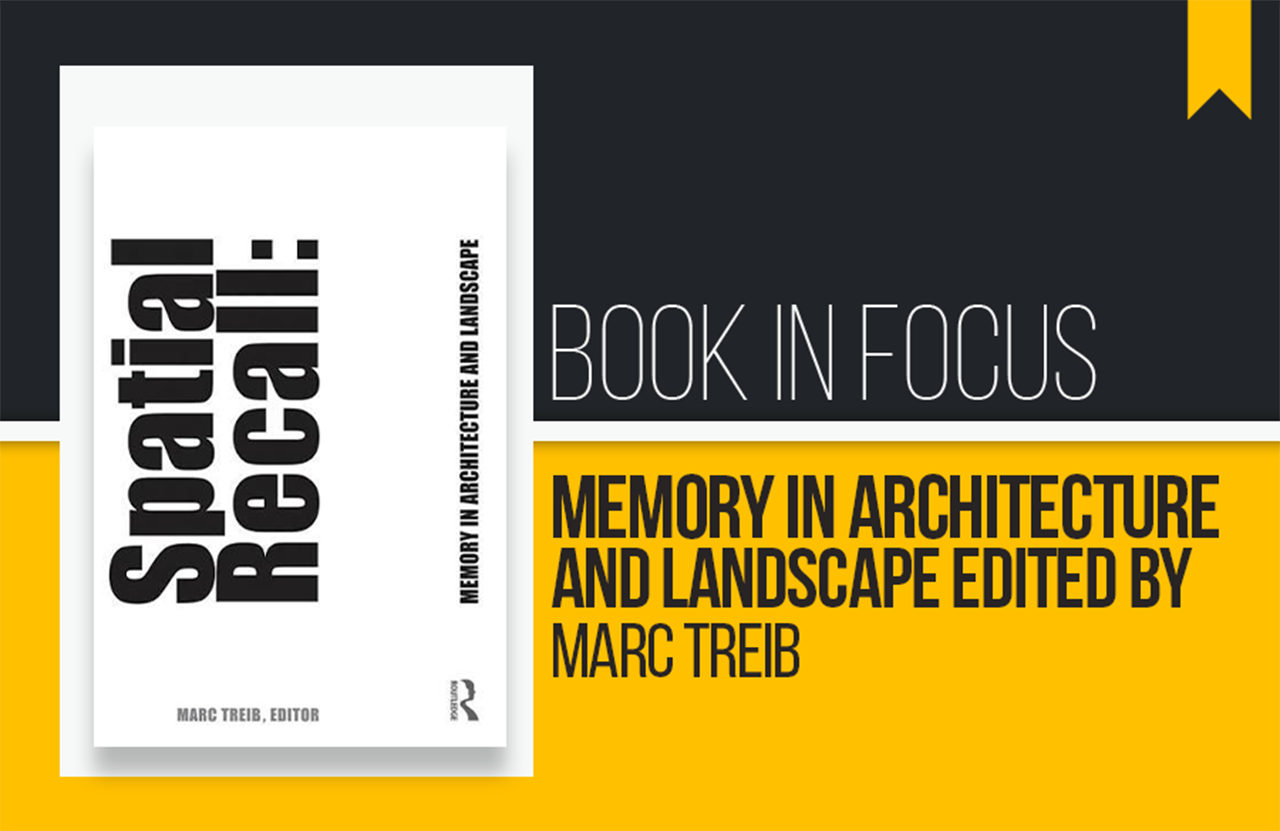
Spatial Recall: Memory in Architecture and Landscape is an interdisciplinary collection of essays, edited by Marc Treib. The book investigates how built environments and landscapes record, store, and transmit human memory. It contains a collection of self-contained and thematic essays. Spatial Recall covers topics ranging from sculpture and hydrology to philosophy and urban historiography. The book is structured nonlinearly, exploring chapters according to their specific interest in design, environmental science, or cultural history. Marc Treib pairs scholars with practicing designers, artists, and engineers. The contributors approach each essay through a distinct professional lens. They try to connect philosophical concepts of memory directly to physical construction, artistic installation, and environmental management.
E.Marc Treib is Professor Emeritus of architecture at the University of California, Berkeley. He is a practicing graphic designer and architectural critic. In addition to editing Spatial Recall, he has written and edited works on design, landscape, and architectural history. Noguchi’s Gardens: Landscape as Sculpture (2024), Landscapes of Modern Architecture: Wright, Mies, Neutra, Aalto, Barragán (2017), Space Calculated in Seconds: The Philips Pavilion; Le Corbusier; Edgard Varèse (1996), and Settings and Stray Paths: Writings on Landscape and Gardens (2005) are some of his notable works.
Concept of Spatial Memory
The introductory framework for Spatial Recall is titled “Yes, Now I Remember: An Introduction”. Here Marc Treib examines how modern-day society reuses physical remnants and industrial relics as emotional triggers. This sets up a stage for interdisciplinary dialogue among scholars, architects, landscape designers, and artists. In this framework, the built environment acts as an externalized mnemonic devices that records, stores, and transmit history and culture. In this essay, he describes how memory operates as a memory bank where deposits and withdrawals are transacted between personal recall and collective identity.

In Spatial Recall: Memory in Architecture and Landscape, the contributors approach the relationship between memory, space, and design from several distinct disciplinary perspectives. The book brings together authors from diverse disciplines: architecture, landscape design, hydrology, cognitive neuroscience, sculpture, urban history, and historic preservation. The book is a collection of 12 essays that are categorized into three main parts. Spatial Recall’s three-part structure creates a natural progression that helps readers navigate and digest a dense and interdisciplinary idea of memory. The essays are divided into three thematic sections: Body, Landscape, and Building. Though the core philosophy is the same, each part examines spatial memory across different scales, media, and disciplines. Part I begins at the intimate internal scale of human perception, psychology, and individual cognition. In Part II, the perspective expands outward to the regional level. The final part, Part III, explores the idea at a civic level.
Part I – Body: Memory, Perception, and Experience
The first part, Body, features essays by Juhani Pallasmaa, Susan Schwartzenberg, Donlyn Lyndon, and Alice Aycock. This segment describes memory at a micro scale: memory within the human body and senses. The essays investigate how human memory is registered through movement, emotional associations, and mental reconstruction. For example, Susan Schwartzenberg’s case study of artist Franco Magnani’s, illustrates how nostalgia distorts scale, perspective, and subjective experience. Here, the author focuses on the sensory, cognitive, and psychological mechanisms through which individuals experience and remember space

Part II – Landscape: Memory Written onto the Land
In the second part of the Spatial Recall, Landscape expands the investigation of the meaning of memory through topographies, water systems, and regional ecosystems. This section includes works by Matt Kondolf, Georges Descombes, Adriaan Geuze, and Luig Latini. These four author bring their expertise from geomorphology, hydrology, landscape architecture, and urban design. In Part II, memory is observed at the macro scale, where it is beyond human control. Here, the authors see landscapes as not just a static background but active, externalized memory banks that record environmental processes, historical traces, and cultural identities throughout the period.
Part III – Building: Architecture as Historical Record
The final section, Building, contains essays by Esther da Costa Meyer, Marc Treib, Andrew Shanken, and Jorge Otero Pailos. The four authors bring distinct historical, theoretical, and preservationist perspectives into the study of spatial memory. Part III observes memory at the civic level, where it investigates built structures and challenges collective memory. It examines how structures, urban fabrics, and memorials become tangible historical records. For example, through the Landschaftspark Duisburg-Nord case study, Marc Treib observes how communities and cities integrate physical remains of conflict or industry into modern civic life.
For the Readers
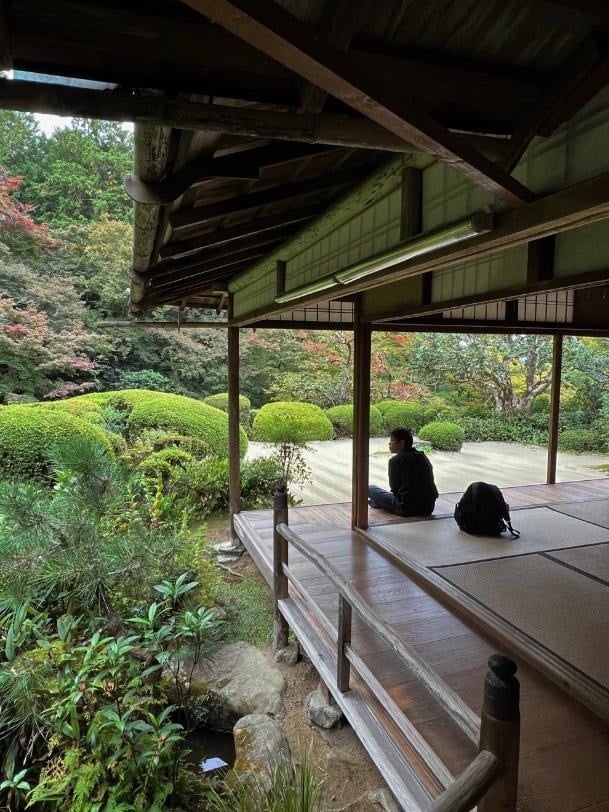
The book Spatial Recall: Memory in Architecture and Landscape is a great read for architects, landscape designers, urban planners, historians, and general readers who are interested in how physical surroundings shape human experience, cultural identity, and historical continuity. The grouping of authors by shared themes gives readers a clear mental map of how each discipline contributes to the core thesis. The essay defines Memory as the lingering trace of what has come before, preserved either as physical remains or as an enduring mental presence. It explores the idea of memory beyond the abstract concept. Spatial Recall demonstrates how environments actively shape human identity, emotion, and remembrance. The book encourages readers to experience their everyday environments as living repositories of human culture and time.
References:
Treib, M. (2009). Spatial recall : memory in architecture and landscape. London: Routledge.
a landscape lover’s blog. (2010). Book review: Spatial Recall. [online] Available at: https://landscapelover.wordpress.com/2010/06/03/book-review-spatial-recall/ [Accessed 20 Sept. 2026].
UC Berkeley College of Environmental Design. (2026). E. Marc Treib – UC Berkeley College of Environmental Design. [online] Available at: https://ced.berkeley.edu/people/e-marc-treib [Accessed 20 Sept. 2026].