Elizabeth Ekadashi is a 2014 Marathi film directed by Paresh Mokashi and set in the pilgrimage town of Pandharpur, Maharashtra. The story follows two children, Dnyanesh and Mukta, as their family faces a difficult period. At first, the film appears to be a simple story about childhood, family and an ordinary bicycle. Yet, beneath the narrative is a detailed portrait of a town and the way people inhabit it. Streets, houses, doorways, markets, religious activity and crowds are continuously woven into the story. For architects and designers, Elizabeth Ekadashi becomes interesting not because it showcases spectacular buildings, but because it quietly captures architecture as part of everyday life.

Pandharpur Beyond the Landmark
The architectural character of Elizabeth Ekadashi comes largely from its setting. Pandharpur is not introduced through a sequence of monumental buildings or carefully composed architectural shots. Instead, the camera spends considerable time within the town’s ordinary spaces. Narrow lanes, closely placed buildings, street-facing entrances and small commercial activities form the background to the children’s lives. The result is a town that feels lived in rather than presented as a tourist destination.
This distinction is important for architects. When a site is analysed, attention often goes towards measurable elements such as plot boundaries, road widths, building heights, land use and vegetation. These are essential, but they do not fully describe the character of a place. Elizabeth Ekadashi shows another layer of site reading: the relationship between buildings and people. A wall becomes significant because someone sits beside it. A doorway becomes meaningful because it connects domestic life with the street. A lane becomes memorable because it is repeatedly used and experienced. Architecture here is understood through occupation rather than appearance alone.
The Street as an Extension of Everyday Life
The streets in Elizabeth Ekadashi are among its most useful elements for an architectural reading. They are narrow in places and closely framed by buildings, but they never feel like empty circulation corridors. Children move through them, people stop to interact, small businesses operate along their edges and vehicles negotiate the same limited space. Different activities overlap without requiring a clearly separated zone for each one.
This is a quality that is often visible in older Indian neighbourhoods. The street can become an extension of the house, a marketplace, a social space and a route at the same time. The film captures this without explicitly explaining it. The architecture is revealed through behaviour. A street’s success is therefore not determined only by how efficiently it moves traffic. It can also be judged by whether it allows people to pause, meet, watch, play, trade and feel connected to their surroundings.
For a designer, this is a useful reminder to observe what actually happens in a street before proposing what should happen there.
Seeing the Town at a Human Scale
The children’s perspective gives Elizabeth Ekadashi another architectural quality. Dnyanesh and Mukta experience Pandharpur largely through walking, cycling and short journeys. Their understanding of the town comes from corners, walls, doorways, familiar buildings and small changes in the street rather than from large-scale views.
This makes the film an interesting study of human-scale architecture. A narrow passage can feel significant when experienced at walking speed. A low wall can become a place to sit. A doorway can act as a point of observation. A projecting element above a street can influence the sense of enclosure even if it appears insignificant in an elevation.
For architects, this suggests that a place should occasionally be studied from eye level and at the speed at which it is actually experienced. Plans and aerial photographs reveal the structure of a neighbourhood, but walking through it reveals something else: the sequence of spaces, changes in enclosure, visual connections and moments of pause. Elizabeth Ekadashi makes these ordinary experiences visible.

The Architecture of the Threshold
The spaces between the house and the street are particularly interesting. Doors, steps, walls and semi-open edges repeatedly appear as places where domestic and public life meet. These are not dramatic architectural features, but they create a gradual transition between two different conditions. Traditional Indian settlements often contain such intermediate spaces. A person can sit near an entrance without completely entering the house. Someone inside can remain visually connected with the street. A neighbour can stop for a brief conversation without requiring a formal invitation indoors. These small exchanges are supported by architecture.
Elizabeth Ekadashi demonstrates why thresholds deserve greater attention in design. A building does not necessarily need a hard boundary between private interior and public exterior. Semi open spaces can provide privacy while still encouraging social contact. Verandahs, entrance platforms, recessed doorways and shaded edges can therefore become important social infrastructure within a neighbourhood.
The film’s architectural value lies partly in showing how these spaces are used rather than simply showing what they look like.
Reading Local Character Through Ordinary Buildings
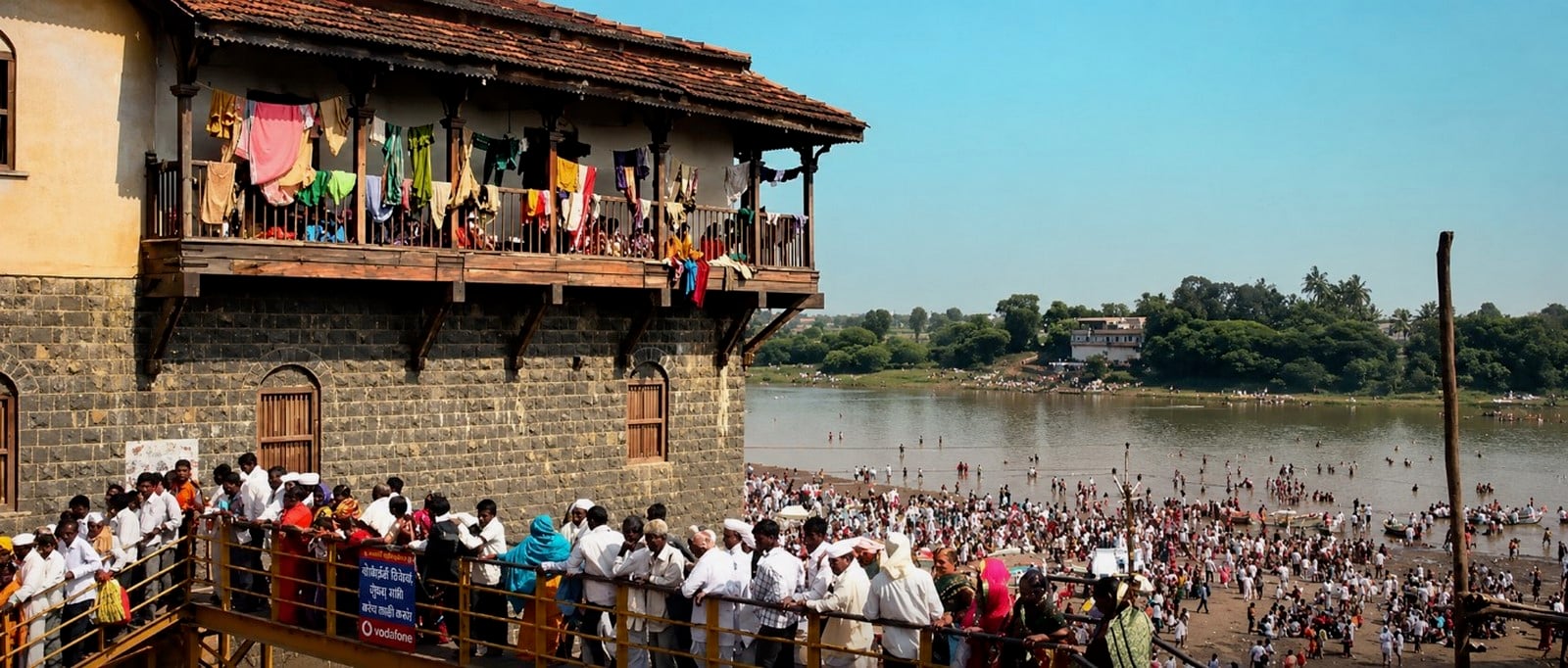
The buildings shown throughout Elizabeth Ekadashi do not appear as isolated architectural objects. Their character comes from repetition and proximity. Walls, openings, projections, rooflines and street edges work together to produce the visual identity of the neighbourhood.
This is an important lesson when designing within an existing context. Context-sensitive architecture does not necessarily mean reproducing traditional façades or applying decorative elements borrowed from the past. It requires a closer understanding of what gives the existing environment its character.
The proportions of openings, relationship between ground floor and street, degree of shading, material texture and scale of buildings can all contribute to this identity. When these qualities are understood as a system, a new building can respond to its surroundings without becoming a historical imitation.
In this sense, Elizabeth Ekadashi encourages architects to study vernacular architecture as a way of thinking rather than simply as a visual style.
When Public and Private Life Overlap
Another subtle quality visible in the film is the overlap between domestic and public life. Activities do not always remain confined within clearly defined boundaries. People can be seen near entrances, along streets and around small shops, creating a continuous relationship between the interior and the public realm.
This kind of spatial arrangement produces familiarity. Residents can recognise people passing by, children can move between home and street, and everyday interactions can happen without requiring a specially designed gathering space. Modern developments often provide designated spaces for interaction: clubhouses, plazas, landscaped courts or community halls. These spaces can be useful, but the film demonstrates that social interaction can also emerge from much smaller and less formal conditions.
A doorstep, shaded edge or narrow lane can sometimes support more spontaneous interaction than a formally designed social space because it is already part of people’s daily routines.
A City That Changes During Ekadashi
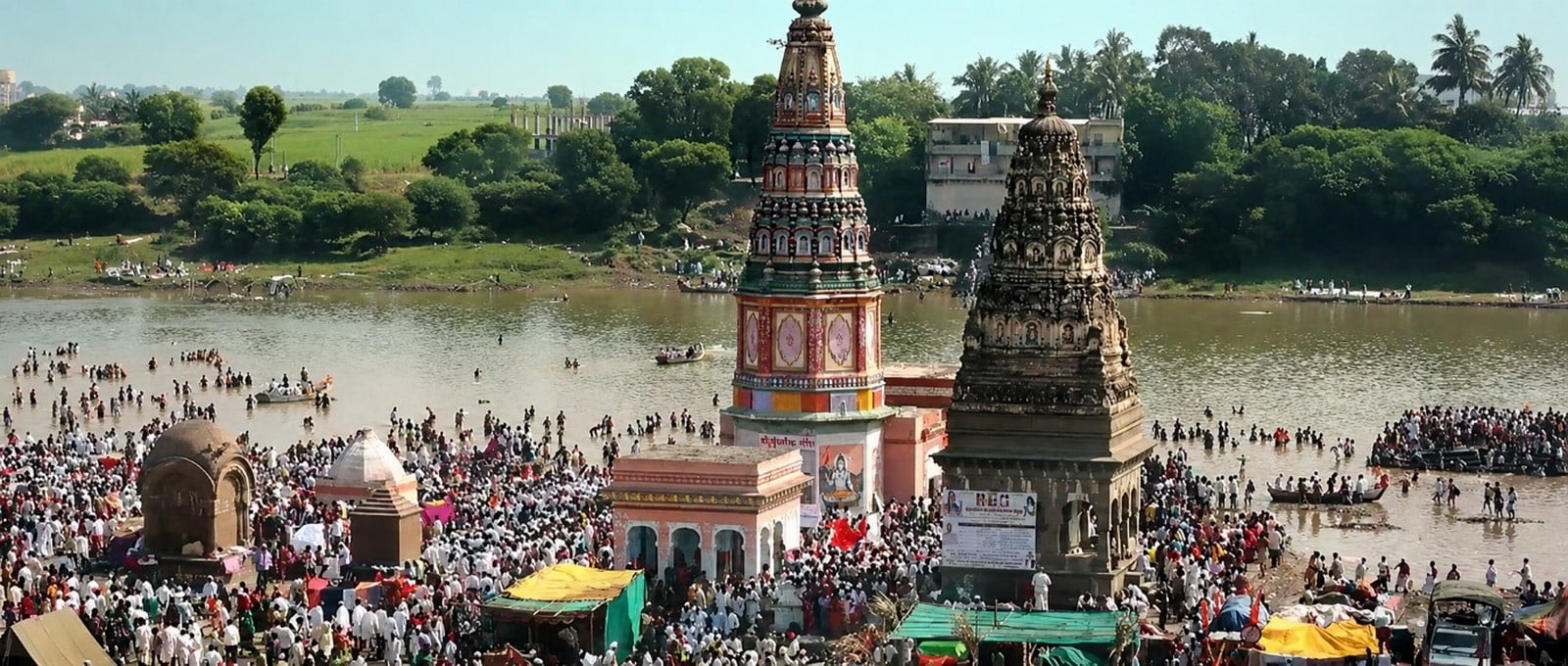
Pandharpur’s identity cannot be separated from pilgrimage. During Ekadashi, the town experiences a dramatic increase in visitors and activity. Streets that may function as ordinary neighbourhood routes at one time become crowded pedestrian environments during the pilgrimage period.
This aspect of Elizabeth Ekadashi is particularly valuable for architects and urban designers because it introduces the idea of time as a design parameter. A place does not have one permanent condition. Its population, movement patterns and activities can change according to festivals, seasons, markets and religious events.
The film was shot in Pandharpur during the actual Kartiki Ekadashi period, which meant that the production itself had to work within the changing conditions of the town. This adds authenticity to the way the crowds and urban activity appear on screen.
For designers, the lesson is significant. Public spaces in culturally active towns may need to support both every day and peak conditions. Streets, open spaces and gathering areas can benefit from flexible arrangements that allow temporary stalls, processions, pedestrian movement and large gatherings without permanently disrupting everyday life.
Informal Activity and the Indian Street
The film also captures the relationship between informal activity and the built environment. Small-scale commerce, transport, pedestrians and temporary activities coexist within relatively compact spaces. The result is visually busy, but it is also socially active.
From an architectural perspective, this raises an important question about how informal urban life is treated. Informality is often seen as something that needs to be removed to make a place more orderly. However, vendors, small shops, temporary stalls and street-based activities can contribute significantly to a neighbourhood’s identity and livelihood. A more sensitive approach is to ask what infrastructure these activities need. Shade, drainage, waste collection, pedestrian access, storage and safety measures can improve the quality of informal spaces without removing the activities themselves.
Elizabeth Ekadashi therefore presents the street not as a perfectly controlled environment, but as a space that accommodates different forms of everyday life.
Architecture, Memory and Belonging
Perhaps the subtlest architectural lesson in Elizabeth Ekadashi is the relationship between space and memory. The characters do not experience their surroundings as anonymous buildings. Familiar streets and objects become associated with particular people, experiences and emotions.
The bicycle Elizabeth is especially important in this regard. Although it is an ordinary object, it acquires emotional significance through its relationship with the family. The same principle applies to architecture. A doorway, courtyard, staircase or street can become meaningful because of the memories attached to it. This is something that architectural drawings cannot easily represent. A building can satisfy every functional requirement and still fail to create a sense of belonging. Conversely, a simple space can become deeply important when people are allowed to use it, adapt it and create memories within it.
For designers, this suggests that architecture should leave room for people to make a place their own.
The Importance of Observing Before Designing
Viewed architecturally, Elizabeth Ekadashi is almost an exercise in observational site study. It encourages attention to things that can easily be overlooked: how people stand near a doorway, how a child chooses a route through a lane, how a shop occupies the edge of a building, how pedestrians share space with vehicles and how a festival changes the density of a street.
These observations can become useful design inputs. Behavioural mapping, photographic documentation, time-based observation and conversations with users can reveal qualities that conventional site surveys may miss.
The film therefore offers a simple lesson for architecture students: before changing a place, understand how it already works.
A Film That Makes Ordinary Architecture Visible
Elizabeth Ekadashi is not an architectural documentary, nor does it attempt to explain the architecture of Pandharpur. Its primary purpose remains the story of a family and two children. Some reviews have praised its direction and characterisation, while finding aspects of its visual presentation weaker. That balance is worth recognising when considering the film as a design reference.
Its architectural value comes from something quieter. The film allows ordinary buildings to remain ordinary. There is no attempt to make every street look picturesque, or every building appear important. Instead, architecture is allowed to exist as part of everyday life.
That makes the film particularly useful for students of architecture. It encourages them to look beyond landmark buildings and appreciate the spatial qualities of streets, thresholds, building edges and neighbourhoods.
Elizabeth Ekadashi offers a gentle but meaningful architectural lesson: the character of a place is created not only by what is built, but by how people live within it.
Pandharpur’s streets, houses and public spaces gain their identity through movement, culture, informal activity and memory. The film shows that architecture is experienced through ordinary moments: walking down a lane, sitting near a doorway, passing a familiar building or sharing a crowded street during a festival. For architects and designers, this makes Elizabeth Ekadashi worth watching. It does not provide a catalogue of architectural forms to copy. Instead, it encourages a more valuable habit: observing the relationship between people and place.
The strongest takeaway is therefore not about a particular building or material. It is about looking carefully. A street is more than its width, a house is more than its façade, and a public space is more than its plan. Architecture becomes meaningful when it supports the everyday life, memories and cultural practices of the people who inhabit it.