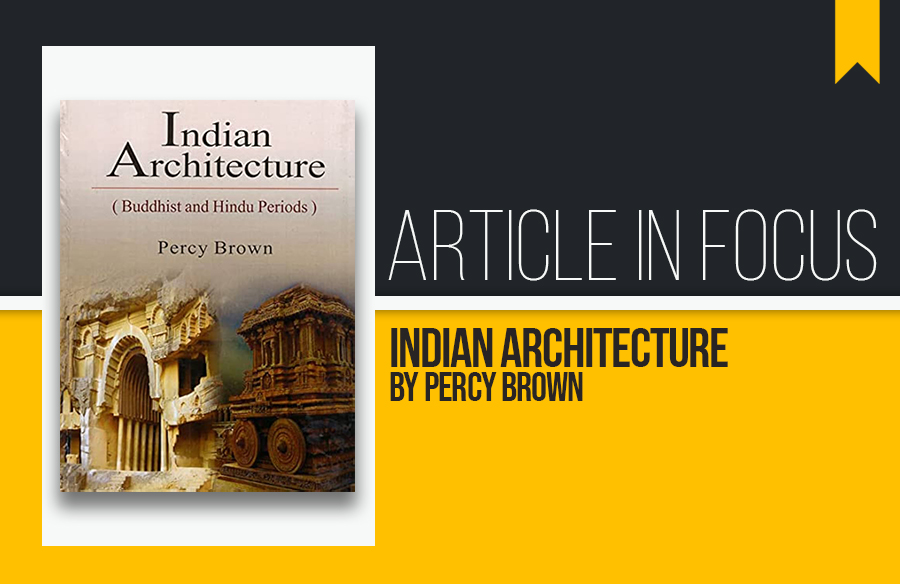
Many people consider Percy Brown’s *Indian Architecture* to be a reliable and perceptive examination of India’s extensive architectural heritage. With a thorough examination of ancient buildings, medieval monuments, and the stylistic development under different dynasties, the two-volume book transports readers through the nation’s rich architectural legacy, which spans thousands of years. In addition to being an academic resource, Brown’s work tells a story that highlights the artistic, historical, and cultural significance of India’s built environment. This review explores the book’s main features and emphasizes how important it is as a resource for professionals, students, and fans of Indian architecture.

A Comprehensive Overview of Indian Architectural History
The two separate volumes of Percy Brown‘s book are devoted to Islamic architecture in India and the ancient and medieval eras, respectively. Readers can obtain a comprehensive grasp of the evolution and traits of every era thanks to this division. From the early Buddhist era to the Gupta dynasty, India’s architectural development is traced in the first volume, which also discusses the significant impact of religion and mythology on structural decisions and design aspects. By carefully analyzing stupas, temples, and monasteries, Brown gives readers a better understanding of their building methods and symbolic significance.

With an emphasis on how these influences altered the environment and produced a distinctive Indo-Islamic fusion, the second book explores the architectural forms introduced to India during Islamic control. Brown’s analysis of forts, mosques, and tombs provides a sophisticated perspective on how architectural integration reflected religious and cultural integration.
Thematic and Stylistic Approach
Brown’s work is notable for its thematic and stylistic approach, which allows readers to recognize architectural patterns in many eras and geographical areas. Brown examines how politics, religion, and society impacted architecture rather than just showcasing it as historical constructions. He looks into the evolution of Buddhist stupas, the regional adaptation of Hindu temple architecture, and the introduction of new forms such as domes, minarets, and elaborate geometric decorations with the advent of Islamic monarchs.
Brown offers a greater comprehension of the Indian ethos and the unique fusion of aesthetics and philosophies that characterize Indian architecture by examining architectural styles in this context. Therefore, his work is a thematic investigation of the forces underlying the structures rather than merely a historical retelling.
Rich Illustrations and Architectural Drawings
With a variety of graphics, photos, and architectural sketches that give the text life, Brown’s work is visually striking. Readers may admire the intricate craftsmanship of architectural marvels like the Taj Mahal, the Khajuraho temples, and the Ajanta and Ellora caves through the detailed illustrations of these landmarks.
One of the book’s distinguishing characteristics is the visual aids it provides, which enable readers to both read about and picture the magnificence of these historic structures. Because they allow readers who are unfamiliar with architectural analysis to make a direct connection between textual descriptions and the architectural forms under discussion, these pictures improve comprehension.
Scholarly Depth and Accessibility
Although Brown’s Indian Architecture is renowned for its intellectual depth, a broad audience may still understand it. The book is well-liked by both architecture students and ordinary readers because of the author’s ability to write clearly enough for non-specialists to understand complicated architectural principles. Accurate architectural vocabulary, descriptions, and analysis enhance the story and combine to produce a scholarly but captivating tale.
However, because Brown was a British historian writing in the early 20th century, his work occasionally exhibits a colonial perspective. His interpretations are occasionally influenced by this, especially when it comes to the cultural effects on Indian architecture. Despite this, he continues to be one of the most comprehensive and thoroughly studied authorities on the subject, making his contributions to the documentation of India’s architectural history essential.
Influence and Legacy in Indian Architectural Studies
As a foundational text for academics and researchers around the world, Percy Brown’s *Indian Architecture* has left a lasting legacy in the area of architectural studies. Numerous studies and research projects have been sparked by Brown’s thorough documenting and classification of Indian architectural forms, which has established a standard in academic circles. His method paved the way for later historians to examine India’s architectural legacy in a more methodical and critical manner.
Even though more recent interpretations and studies offer new insights, Brown’s work is still regarded as a fundamental resource today because of its richness and breadth. It documents a moment in architectural history when India’s architectural legacy was recognized and cataloged on a scale never seen before.
Conclusion: A Must-Read for Enthusiasts and Scholars
Anyone interested in the development of Indian architecture should read Percy Brown’s Indian Architecture. The book is appropriate for both serious scholars and casual readers because it provides both a thorough study and a broad overview. Readers are given an immersive experience by Brown’s meticulous attention to detail and his love of architecture, which permeate the whole work. Despite being created many years ago, *Indian Architecture* is still a highly respected and relevant book that documents India’s architectural development across time.
In conclusion, Brown’s work highlights the beauty and cultural relevance of India’s constructed history and is more than just an architectural catalog. This book is still a timeless and priceless resource for anyone wishing to learn more about Indian architecture.
Citation:
- Brown, Percy. *Indian Architecture (Buddhist and Hindu Periods)*. 3rd ed., Vol. 1, D. B. Taraporevala Sons, 1956.
- Brown, Percy. *Indian Architecture (Islamic Period)*. 3rd ed., Vol. 2, D. B. Taraporevala Sons, 1958.