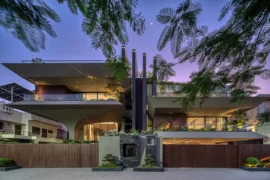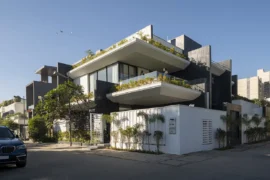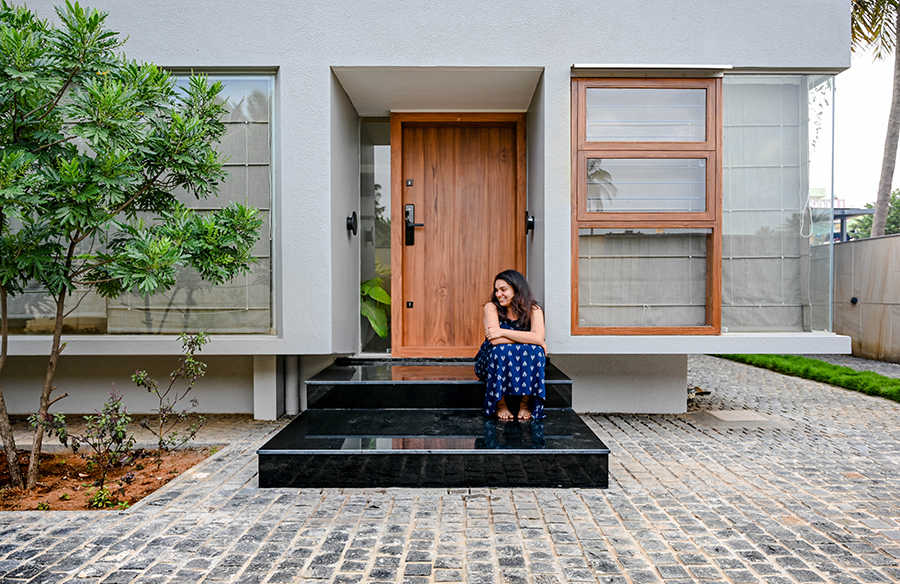
As the name conveys this beautiful house consists of an enormous number of bay windows that makes the project unique in itself. The house is situated at one end of the farmland in malur, one of the towns of kolar district, in karnataka. The bay window house was designed for a family who own the farmland and grow seasonal crops in their land.
Project Name: The Bay Window House
Studio Name: KMN Architects
Area: 4,000 sq.ft
Year: 2023
Lead Architect: Kiran Mohan
Landscape Architect: Chethan garlapur
Photographs: Studio Frameify

The house is spatially organized to have the common spaces towards farmland in order to stay connected during their daily chores and private spaces on the rear side. The common spaces ie, the formal living, informal living and a dining room integrated into the kitchen were intended to have huge bay windows to provide long and uninterrupted views towards the farmland.

In addition to this the bay windows also defined the interior spaces by opening up the space and adding more room to it. They also facilitate maximum natural light into the space in order to brighten up the room for a longer period of the day. Bay window adds on to the aesthetic touch in the house and one can enjoy their evening coffee sitting on the bay window amidst the landscape. It’s also a perfect spot for hobbies and daily activities. The bay windows are enhancing the vastness of the space and providing more space, it can also convert into a mini reading or a study nook.

The interiors have a greater influence on the Japanese style and design, grounded in simplicity and a connection to nature, features clean lines, rough-hewn textures, a neutral palette, and minimal styling. This peaceful approach to decorating encourages relaxation at home by mixing the cultural ethos, citing the importance of complementary shades and textures. Japanese design also uses the concept of “ma.” But it is defined as negative or empty space. In Japanese culture, ma is not only a design concept but a cultural concept that focuses on unoccupied space and time that allows people to pause and breathe. In design, but is used by avoiding filling rooms to the brim to maintain empty space.

The openness allows for harmony between spaces indoors and outdoors. The entrance of the house has a double height space adding the vastness to the space, followed by the living room which has a long stretch of bay. The yellow door is one of the attractive features in the project which separated the living from the dining and kitchen. The dining space is infused into an island kitchen, which maximizes the circulation space all around and adds the Japanese modern touch in terms of design and colors. The bay windows were introduced in the kitchen cum dining space as well so that One can stay visually connected to the beautiful landscape around.

All the common spaces are lit with natural light flowing into the space which keeps the spaces bright all through the day. On similar lines the staircase well is intended to be a sculpture by itself by bringing in the bright light from the top through the skylight. The levels are also visually connected and designed to be more interactive for the users.
Not just the lower level, the upper levels also have bay windows which maximizes the visual connectivity to the farmland in front of the house.