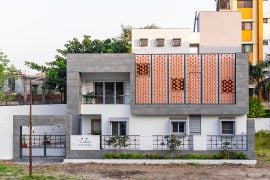

The Ōmori House, a sixty-year-old, two-story wooden residence located in Tokyo’s Ōta ward, stands as a testament to the area’s architectural legacy. This home embodies a nostalgic charm that blends seamlessly with its environment.
Project Name: Ōmori House
Studio Name: Roovice
Completion Year: 2023
Lead Architect & Site Manager: Natsuki Murakami
Photography: Akira Nakamura

After housing a long-term tenant, the property remained vacant for over a decade due to its age and concerns about market appeal. Fortunately, the property owner discovered our Kariage initiative, which specializes in revitalizing and subleasing aging, unoccupied properties at no cost to the owner, offering a creative solution to Japan’s prevalent issue of vacant homes, known as akiya.

Addressing the challenge of limited natural light on the southern side, our approach focused on removing unnecessary partitions and fixtures, creating harmonious open spaces on each floor to allow light and air to flow through the interior.

On the ground level, we removed ceiling boards to reveal the wooden framework, complemented by a modern, custom-made square-shaped white tile kitchen counter and sleek gray tile flooring. Blue accents were used for the grout lines of the kitchen tiles and the bathroom sliding door, balancing modernity with tradition.

Upstairs, we preserved the traditional Japanese essence by keeping tatami mats and ceiling boards while removing dividing walls to create an open layout. Relocating the bathroom facilities downstairs enabled us to incorporate a walk-in closet that doubles as a workspace and revealed a previously obscured south-facing window, bringing in natural light.

Continuity between floors was enhanced by uniform tile flooring near the staircase. The delicate frosted glass windows from the Shōwa era were preserved not only for their aesthetic value but also to ensure privacy, blending heritage with practicality.