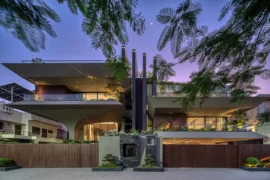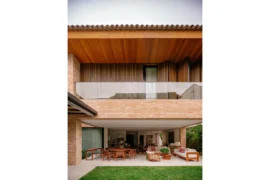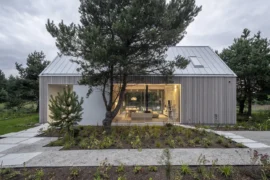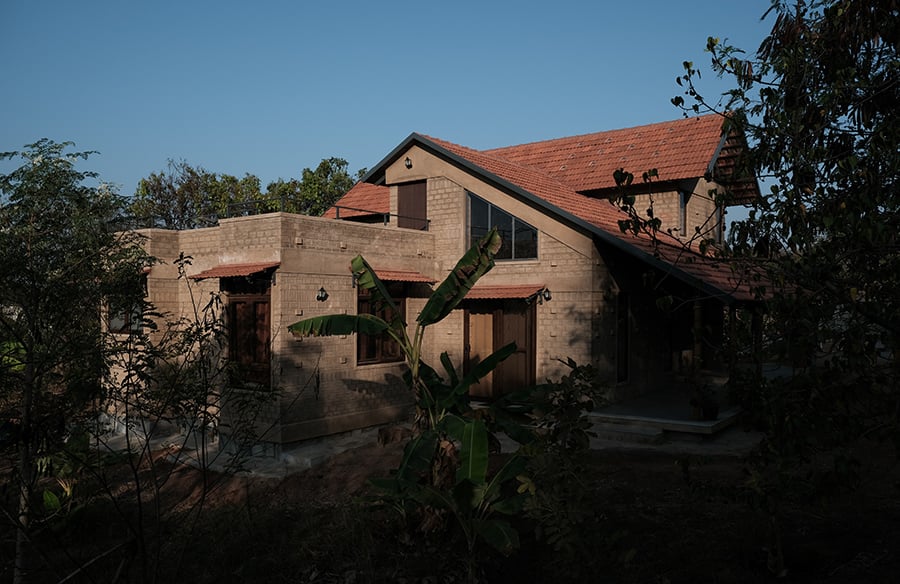
Nestled within the scenic landscapes of Shoolagiri, in a serene village setting, stands a property that epitomizes sustainable living and architectural innovation. Situated deep in elephant country, this site offers a unique backdrop for an architectural venture that embraces and respects its natural surroundings.
Project Name: The Boulder Farmhouse
Office Name: HabitArt Architecture Studio
Completion Year: 2024
Gross Built Area (m2/ ft2): 2,400 Sft
Project Location: Shoolagiri, Tamil Nadu, India
Lead Architects: Aditya Venkat
Architects : Rochana Ramakrishna, Yogita Kamat, Divya Chandrashekhar
Contractor : Swethadri D
Photo Credits: GeoMorph Studio

Spanning three-quarters of an acre, the land is enveloped by boulders and lush plantations cascading towards a water catchment area. This tranquil retreat from the bustling city life of Bangalore encompasses a modest 2400 square feet, nestled snugly amidst boulders to the North and South, while opening up to a fruit plantation on the East.
The origin of the name ‘Boulder House’ isn’t merely a stroke of architectural branding; rather, it pays homage to the intrinsic essence of its environment. It seems as though the land itself dictated the name, with its majestic boulders and rugged terrain influencing not only the design but also the title.

Drawing inspiration from vernacular architecture, the design seamlessly integrates mud, stone, wood, and clay – materials deeply rooted in the construction traditions of the region.
Materiality and Craftsmanship Stabilized mud blocks, meticulously crafted on-site, form the foundation of a dwelling designed to offer refuge from the region’s scorching heat. The decision to utilize local materials not only makes an ecological statement but also presents a practical solution to the challenges posed by the environment, while simultaneously supporting the local economy.

Skilled craftsmen, known locally as “karigars and maistries,” collaborated closely to erect a load-bearing structure that reflects not only the expertise of the community but also a deep commitment to sustainability. This synergy between local craftsmanship and natural materials underscores a dedication to sustainability that extends beyond mere aesthetics, embedding the home within Shoolagiri’s cultural and environmental fabric.

The Boulder House stands as a testament to both engineering prowess and ecological sensitivity. By repurposing abundant yet often overlooked materials like quarry rock and mining waste, the construction team laid the groundwork for a structure that is as sturdy as it is sustainable.
Natural Light and Ventilation Upon stepping into the house, visitors are greeted by a double-height volume that emphasizes the home’s core principle: ventilation. Harnessing the “Stack Effect,” the design ensures a continuous flow of hot air upwards and outwards, maintaining a naturally cool interior without reliance on artificial cooling. This natural ventilation strategy is complemented by an open layout, facilitating seamless transitions between spaces and providing uninterrupted views throughout the house.

A strategically positioned rock outcrop behind the house creates a natural courtyard that extends from the living area, serving to reduce heat ingress from the south while harmonizing the built environment with the surrounding landscape.
The high-volume pitched roofs feature clay tiles from Mangalore, providing thermal insulation, with some tiles incorporating glass inserts to capture sunlight throughout the day.
Flat roofs utilize porotherm clay block fillers, minimizing concrete usage and reducing heat penetration into the interior space.
The farmhouse operates entirely on an 8KW solar backup system, rendering it completely independent of the grid. Excess electricity generated is fed back into the grid, further contributing to sustainable energy practices. Rainwater harvesting is facilitated through sloped roofs and strategically placed gutters, directing surface water into underground rainwater tanks for landscaping and domestic use, including a drip irrigation system for the plantation.

Waste management is handled through a Bio-digester system, which efficiently segregates sludge waste and water, preventing groundwater contamination.
The Boulder House in Shoolagiri stands as a testament to environmental stewardship, blending sustainable architecture with the natural landscape. Amidst the tranquility of elephant country, surrounded by boulders and verdant plantations, it serves as a beacon for the future of sustainable living, where design and environmental responsibility intertwine seamlessly.