Today, when we talk about architecture, lighting usually refers to ambient lighting, LED lighting, accent lighting, mood lighting, and automated lighting systems—all of which are now essential to how we design and experience our interiors. However, these types of artificial lighting are not exactly new in architecture. What has changed is the increasing importance of technology in producing an architectural atmosphere.
Has the dramatic aspect of architecture at this stage of development shifted from how a building interacts with its natural environment to how we alter its interiors using artificial and technological means?
Sunlight and daylighting are no longer given the same consideration because of how we build today. As cities become denser and architectural development moves vertically rather than horizontally, it becomes increasingly difficult to provide access to natural light, ventilation, and open space. Today, we often design with a heavy reliance on natural light and ventilation as if they were a luxury rather than an essential element of the architectural experience.
But is it, truly?
The issue is no longer whether architecture has sufficient light, but whether it enables us to experience light.
What effect does a building have on us when light is permitted to change rather than just illuminate?
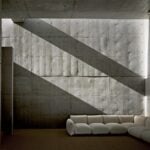
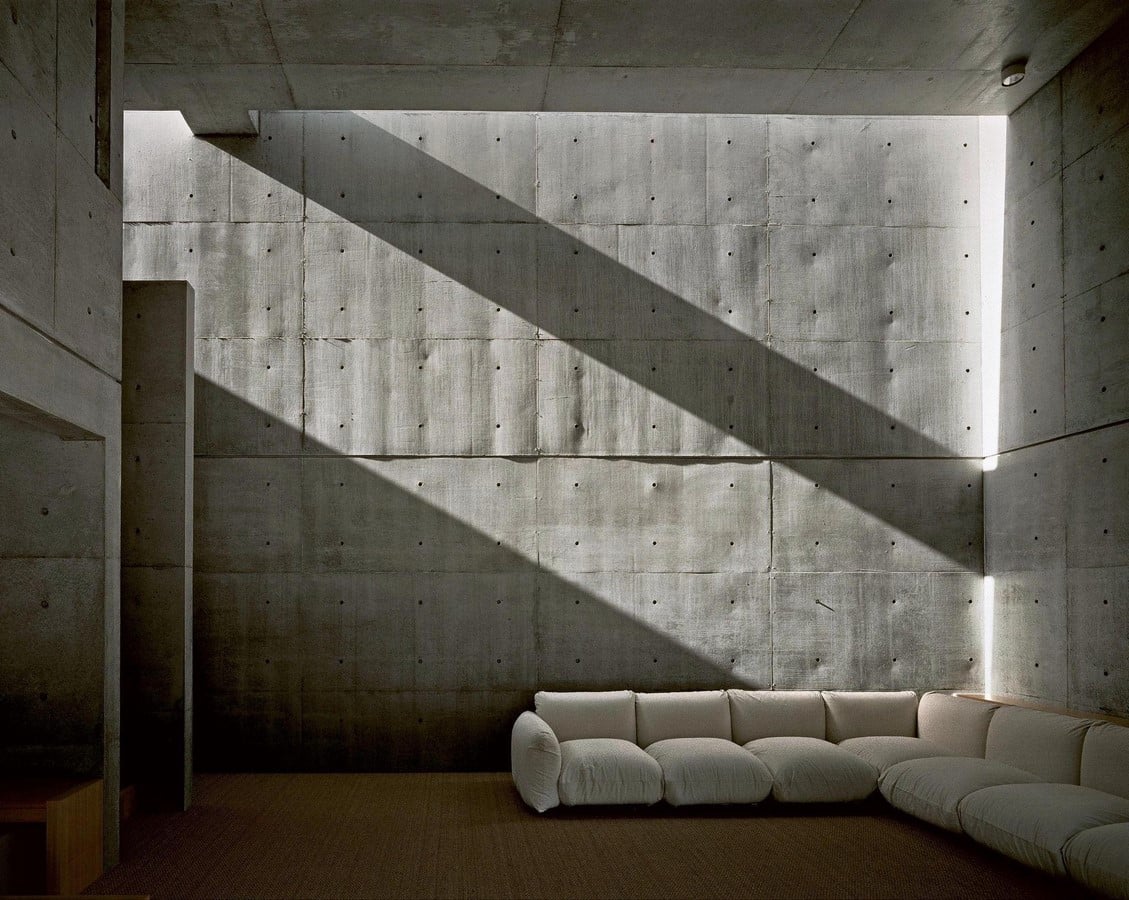
The architect who first comes to mind is Tadao Ando, because of how he incorporates natural light with a modest, modern range of materials. In many of his buildings, it is clear that architectural drama needn’t always consist in adding more. It can sometimes arise from intentionally leaving things open.
The architecture does not act against the light. Instead, it provides the light with a stage.

A thoughtfully placed opening, such as a gap in the ceiling or a narrow opening in a thick concrete wall, is enough to change how a whole room is seen. These interventions have such an effect not primarily because of the amount of light they admit, but because they make us aware of that light. A beam of sunlight passing across a wall is no longer just illuminating the surface. It becomes something we look at, creating a sense of hierarchy, depth and movement within a space which would otherwise be static.
At this point, natural light begins to differ from artificially produced light. An electric light fixture can be placed and adjusted to create a certain atmosphere. Daylight, on the other hand, is always in motion. Although the room stays the same, the way we perceive it might not. The same room and opening can look completely different at different times of day, from morning to night.
This is a psychologically interesting situation. A room which is exposed to changing daylight is never exactly the same on two different occasions. The way a shadow moves across a wall can make us aware of time even without a clock. When brightness suddenly decreases, we can tell the clouds have moved across the sky. The warmth of late-afternoon light can affect how we perceive materials and colour. In none of these cases does the architect need to modify the physical space, the environment does this for us.
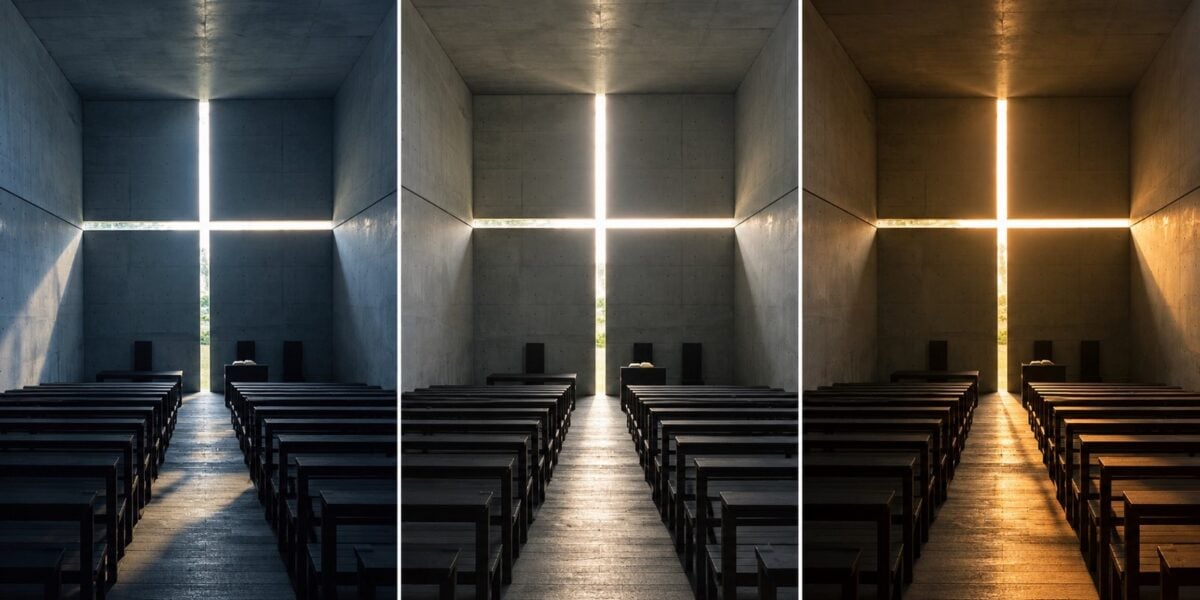
It is difficult to achieve this effect when the only source of light is illumination. Although artificial light can produce brightness, it cannot fully replicate the environmental information contained in daylight, and by itself it doesn’t tell us that the sun has moved, that it has started to rain, or that the afternoon is slowly being replaced by evening.
The connection between daylight and our emotional sense of space goes beyond a mere architectural intuition. A 2022 study of 750 participants examined how different natural-lighting conditions influenced participants’ perceived levels of happiness and sadness in residential interiors. The researchers found that changes in a home’s daylight levels significantly affected emotional assessments of the spaces, with daylight producing the most pronounced effects. Crucially, the study did not treat daylight as simply whether a window was present, instead it considered architectural factors such as window size, orientation, distance between buildings, and other features related to how daylight entered the home.
This raises an even more interesting question for architects. If the emotional effect of a room can be affected by how daylight enters it, then the architect is not merely designing an opening but designing the relationship between the occupant and the changing environment outside.
The importance of the distinction increases when restoration is taken into account. A systematic review from 2024 examined 33 studies on daylight and restorative outcomes, covering cognitive, affective, physiological, and clinical measures. Of the relationships investigated, 42 per cent found a positive restorative effect linked with greater or more natural daylight, while 49 per cent found no significant effect. The authors thus regard the evidence as promising rather than conclusive, and they also noted that direct sunlight seemed especially promising when it did not cause visual discomfort.
This uncertainty matters because it shows the solution is not simply to fill all rooms with as much sunlight as possible. More light does not necessarily mean that it is better light, since glare, heat, visual discomfort, and overexposure can turn the same environmental condition into one that causes discomfort.

Architecture requires not more daylight, but a more considered way of arranging it.
Psychologically, light may fall somewhere between brightness and darkness, exposure and refuge, permanence and change. In a very shaded room, a small opening appears more luminous. A courtyard makes a spot of sunlight stand out more clearly. A window with a screen turns direct sunlight into moving patterns. A tree outside of the building can turn a blank wall into one that changes as the leaves move.
In this regard, shadow is not a lack of light, it is a part of the experience of light.
That is where architecture does more than offer a pleasing appearance. It starts to produce moments of attention.

We see the spot of sunlight on the floor, note that it has moved, observe the shadow of a tree, and notice that the room has grown quieter under the overcast sky. Although these observations may seem unimportant, they are small instances in which a person becomes aware of their surroundings rather than staying completely detached from them.
Daylight may be one of the less noticeable psychological functions in an interior, as it connects the space to time.
Modern interior spaces can increasingly maintain a consistent appearance all day. A lighting system which is programmed can preserve a set atmosphere from morning until evening. Curtains can separate the interior from the outside almost entirely. Air-conditioning can keep the temperature steady. There can be no doubt about the convenience.
What would occur then if a house became so thoroughly controlled that the changing conditions of the outside world became almost imperceptible?
The question then should rather be whether technology has made our interiors better or worse; since it has made them more controllable, it has also made them less responsive.
At this point, the lessons from older architecture come back into relevance.
If the presence of light is capable of altering the character of a room without any change actually taking place in the room itself, should we focus on controlling the light or on the experience of change?
Sources:
- Rynska, E. & Yanchuk, M. (2022). Dense and Proximate Development—Daylight in the Downtown Area of a Compact City. Sustainability 14(2). https://doi.org/10.3390/su14020774
- Ali, R. A., Megahed, N. A., Shahda, M. M. & Hassan, A. M. (2023). Natural ventilation as a passive cooling strategy for multi-story buildings: analytic vertical skycourt formations. City 10. https://doi.org/10.1186/s40410-023-00212-6
- Tunahan, G. I., Altamirano, H., Teji, J. U. & Ticleanu, C. (2022). Evaluation of Daylight Perception Assessment Methods. Frontiers in Psychology 13. https://doi.org/10.3389/fpsyg.2022.805796
- Morales-Bravo, J. & Navarrete-Hernandez, P. (2022). Enlightening wellbeing in the home: The impact of natural light design on perceived happiness and sadness in residential spaces. Building and Environment 223. https://doi.org/10.1016/j.buildenv.2022.109317
- Madan, O. K., Chamilothori, K., Duijnhoven, J. v. & Aarts, M. P. (2024). Restorative effects of daylight in indoor environments – A systematic literature review. Journal of Environmental Psychology 97. https://doi.org/10.1016/j.jenvp.2024.102323
- Aussat, Y., Rosmanis, A. & Keshav, S. (2022). A power-efficient self-calibrating smart lighting system. Energy and Buildings 259. https://doi.org/10.1016/J.ENBUILD.2022.111874