A regular flashlight helps people see in dark spaces, but some situations require more than illumination. A teacher explaining a diagram, a warehouse worker identifying a distant shelf, or an outdoor guide directing a group may need to point toward a specific object without walking over to it. Combining a flashlight with a laser pointer brings these two functions into one device, making it possible to illuminate an area and indicate a particular point when needed.
However, this combination is not necessary for everyone. Its usefulness depends on the tasks involved, the environment, and how frequently the laser function will be used. Before choosing a flashlight, it helps to understand what these devices do, which users may benefit from them, and what safety precautions should guide their use.
What Makes a Flashlight and Laser Pointer Combination Different?
A flashlight and laser pointer serve two different purposes. A flashlight spreads light across an area so people can see their surroundings, inspect equipment, or move safely through a dim space. A laser pointer produces a concentrated beam that creates a visible point on a surface, helping someone indicate a particular location.
Combining these functions can reduce the number of separate tools a person needs to carry. For example, an instructor could use the flashlight to illuminate a dim display area and the laser to identify a specific feature on a diagram. A technician might use the white light to inspect equipment and the laser to indicate a component to a colleague.
The two functions should not be confused. A laser pointer is not a replacement for a flashlight because its narrow beam does not provide broad illumination. Likewise, a bright flashlight cannot always indicate a precise point as clearly as a laser can.
When comparing these devices, consider the brightness of the white light, the laser’s color and output, the available controls, and the overall size. A combination device is most useful when both functions have a genuine purpose in the user’s daily activities.
Who Can Benefit From Having a Flashlight With a Laser Pointer?
Different occupations and hobbies create different reasons to use a combined lighting tool. The value comes from matching the device to a specific task rather than assuming that everyone needs a laser function.
Teachers and Presenters Explaining Visual Information
Teachers, trainers, and presenters often need to draw attention to a particular part of a diagram, map, chart, or presentation screen. A laser pointer can help identify a specific detail while allowing the presenter to remain at a comfortable distance.
The flashlight function may also be useful when setting up equipment in a dim room or checking cables and presentation materials. However, laser use should follow the venue’s rules, and presenters should avoid directing the beam toward people.
Warehouse Staff and Equipment Inspectors
Warehouses, workshops, and storage facilities contain shelves, labels, machinery, and components that may be difficult to see in poorly lit areas. A flashlight can help workers inspect these spaces, while a laser pointer may help communicate the location of a particular item to a colleague.
A laser is not a substitute for proper workplace lighting or approved inspection procedures. Workers should also follow site safety rules, especially around moving machinery, reflective surfaces, and vehicles. In many situations, a conventional flashlight alone will be sufficient.
Outdoor Guides and People Who Enjoy Outdoor Activities
Outdoor guides sometimes need to direct attention toward a landmark or another fixed feature during an explanation. A laser pointer may help identify a distant point when conditions and local rules make its use appropriate, while the flashlight can assist with nearby tasks after sunset.
For hikers and campers, however, a laser is usually an additional feature rather than an essential requirement. A dependable white light, comfortable carrying design, and suitable battery runtime generally deserve greater attention when choosing outdoor lighting.
Pet Owners Looking for a Multi-Function Light
Some pet owners are interested in laser functions for interactive play with cats. A laser can encourage movement, but it should be used responsibly. Never shine it into an animal’s eyes, and finish play with a tangible toy or treat so the animal has an opportunity to complete the activity rather than repeatedly chasing an unreachable point.
A flashlight may also be useful during evening walks or when checking a garden or garage. For pet owners, the combination makes the most sense when the lighting function has everyday value beyond occasional play.
People researching these applications can also read this guide to a flashlight with laser pointer to explore how the combination fits different needs.
Green, Blue, and Red Lasers: Understanding the Differences
Laser color influences how a beam appears to the human eye, but color alone does not determine safety, range, or overall performance. Output power, beam characteristics, lighting conditions, and the surrounding environment also matter.
Green lasers are often easier to see than red lasers at comparable output levels under many ordinary viewing conditions. This can make a green pointer useful when identifying a point on a surface in a moderately lit environment. However, visibility still depends on the actual device and surrounding conditions.
Red lasers are common in presentation pointers and other basic pointing tools. They can work well indoors when the target surface is suitable and ambient lighting is controlled. Their visibility may be more limited in bright environments, particularly at a distance.
Blue lasers produce a different appearance and may be useful in specialized applications, but they are not automatically more effective or safer than other colors. Their visibility depends on the laser’s characteristics and the conditions in which it is used.
Regardless of color, users should never judge a laser’s safety by how bright its dot appears. The output rating and laser classification are more meaningful when assessing potential risk. A laser that seems relatively dim can still cause eye injury if used improperly.
Laser Safety and Legal Rules Every User Should Know
 Laser pointers require careful handling because the beam can injure eyes, even when exposure lasts only briefly. Never direct a laser toward someone’s eyes, and never point it at aircraft, helicopters, or their flight paths. In the United States, intentionally aiming a laser at an aircraft or its flight path can result in serious federal penalties.
Reflective surfaces can also redirect a beam unexpectedly, so avoid pointing lasers toward mirrors, polished metal, glass, or other surfaces that may reflect the light into someone’s eyes. Keep devices away from children unless their use is appropriately supervised, and follow the manufacturer’s instructions for storage and operation.
Laser classifications provide information about potential hazards. For example, the Arkfeld Pro uses a Class 3R green laser, which requires more caution than an ordinary low-power presentation pointer. Never assume that a compact size makes a laser harmless.
OLIGHT Models That Combine Illumination With Laser Functions
Different designs suit different activities, from everyday carry to specialized equipment applications. Three models worth understanding are the Arkfeld Pro, ArkPro (UV + Green Laser Version), and Baldr S BL (Blue Laser Gun Light). They have different designs and intended uses, so their specifications should not be treated as interchangeable.
Arkfeld Pro: A Compact Multi-Function Everyday Light
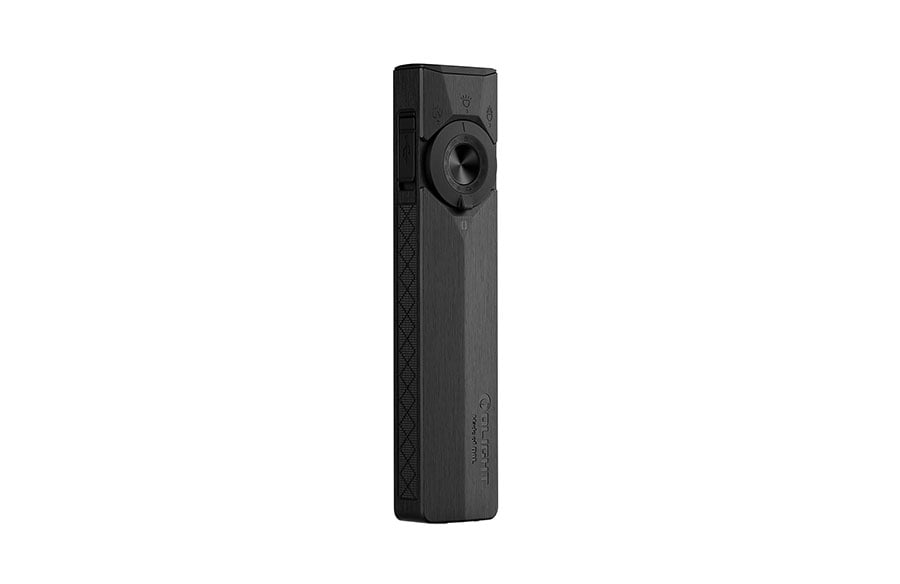
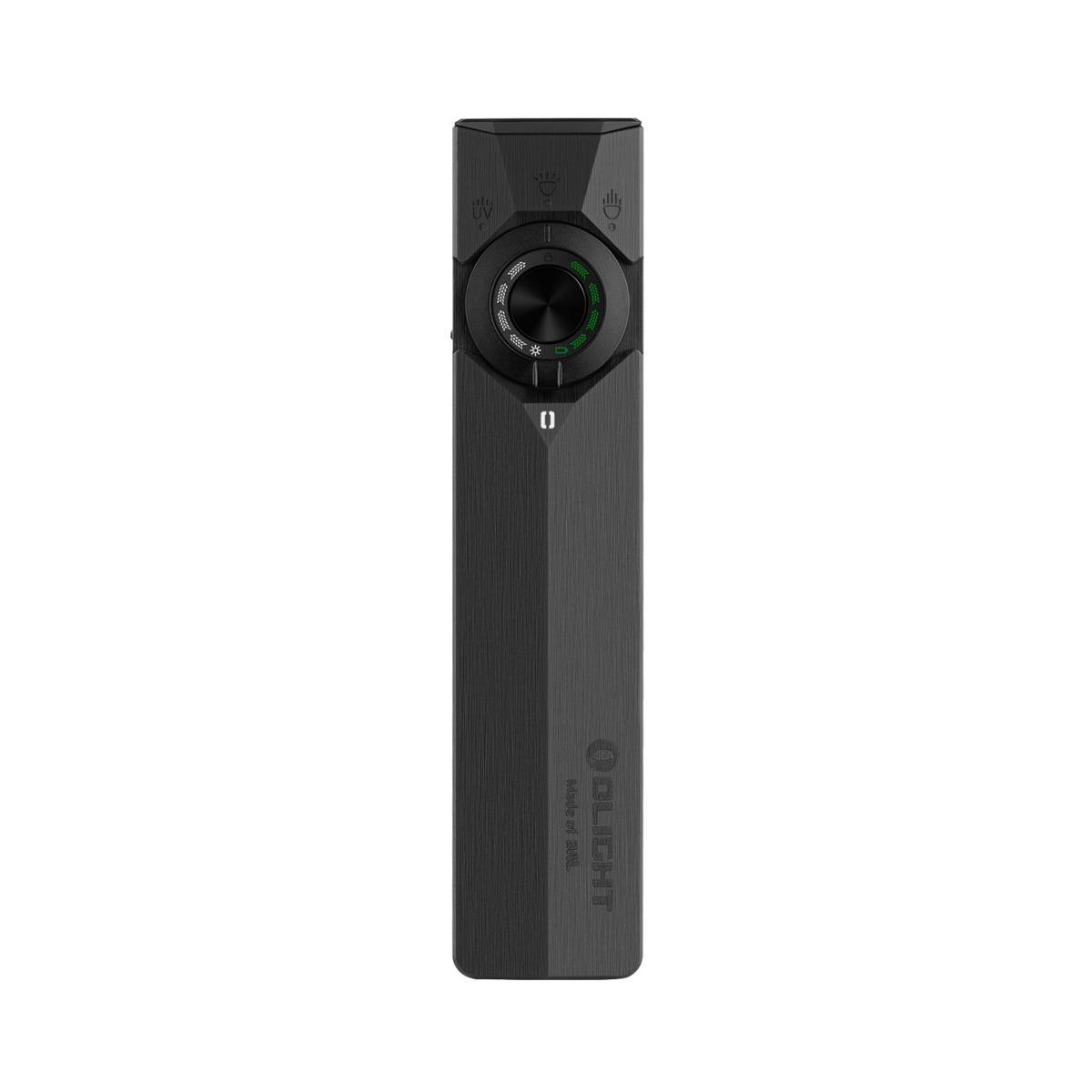
The Arkfeld Pro combines white light, ultraviolet illumination, and a green laser in a flat everyday-carry design. According to Olight’s product information, it offers up to 1,300 lumens of white light, 900 mW of UV optical power at a typical wavelength of 365 nm, and a Class 3R green laser. Its built-in 1,500 mAh lithium-polymer battery supports rechargeable operation.
This combination may appeal to users who want general illumination alongside specialized pointing and UV functions. Before choosing it, consider whether those additional features will be useful often enough to justify carrying them.
ArkPro: Flat Design With Multiple Lighting Sources
The ArkPro (UV + Green Laser Version) combines several functions in a slim, flat-bodied design. The official product listing specifies a 1,500-lumen flood beam, an 800-lumen spot beam with a stated beam distance of 205 meters, UV lighting, and a green beam. It also lists a 2,000 mAh battery, USB-C and magnetic charging, and an IPX7 water-resistance rating.
Its combination of flood and spot lighting makes it relevant to users who need both nearby illumination and a more focused beam. The UV and laser functions serve separate purposes and should be used according to the manufacturer’s instructions.
Baldr S BL: A Specialized Blue Laser Gun Light
The Baldr S BL is designed for a different purpose from ordinary pocket flashlights. It combines white illumination with a blue laser and is intended as a rail-mounted firearm light. Olight’s product information lists up to 800 lumens of white light and a Class IIIa blue laser with a wavelength of 440–460 nm and output below 5 mW.
Because this model is intended for firearm mounting, it is not a general-purpose substitute for a presentation pointer or an everyday pocket light. Prospective users should check compatibility, follow all firearm and laser safety requirements, and handle the device only in accordance with applicable laws and the manufacturer’s instructions.
How to Decide Whether a Laser-Equipped Flashlight Is Right for You
The best choice depends on how you expect to use the device. If your main need is walking after dark, completing household repairs, or preparing for power outages, a reliable flashlight without a laser may be all you need.
If you regularly present information, identify specific points during inspections, or use multiple lighting functions in your work, a combination model may offer practical value. Compare the white-light output, battery runtime, charging options, laser classification, and carrying design before making a decision.
A flashlight with a laser pointer is most useful when its two functions solve real problems. Understanding the differences between laser colors, recognizing the safety risks, and selecting a suitable design can help you make an informed choice without paying for features that do not fit your routine.