The tendency of contemporary architects to go beyond the traditional physical space and objects and to relate to other scales of time is not new. It is, therefore, not surprising that many contemporary architects also venture into areas of study such as mental health, behaviour and other social sciences, which are not directly related to physical space. Everyday life has been a method for studying architecture through empirical and daily activities. As we continue to include more sciences in the design of spaces, looking at architecture through everyday life and daily routine gives us a new method of research to study the relationship between human activities and space beyond what formal architectural theories offer.
Architecture’s Role in Shaping Daily Routines
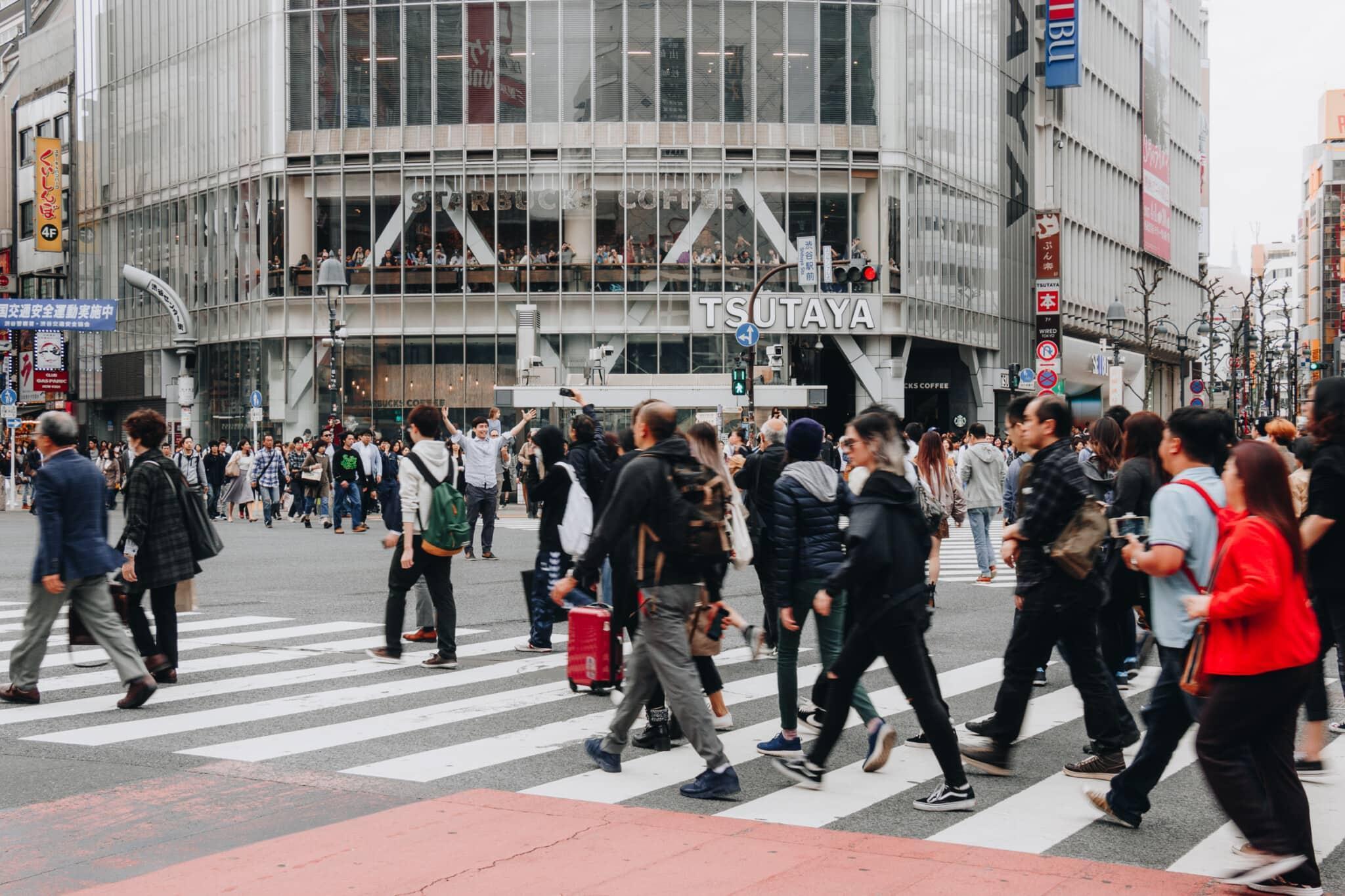
‘Everyday life’ has been studied extensively since Henri Lefebvre (2004) planted the term in the architectural vocabulary. As scholars like Rita Felks (2000) and Dell Upton (2002) point out, our sense of everyday life relates to habitual interactions with spaces like the home, the workplace, and the mall and movement between these spaces, such as when walking, commuting, flying and so on. These define the rhythm of our routines. The architecture of spaces enables these routines by providing function-specific areas. For example, a well-designed kitchen supports cooking, while a well-planned workspace supports productivity.
Conversely, architecture that does not enable an activity is starkly perceived. We register spaces that do not function as they should because they break the rhythm of our daily routines. (Lefebvre 2004) When the lock we close every day suddenly changes its appearance, or the light starts flickering in the room where we work every day, we notice something has changed. Appropriately designed spaces make users feel comfortable. Strong, bold architectural moves, on the other hand, can evoke diverse emotions. The emotions they evoke may differ contextually and socially based on individual experiences; hence, architecture must consider culture. Nevertheless, noticing the change in our environments implies that we subconsciously take in plenty of the information around us even though we do not process all of it simultaneously.
Routines and Architecture
Architecture does conceive routines, but it is also derived from them. Humans started building for the everyday need of shelter. Over time, we tried to improve construction from the point of view of its structure and aesthetics. However, people are not the same; social and economic activities change and, therefore, cultures change. The ever-changing society and people make research an essential part of architecture. Designers should not start directly with the design. Instead, they should think about how spaces are occupied through lived experience and from situated perspectives. (Gattupalli 2024)
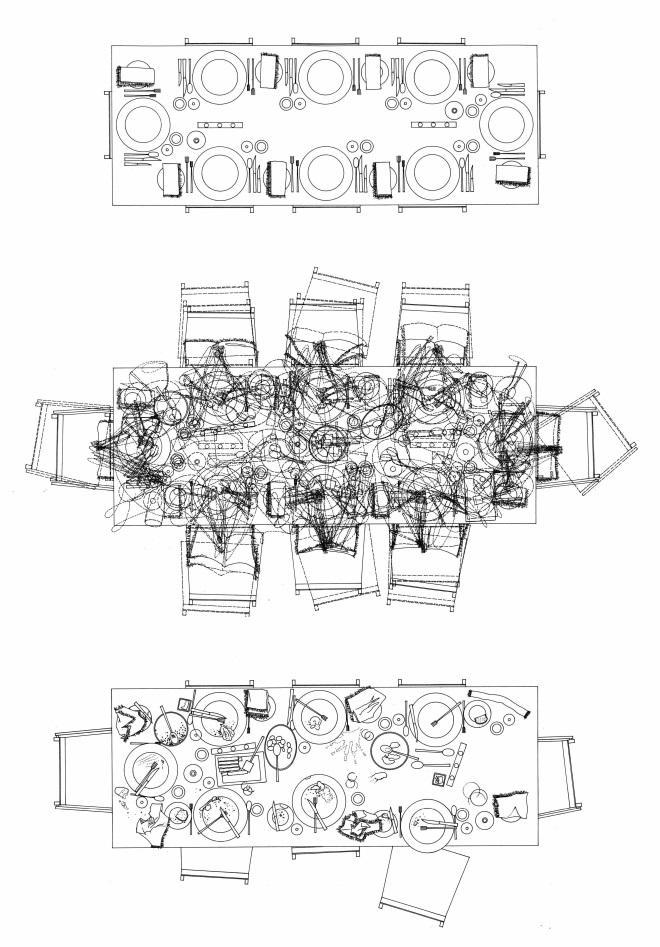
The ‘everyday’ could become a valuable source of contextual research, moving away from the beautiful and static ‘selling render’ as a design output. Through famous diagrams of dining table usage, Sarah Wigglesworth (Wigglesworth and Till 1998) explains how architectural stability is just a frozen concept. While the fixed dining table is stable, this state is undermined during and after its use. This process guides her to design a plan(e) of seeming disorder but an organised floor plan with activity traces.
Everyday Life and Behaviour
Our behaviour in spaces is also, in a subtle way, determined by architecture. For instance, an open-plan office may enhance interaction and idea transfer, but this may reduce productivity and privacy. These spaces are not just that which accompanies our activities; they also direct our actions. A clear footpath in the city promotes walking; bike lanes in the urbanscape encourage cycling. However, if the roads are designed for cars, it may make people feel unwelcome and promote less healthy choices in the long run, adversely affecting them.
In homes, architecture affects the pattern of family life and habits. An open plan with spaces for walking and sitting increases interaction and togetherness; thus, different sections for reading, writing, or other activities help set limits and focus. The behaviour of people and their social interaction in the neighbourhood is determined by outdoor and communal areas such as parks and plazas. A good park will spur the person to engage in physical activity and relaxation. Still, a park that is not well kept or is inaccessible will deter people from using it and hence limit social interaction.
Everyday Life and Health
Architecture extends beyond the usual boundaries of space and finds itself amid psychological and comfort level optimisation research. Our everyday life is dependent on our mental health, and we cannot lead a happy life without being mentally healthy. Studies show that parks and other green areas in a neighbourhood help boost the mental health of inhabitants (Lange and Rodrigues 2021). The urban form also affects choices, and people would benefit from having available and accessible resources rather than having to travel far for their daily needs. Walkable distances to shops, restaurants, gyms, and other nearby utilities ensure that people have multiple options and are not forced to choose between less healthy options and longer travel times.
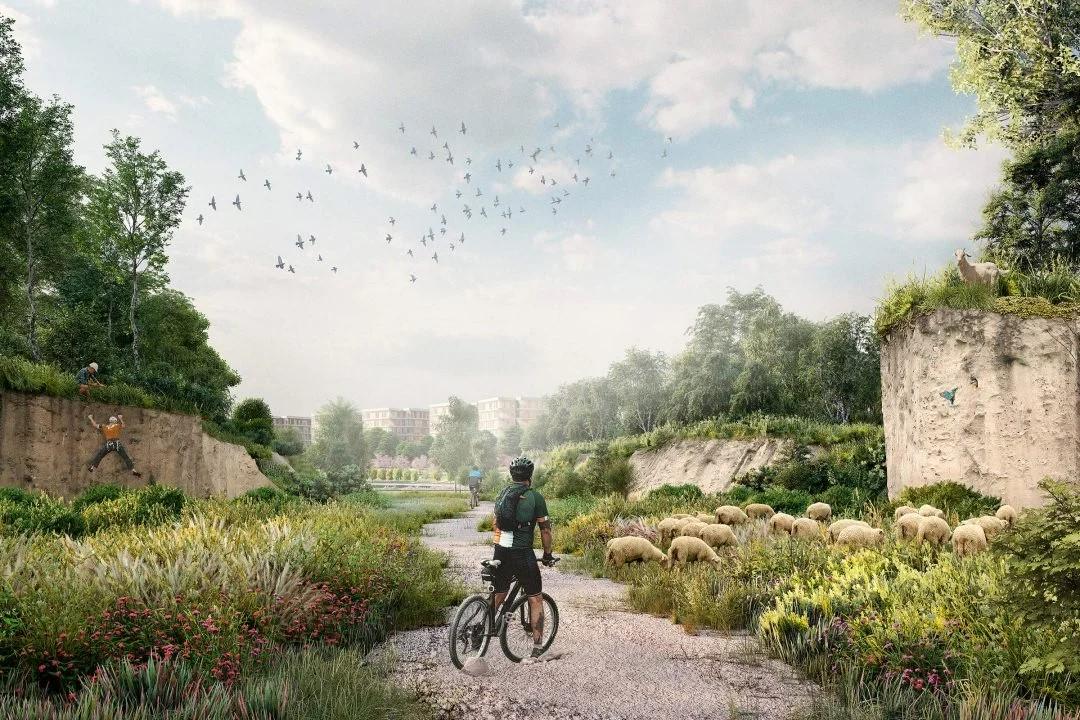
On a smaller scale, in-between spaces help people transition from one space to another and also give people time to shift gears and make the transition smooth. Light, material, texture, colour, smell, sound, and other sensory factors also affect how people behave and perform their activities. For instance, workers who work in areas with more natural light have better mental health and work performance, and their sleep schedule is affected. (Ko and Glazier 2022)
The impact of architecture on everyday life, behaviour, and health is extensive. Well-designed spaces make everyday activities easier, encourage good habits, and positively affect physical and mental health. As more architects embrace principles from psychology, sociology, and health sciences, there is a growing potential for incorporating everyday routines in the creation of environments that meet users’ needs and inspire them. Through the application of thoughtful, human-centred design, architecture has the potential to improve the quality of life of people and communities.
References:
Felski, R., 2000. 3. THE INVENTION OF EVERYDAY LIFE, in: Doing Time: Feminist Theory and Postmodern Culture. New York University Press, pp. 77–98. https://doi.org/10.18574/nyu/9780814728703.003.0007
Gattupalli, A., 2024. How Can Architecture be Designed to Reflect Human Behavior? [WWW Document]. ArchDaily. URL https://www.archdaily.com/1013253/how-can-architecture-be-designed-to-reflect-human-behavior (accessed 1.21.25).
Ko, E., Glazier, E., 2022. Being in natural light improves mood, increases happiness [WWW Document]. URL https://www.uclahealth.org/news/article/being-in-natural-light-improves-mood-increases-happiness (accessed 1.20.25).
Lange, I.S.G., Rodrigues, C.N., 2021. Urban Green Spaces: Combining Goals for Sustainability and Placemaking [WWW Document]. URL https://www.europenowjournal.org/2021/05/10/urban-green-spaces-combining-goals-for-sustainability-and-placemaking/ (accessed 1.21.25).
Lefebvre, H., 2004. Rhythmanalysis : Space, Time and Everyday Life. Continuum. https://doi.org/10.5040/9781472547385
Upton, D., 2002. Architecture in Everyday Life. New Literary History 33, 707–723.
Wigglesworth, S., Till, J. (Eds.), 1998. The Everyday and Architecture. Academy Press, London.