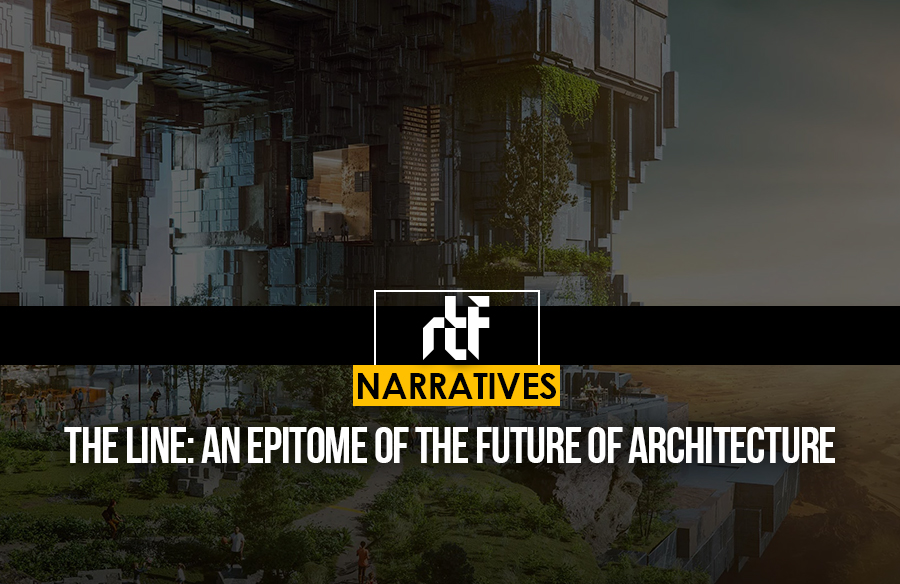
The name indicates what happens when an urban city is wrapped inside one line. Will it be a new normal or a revolutionary future? As we stand in the era of artificial reality, the story of the future is being evolved and the line stands as a new powerful chapter in this evolving story.

Revolutionary Urbanism
The emerging population, rapidly growing technology, invention of new materials, and possibilities of making the unimaginable into reality. The world is evolving in terms of all sectors. From technology to medicine to construction methods to construction materials and artificial intelligence create a utopian sci-fi building with a bit of sustainability due to rapid climate change in the earth. And there the line emerges as a futuristic urbanism.
Announced by Saudi Arabia’s Crown Prince Mohammed bin Salman as part of Neom, a fully automated $500 billion region, the line stretches 170 kilometres across mountains, desert valleys, and the Red Sea. This linear city towers 500 meters above sea level while spanning only 200 meters in width, making it a futuristic approach to urban development.
The mirrored façade of the line reflected the architectural statement that carries within – It’s a new reflection of urbanism, sustainability, and innovation. This led to a question: is this what the future city looks like? In history, we have seen how the model of a city changed from an organic city to a planned city as it tells the story of the revolution of human change with the ethos of our times.

Sustainable narrative: zero emissions, zero roads
The line is designed in such a way that it has no roads, cars, and no emissions. It will run on 100% renewable energy. It is a testament to the emerging narrative of sustainability in architecture. The line’s commitment to preserving 95% of the land for nature and housing 9 million people in a 34 square-kilometre footprint is an example of how future cities can balance innovation with the ecosystem.
The Line offers a glimpse into a future where urban spaces are designed to be as harmonious with nature as they are with human needs. With a reduced infrastructure footprint, creating never before seen efficiencies in city functions. Ensuring an ideal climate all year round to enjoy the surrounding nature. Residents will also have access to all daily essentials within a five-minute walk, in addition to high-speed rail with an end-to-end transit of 20 minutes.

Innovative city modules and layers
The line’s modular design with interconnected communities and AI-driven infrastructure evokes imagery straight out of a sci-fi movie. This future vision depicts cities as dynamic, responsive environments that adapt to the demands of their residents rather than just places to live.
The 100-mile mega city consists of connected communities which it calls its city modules. The line consists of 3 city modules and a spine connects the three of them. The two underground layers for transportation and services, in which one layer directly underneath the ground is the service layer and a lower level spine layer for transport. The over-ground layer is a pedestrian layer.
The Line’s experimental design makes us wonder if architecture will keep moving in the direction of these cutting-edge, high-tech advancements. Will it return to more traditional, human-scale designs, or something else? According to The Line, modern architecture may combine elements of the past and present in a way that allows cutting-edge technology and the ageless ideas of human-centered design to coexist rather than being either/or.

The line: A restorative city
The line is not just an urban development but is a restorative approach to nature, people, and economy. It preserves 95% neoms, reducing footprint while achieving zero emissions and using 100% renewable energy sources such as solar, wind, and hydrogen. The design builds a close-knit community with access to 80,000 people within 5 5-minute neighborhoods with access to all daily necessities and nature. It also promotes a knowledge-based city for research and innovation by attracting and empowering talented individuals and creating economic well-being. The line’s approach to future cities can be seen as a prototype for the future cities. As we face the reality of climate change, the line can offer a hopeful narrative of a restorative yet sustainable environment.

A Place to Prototype Businesses: A Narrative of Innovation
The Line’s human-centered design, with its cognitive infrastructure that anticipates and meets the needs of its residents, fosters a rich human experience and creates new business opportunities and large-scale job creation. This vision of the future suggests that architecture will increasingly play a role in not just shaping physical spaces but also in crafting economic and social ecosystems that support innovation and human well-being.
World-Class Quality of Life
The line is designed for the best and brightest, it offers a place of unparalleled social and economic experimentation, free from pollution and traffic. With world-class healthcare and a vertical garden city concept where people live longer, and healthier in harmony with nature. The line shows us that architecture is not just about designing buildings it’s about building better lives

The line is more than just a city, it’s a new normal blueprint for the future of urban living. It represents innovation, sustainability preservation, and functionality. As architects, urban planners, and designers, we have the power to shape the future story that the city will tell. The line is a bold chapter that challenges us to rethink the conventional prototype and to build a world where the impossible becomes a reality.
REFERENCE:
The line a revolution in urban living. Available at: https://www.neom.com/en-us/regions/theline
The line: The City of the future in Saudi Arabia. (2024) The Line: The City of the Future. Available at: https://line-neom.com/
The line, Saudi Arabia (2024) Wikipedia. Available at: https://en.wikipedia.org/wiki/The_Line,_Saudi_Arabia
Ikiz, S.U. (2024) 8 key facts you should know about Saudi Arabia’s the line, Parametric Architecture. Available at: https://parametric-architecture.com/8-key-facts-you-should-know-about-saudi-arabias-the-line/