Renaissance Italian frescoes serve as significant examples of the rich European artistic heritage. Fresco paintings are done by using water-based pigments and applying them on walls with fresh plaster or lime-soaked surfaces. They were popularised in the Renaissance period and later briefly revived in Mexico during the 20th century. One can find these frescos all over the chapels and other monumental structures built during the Renaissance in Italy. The permanence of these fresco paintings, by having them on the walls, has provided the monuments with a grand and luxurious aesthetic. However, it has also caused problems with preserving, as the paintings are directly exposed to the physical and chemical environment and thus are highly sensitive to change.
Consistent efforts have been made to preserve and restore these paintings so they are not lost to time. Usually involving painstaking cleaning, consolidation of loose areas and repainting those areas that have lost colour. But not every effort provided solutions; some also created new challenges. Synthetic acrylic resins were used as protective coatings, but these could age and become difficult to remove and also changed the surface properties of the originals. Cleaning with pure organic solvents also risked carrying dissolved contaminants deeper into the porous plaster rather than extracting them. Due to the various challenges faced in the restoration and preservation of these ancient artworks.

Understanding Nanoparticle Cleaning
Researchers in Italy developed inorganic nanoparticle cleaning technology to simultaneously restore and preserve these frescoes. Researchers at the University of Florence, including Piero Baglioni and his colleagues, have developed nanostructured cleaning systems for the conservation of cultural heritage. Nanoparticle cleaning uses nanostructured materials to remove unwanted substances while minimising the already present damages to the original artwork. A prominent advancement was oil-in-water microemulsions. In this technology microdroplets of oil were dispersed in water and stabilised by the surfactants. The oil dissolved wax, grease and certain organic residues that are hydrophobic. The aqueous continuous phase helps deliver the cleaning system while limiting the use of free organic solvent. The droplets are typically in the nanometre range, creating a large interfacial area that improves cleaning efficiency. Instead of applying a large quantity of an organic solvent directly onto the fresco, the cleaning agent is contained within these microscopic droplets. This reduces the risk of contaminants spreading into the underlying plaster.
Case study: The Brancacci Chapel, Florence
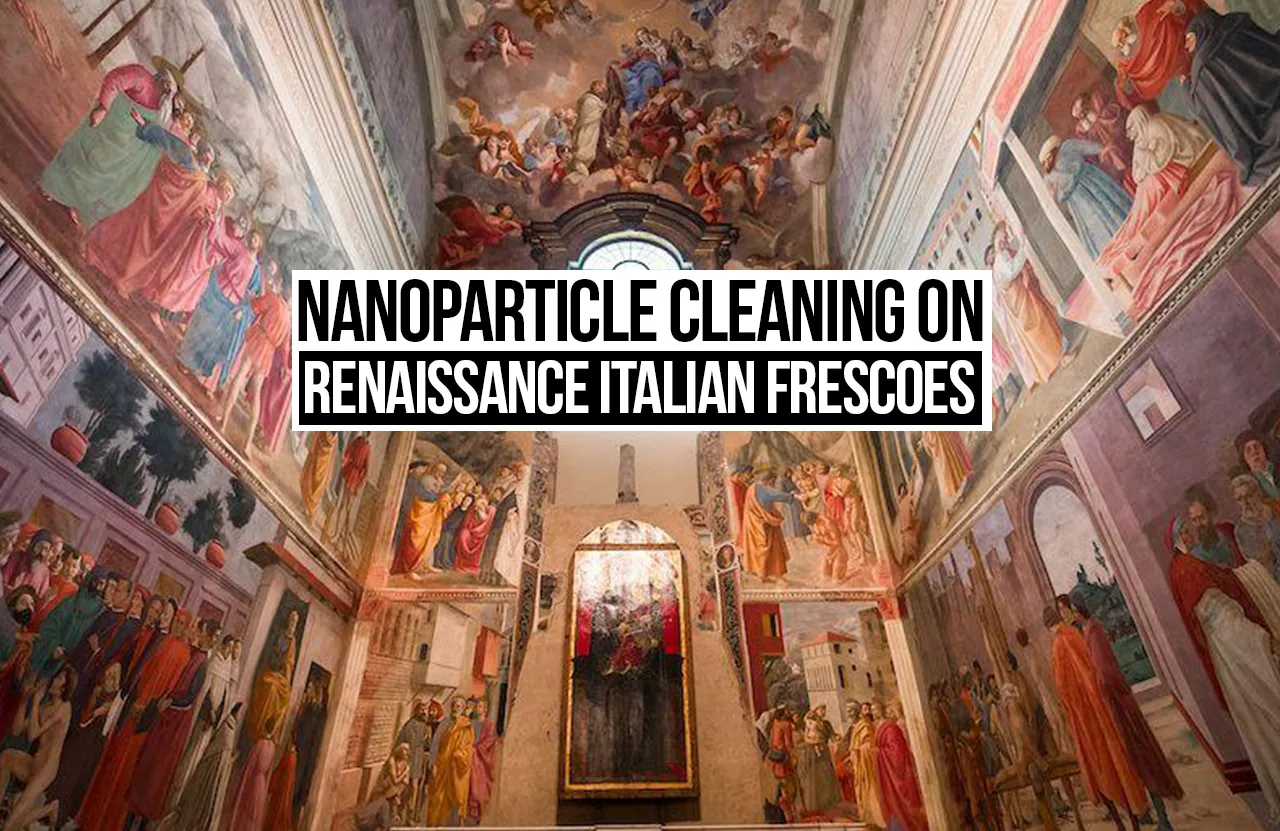
One of the earliest and most significant case studies and applications of this nanoparticle cleaning to simultaneously restore and preserve paintings was done in the Brancacci Chapel in Florence. This chapel houses prominent Renaissance fresco paintings done by artists Masaccio, Masolino and Filippino Lippi. Over the decades, due to the use of wax candles, the walls of this chapel had accumulated wax. This created patches of hydrophobic contaminants over the paintings. Conventional solvents posed a prominent challenge. While the solvents could dissolve the wax, they were also absorbed into the walls, making complete removal or cleaning nearly impossible. This required a cleaning method that could dissolve the wax without allowing it to spread into the wall.
This was accomplished through the creation of an oil-in-water microemulsion by two scientists working in the field of conservation, Enzo Ferroni and Piero Baglioni. The composition consisted mainly of water, wherein dodecane was the oil phase, ammonium dodecyl sulphate was the surfactant, and 1-pentanol was the co-surfactant. Dodecane acted on the wax by dissolving it, whereas the surfactant helped to stabilise the wax in nanoscale droplets. This ensured that the contaminants were separated and isolated and not spread out across the painted area. Thus, the use of nanostructured cleaning was demonstrated as an alternative to solvent-based restoration and laid the groundwork for further research in this area.

How does the cleaning process work?
There are three main steps in the nanoparticle cleaning process:
- Application: The microemulsion is applied to the surface of the dirtied fresco, sometimes in combination with a poultice made of cellulose or special applicators, thus ensuring the right amount of time of action of the cleansing agent.
- Solubilisation and extraction: Oil droplets bind hydrophobic contaminants, dissolving and encapsulating them. In this way, wax and similar contaminants are stripped off the paint and remain trapped in the nanosystem.
- Removal: Removal is carried out using some special absorbent material or a poultice and ensures that the contaminants do not redeposit anywhere else on the fresco.
This technique works by enabling selective extraction and limited contamination of the original with aggressive substances. It becomes especially effective when the conventional use of solvents might provoke their penetration or relocation on the contaminated surface of the fresco.
There are some benefits that nanoparticle cleaning technology can provide over traditional restoration methods. The predominance of water-based techniques allows for reducing the amount of organic solvents used. Nanoparticles allow for dissolving and containing hydrophobic particles to reduce their spread in porous plaster. A properly designed system will allow for reducing the number of adverse reactions with the original painting layer. Various systems can be used for cleaning wax, grease, synthetic polymers, and other types of contaminants.
However, nanoparticle cleaning cannot be a universal remedy. Each fresco has its unique chemistry, conditions and previous restorations. There are some parameters which have to be taken into account before using this technology, such as the vulnerability of pigments, porosity, moisture content and chemical composition of contaminants. Even water-based systems may cause damage if applied in large quantities on vulnerable or weakly bonded surfaces.
References:
Baglioni, M. et al. (2012) ‘Smart cleaning of cultural heritage: A new challenge for Soft Nanoscience’, Nanoscale, 4(1), pp. 42–53. doi:10.1039/c1nr10911a.
Brown, M. (2023). Nanoparticle Protection. RSC Education. Available at: https://edu.rsc.org/feature/nanoparticle-protection/3007347.article (Accessed: 08 November 2026).
Carretti, E. et al. (2007) ‘Oil-in-water nanocontainers as low environmental impact cleaning tools for works of art: Two case studies’, Langmuir, 23(11), pp. 6396–6403. doi:10.1021/la700487s.